Comparisons
How to choose a CoQ10 supplement: form, dose and quality
Labels vary in form, amount and quality. Here is a practical checklist based on what the research and government sources say.
VitaBrief editorial · Last reviewed November 2026 · Sources listed below
Reader-supported. This page may contain affiliate links. If you buy through one, we may earn a commission at no extra cost to you. It never changes what we write. Affiliate disclosure

A pharmacy shelf can hold a dozen CoQ10 products that look alike but differ in form, amount, formulation and price. Some say ubiquinone, some say ubiquinol, some promise “enhanced absorption,” and the milligram figures range widely. Because CoQ10 is sold as a dietary supplement rather than a drug, the label is the main information you get, and it is not reviewed by the FDA before sale.
This guide gives a practical checklist for comparing products. It draws on the National Center for Complementary and Integrative Health (NCCIH), the National Cancer Institute (NCI), the FDA and published absorption studies. VitaBrief does not recommend brands. This is general information, not medical advice.
How to choose a CoQ10 supplement: the short answer
How to choose a CoQ10 supplement: ubiquinone vs. ubiquinol, softgels and formulations, amounts per serving, third-party testing, label red flags and who should talk with a doctor first.
Quick checklist
| What to check | What to look for | Why it matters |
|---|---|---|
| Form | Ubiquinone or ubiquinol, clearly stated | Absorption evidence for ubiquinol is mixed; ubiquinone is often cheaper |
| Amount per serving | Milligrams per softgel and per serving | Studies used about 100 to 600 mg per day |
| Formulation | Oil-based softgel or tested water-soluble form | Formulation affected absorption in one study |
| Quality testing | Independent third-party testing seal | FDA does not approve supplements before sale |
| Claims | No promises to treat or cure disease | Disease claims are a red flag |
| Other ingredients | Short list; note any added herbs or vitamins | Extra ingredients add interaction questions |
| Price per mg | Compare cost per milligram, not per bottle | Higher price does not prove better results |
Start with whether you need it
Before comparing products, it helps to be clear about why you are considering CoQ10. The body makes its own, and NCI notes that levels decrease with age. Statins can also reduce the body’s CoQ10, according to a JACC review (Raizner 2021). Those are the two most common reasons people look at supplements.
The evidence for benefits is mixed. A two-year trial in heart failure found fewer major cardiovascular events when CoQ10 was added to standard care (Mortensen 2014), but NCCIH calls heart failure research inconclusive. Meta-analyses of statin muscle symptoms disagree, and a Cochrane review found no clinically significant effect on blood pressure (Ho 2016). Migraine and fertility studies are promising but small. Our CoQ10 benefits article summarizes the research. If you have a medical condition, the right first step is a conversation with your doctor, not a shopping trip.
Choose a form: ubiquinone or ubiquinol
Ubiquinone is the oxidized form and ubiquinol the reduced form of the same molecule. Ubiquinol is often priced higher and marketed as better absorbed.
The research is mixed. In 12 healthy volunteers, four weeks of 200 mg per day of ubiquinol raised total blood CoQ10 from 0.9 to 4.3 µg/mL, while the same amount of ubiquinone raised it from 0.9 to 2.5 µg/mL (Langsjoen 2014). But in 21 adults aged 65 to 74, a single 100 mg dose of ubiquinol was not significantly better absorbed than ubiquinone, and CoQ10 appeared in the blood mostly as ubiquinol whichever form was swallowed (Pravst 2020). Neither study measured health outcomes.
A practical approach: ubiquinone is a reasonable default at a lower price. Ubiquinol is an option if you and your clinician think a possible absorption edge is worth the cost. Read our full ubiquinol vs. ubiquinone comparison.
Look at the formulation
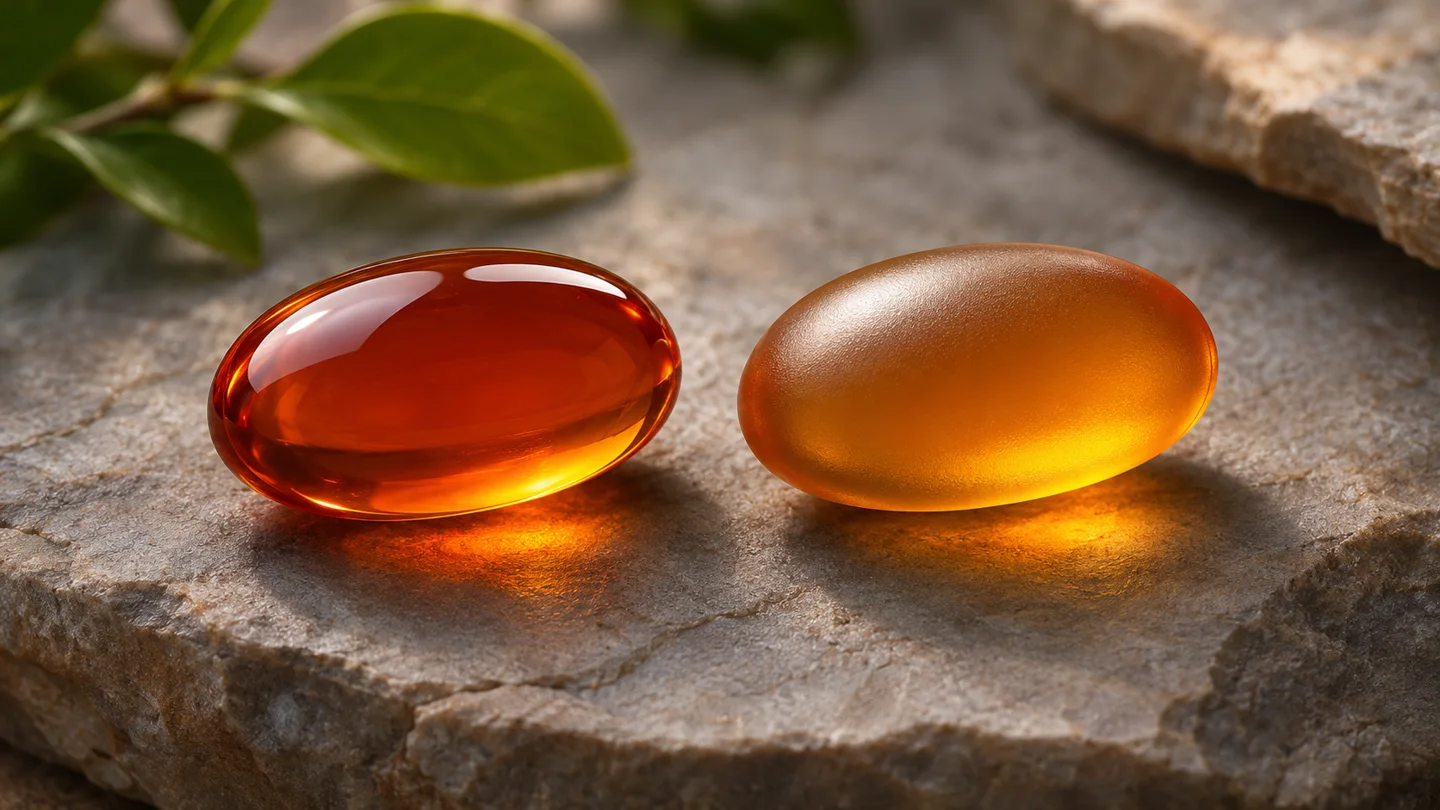
CoQ10 is fat-soluble, which is why many products are softgels containing oil. As a general tip rather than a study finding, many people take CoQ10 with a meal that contains some fat. Dry tablets and powder capsules are also sold. The sources reviewed here do not compare softgels with dry tablets directly, so treat the oil-based preference as a practical rule of thumb.
What the evidence does show is that formulation can matter. In the Pravst study, a water-soluble CoQ10 syrup produced about 2.4 times the absorption of standard ubiquinone capsules, a statistically significant difference, while ubiquinol capsules did not differ significantly (Pravst 2020). This was one small, single-dose study of one specific product type, so it does not prove that every product labeled “water-soluble” or “enhanced absorption” performs better. Be cautious with absorption claims that do not point to published testing of that formulation.
Check the amount per serving
There is no official recommended daily amount for CoQ10. The studies VitaBrief cites used roughly 100 to 600 mg per day. The large heart failure trial used 100 mg three times daily (Mortensen 2014), and statin muscle-symptom trials used 100 to 600 mg per day for 30 to 90 days (Kovacic 2025).
On the label, check the milligrams per softgel and the serving size, which may be more than one softgel. A low price per bottle can hide a small amount per capsule. Divide the price by the total milligrams in the bottle to compare value fairly. Also check how many days a bottle lasts at the serving size printed on the label, because two products with similar prices can last very different lengths of time. Our CoQ10 dosage guide explains what the study amounts mean and why you should agree on a dose with your doctor.
Check quality and testing
This is where products differ most and where labels say least. NCI explains that the FDA’s Good Manufacturing Practices require that every finished batch of supplements is safe and that label claims are true and not misleading. However, the FDA does not regularly review how supplements are made, so all batches and brands of CoQ10 may not be the same. The FDA’s dietary supplements page explains that supplements are regulated differently from drugs.
Because of that gap, an independent third-party testing seal is one of the most useful things to look for. These programs typically check that a product contains what the label says and is not contaminated. A seal does not prove the supplement works, but it gives some assurance about what is in the bottle. As a general tip, also check for a clear expiry date and follow the storage instructions on the label.
Label red flags
- Claims to treat, cure or prevent heart disease, cancer, infertility or other diseases. NCI notes the FDA has not approved CoQ10 as a cancer treatment.
- Suggestions that CoQ10 can replace a statin, blood pressure medicine or heart failure treatment. It cannot.
- Vague “proprietary blends” that do not state how much CoQ10 each serving contains.
- Absorption claims, such as “10 times better,” with no published study of that specific product.
- Long lists of added herbs or stimulants, which add interaction and side effect questions.
You can learn more about evaluating supplement information from MedlinePlus.
Safety before you buy
NCCIH reports no serious side effects of CoQ10, with mild effects such as insomnia or digestive upsets possible. The bigger concern is interactions. NCCIH says CoQ10 may interact with warfarin and insulin and may not be compatible with some cancer treatments. Read CoQ10 interactions and CoQ10 side effects first.
Talk with your doctor or pharmacist before buying if you have heart failure, take a statin, warfarin, insulin or blood pressure medicine, are pregnant or breastfeeding, are in fertility treatment, or are being treated for cancer. Never stop a statin or replace prescribed treatment with CoQ10. If you already take other heart-focused supplements, such as those in our omega-3 guide, mention them too.
Frequently asked questions
What is the best form of CoQ10 to buy?
Neither form has proven better health results. Ubiquinone is a reasonable lower-cost default; ubiquinol may raise blood levels more in some studies but not all.
Are softgels better than tablets?
CoQ10 is fat-soluble, so oil-based softgels are common, but the sources reviewed here do not directly compare softgels with tablets.
How do I know a CoQ10 product contains what it says?
The FDA does not approve supplements before sale, so look for an independent third-party testing seal and a clear amount per serving.
Is expensive CoQ10 worth it?
Not necessarily. Compare price per milligram and testing, not marketing. A higher price does not prove better absorption or results.
How much CoQ10 should a supplement contain?
There is no official amount. Studies used about 100 to 600 mg per day. Agree on an amount with your doctor, especially if you take medicines.
Sources
- National Center for Complementary and Integrative Health. Coenzyme Q10.
- National Cancer Institute. Coenzyme Q10 (PDQ), patient version.
- U.S. Food and Drug Administration. Dietary supplements.
- MedlinePlus. Dietary supplements.
- Langsjoen, et al. Comparison study of plasma coenzyme Q10 levels in healthy subjects supplemented with ubiquinol versus ubiquinone. Clin Pharmacol Drug Dev. 2014.
- Pravst, et al. Comparative bioavailability of different coenzyme Q10 formulations in healthy elderly individuals. Nutrients. 2020.
- Mortensen, et al. The effect of coenzyme Q10 on morbidity and mortality in chronic heart failure: results from Q-SYMBIO. JACC Heart Fail. 2014.
- Kovacic, et al. Effects of coenzyme Q10 supplementation on myopathy in statin-treated patients. J Nutr Sci. 2025.
- Ho, et al. Blood pressure lowering efficacy of coenzyme Q10 for primary hypertension. Cochrane Database Syst Rev. 2016.
- Raizner, et al. Coenzyme Q10 for patients with cardiovascular disease: JACC focus seminar. J Am Coll Cardiol. 2021.
Last reviewed November 2026. VitaBrief is educational and is not medical advice. Talk with a doctor, registered dietitian or pharmacist before starting a supplement, especially if you are pregnant, take medication or have kidney disease.
Not medical advice. This guide is for general education. Talk to your doctor or pharmacist before taking a supplement, especially if you are pregnant or breastfeeding, take medication or have a health condition. Medical disclaimer