Comparisons
MK-4 vs. MK-7: how the two main forms of vitamin K2 compare
This guide to MK-4 vs MK-7 explains how the two main forms of vitamin K2 differ. Both are forms of vitamin K2, but they come from different foods, last different lengths of time in the body and were tested at very different doses.
VitaBrief editorial · Last reviewed November 2026 · Sources listed below
Reader-supported. This page may contain affiliate links. If you buy through one, we may earn a commission at no extra cost to you. It never changes what we write. Affiliate disclosure
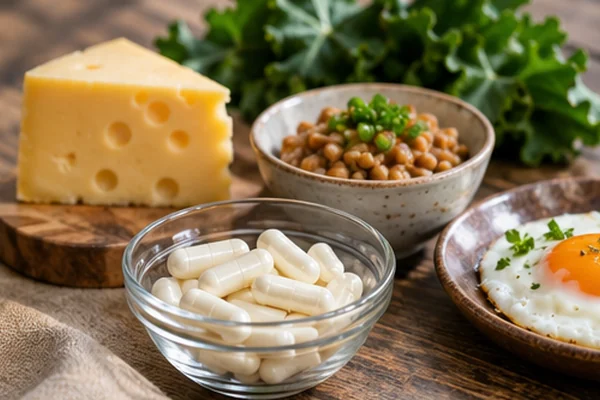
Pick up a vitamin K2 supplement and the label will usually name one of two forms: MK-4 or MK-7. Marketing for each tends to suggest it is the superior choice. MK-7 is often promoted for its long half-life and small dose, while MK-4 is often linked to Japanese osteoporosis research. Both claims have some basis, but they leave out important context.
This comparison explains what each form is, where it is found, how the body handles it and what the studies actually tested. It draws on the NIH Office of Dietary Supplements (ODS) and published research. It is general information, not medical advice. For background on vitamin K2 in general, see our vitamin K2 guide.
MK-4 vs. MK-7: the short answer
Mk4 vs. mk7: what each form of vitamin K2 is, food sources, half-life, the doses used in the Japanese MK-4 fracture trials and the Knapen MK-7 trial, safety with warfarin, and how to choose.
At a glance
| Feature | MK-4 | MK-7 |
|---|---|---|
| Chain length | Short-chain menaquinone | Long-chain menaquinone |
| How it is made in nature | Made by the body (and animals) from vitamin K1 or menadione, without bacteria | Made by bacteria, including in fermented foods |
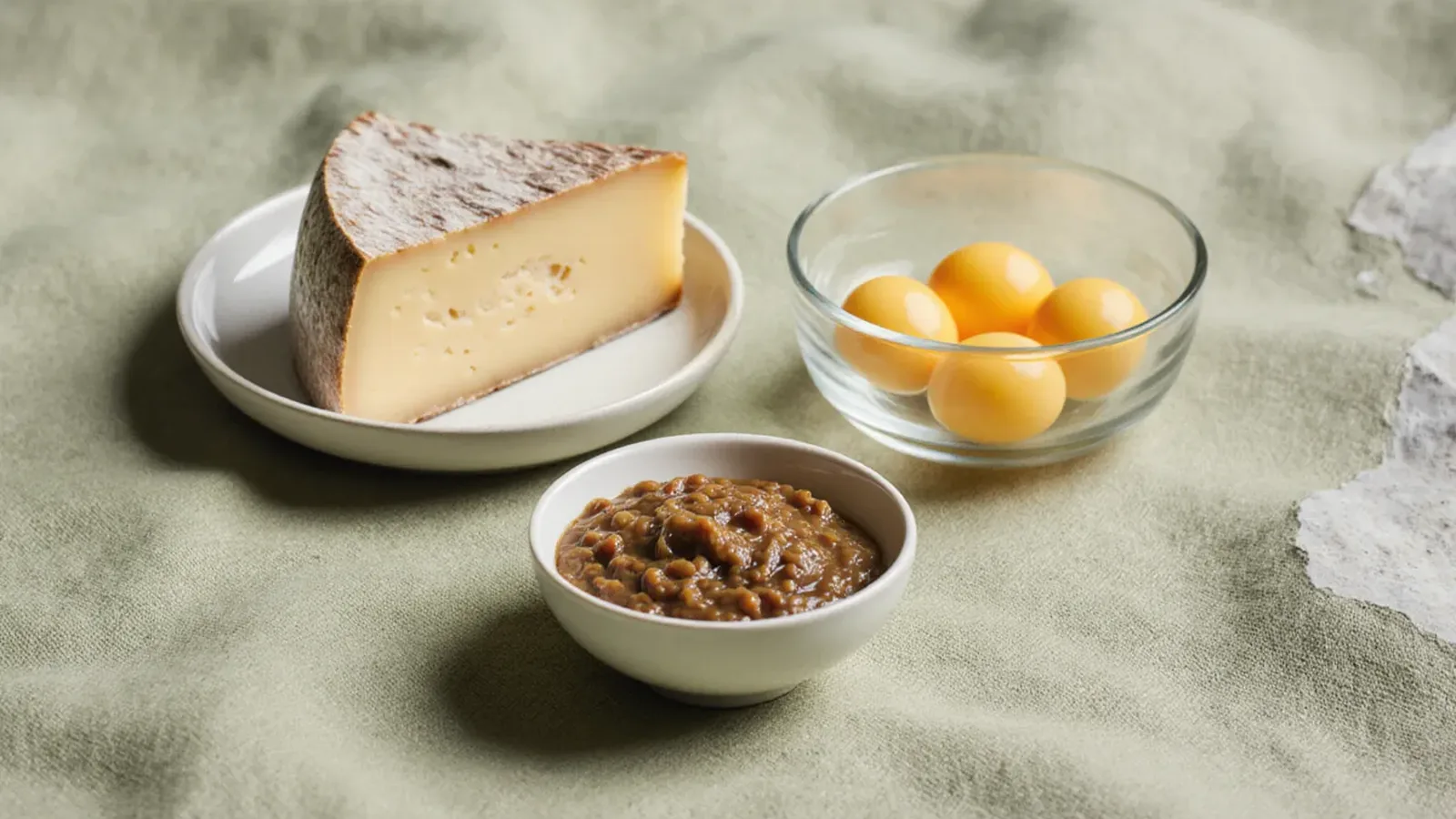
| Main food sources | Meat, poultry, eggs, dairy, in small amounts | Natto (about 850 mcg per 3 ounces); some cheeses |
| Half-life | Not directly compared with MK-7 in the sources reviewed | Longer half-life than vitamin K1, per one study cited by ODS |
| Dose in key bone trials | 15 or 45 mg a day (Japanese trials) | 180 mcg a day (Knapen 2013) |
| Main outcome studied | Fractures and bone density, mostly in Japanese women | Bone loss in healthy postmenopausal women |
| Warfarin caution | Applies to both forms: keep vitamin K intake consistent and ask your prescriber | |
What MK-4 and MK-7 are
Vitamin K2 is a group of compounds called menaquinones. ODS explains that they are numbered MK-4 through MK-13 according to the length of their side chain, and that MK-4, MK-7 and MK-9 are the best studied. The number refers to how many repeating units are in that chain, so MK-4 is a short-chain form and MK-7 a long-chain form.
The two forms share the same basic job. Like all forms of vitamin K, they serve as a coenzyme for making proteins involved in blood clotting and bone metabolism. The differences lie in where they come from, how long they stay in the body and how they have been studied. For how both relate to vitamin K1, see vitamin K1 vs. K2.
Where each form comes from
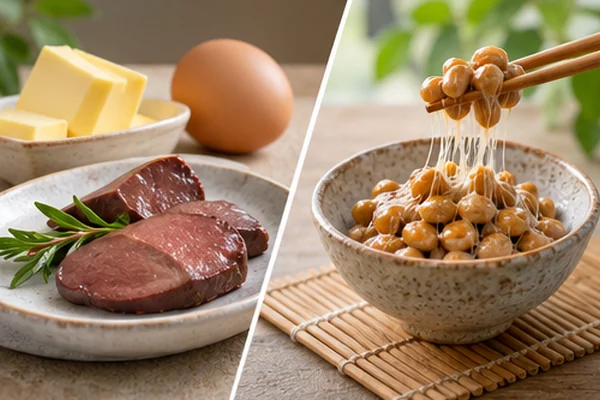
MK-4. ODS describes MK-4 as unique among menaquinones because the body produces it from vitamin K1 (phylloquinone) through a process that does not involve bacteria. Animals also make MK-4 from menadione, a synthetic form of vitamin K that can be added to poultry and pig feed, so poultry and pork can contain MK-4. The ODS food table lists MK-4 in amounts such as about 13 mcg in 3 ounces of rotisserie chicken breast, 6 mcg in 3 ounces of ground beef, 4 mcg in a large hard-boiled egg and 4 mcg in 1.5 ounces of cheddar cheese.
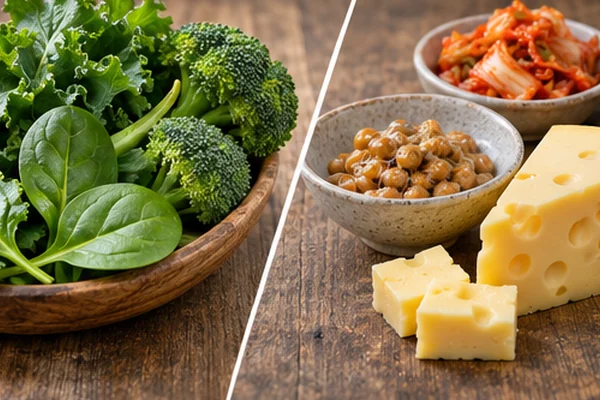
MK-7. MK-7 is a bacterial product. The standout source is natto, fermented soybeans, which ODS lists at about 850 mcg of MK-7 in 3 ounces. Other fermented foods, such as some cheeses, contain menaquinones, but ODS notes that amounts and forms vary with the bacteria and fermentation conditions used. ODS also says bacteria in the human gut produce most menaquinones, especially long-chain ones, although how much of these the body absorbs is unclear.
In practice, most people eating a Western diet without natto get small amounts of both forms, and far more vitamin K1 from vegetables. See vitamin K2 foods for a fuller list.
Absorption and half-life
This is where MK-7 has its main selling point. ODS notes that data on the bioavailability of different supplement forms are limited, but that one study found both phytonadione (synthetic vitamin K1) and MK-7 were well absorbed, with MK-7 having a longer half-life. ODS also mentions limited research suggesting long-chain menaquinones may be absorbed better than vitamin K1 from green vegetables.
In their trial report, Knapen and colleagues describe the longer half-life and greater potency of MK-7 as their reason for testing a low dose. A longer half-life means a compound stays in the blood longer, which may allow a smaller daily dose. It does not by itself show better health outcomes. No trial in the sources reviewed here compared MK-4 and MK-7 head to head on bone or heart outcomes.
The MK-4 evidence
The 2006 meta-analysis by Cockayne and colleagues found that seven trials with fracture data were all Japanese and used menaquinone. Pooled, they showed large reductions in vertebral, hip and nonvertebral fractures, and the authors described a strong effect on fractures among Japanese patients. ODS reports that these trials used MK-4 at 15 mg a day in one trial and 45 mg a day in six. That is 45,000 mcg, far above typical vitamin K intakes, and ODS notes that 45 mg of MK-4 is used as an osteoporosis treatment in Japan and other parts of Asia.
The picture changed later. The 2019 review by Mott and colleagues was updated partly because the integrity of some earlier evidence had been questioned. It found no evidence that vitamin K affects bone density or vertebral fractures in postmenopausal or osteoporotic patients, and called the evidence on clinical fractures insufficient to confirm a benefit. ODS also describes a 12-month trial in 381 postmenopausal women in which 45 mg of MK-4 lowered undercarboxylated osteocalcin but did not change bone mineral density compared with placebo.
The MK-7 evidence
The leading MK-7 trial is Knapen 2013. Researchers gave 244 healthy postmenopausal women 180 mcg of MK-7 or a placebo daily for three years. MK-7 improved vitamin K status and reduced age-related loss of bone mineral content and density at the lumbar spine and femoral neck, but not at the total hip. It also favorably affected bone strength and reduced loss of vertebral height in part of the lower spine. The authors said whether the results apply to other groups, such as men and children, needs further investigation.
MK-7 has also been tested for blood vessel calcification. The BASIK2 trial design paper (Peeters 2018) describes a planned trial of 360 mcg of MK-7 a day in 44 people with a bicuspid aortic valve and mild to moderate valve narrowing; that paper reports the design, not results. In the separate K4Kidneys trial (Witham 2020), whose abstract does not name the K2 form, 400 mcg of vitamin K2 a day for a year did not improve arterial stiffness in people with chronic kidney disease. See vitamin K2 and heart health.
Safety of each form
ODS reports that no Tolerable Upper Intake Level has been set for vitamin K because of its low potential for toxicity, and that no adverse effects from food or supplement vitamin K have been reported in humans or animals. The sources reviewed here do not show a safety difference between MK-4 and MK-7 for healthy adults.
The important caution applies to both. ODS warns that vitamin K can interact seriously with warfarin and similar anticoagulants, and that people taking them need consistent vitamin K intake because sudden changes can raise or lower the drug’s effect. MedlinePlus tells warfarin users to eat consistent amounts of vitamin K-containing foods from week to week and to tell their doctor and pharmacist about supplements they take or plan to take. Do not start either form without your prescriber. For other blood thinners such as apixaban, ask your prescriber or pharmacist. See vitamin K2 and blood thinners.
How to choose
If you want to match the dose used in the best-known low-dose bone trial, that was 180 mcg of MK-7 daily. The MK-4 fracture results came from 45 mg doses used as a medical treatment in Japan, which is not the same as a typical over-the-counter MK-4 product. Neither form has been proven to prevent fractures or heart disease in the general population.
Many people take vitamin K2 alongside vitamin D; our vitamin D and K2 page covers that pairing. For label reading and dose selection, see how to choose a vitamin K2 supplement.
Frequently asked questions
Is MK-7 better than MK-4?
MK-7 has a longer half-life, but no trial in our sources compared the two on health outcomes. Neither is proven better overall.
Why do MK-4 doses look so much bigger?
The Japanese fracture trials used 15 to 45 mg of MK-4 as a drug-like treatment. MK-7 studies used micrograms, such as 180 mcg a day.
Can my body make MK-4?
Yes. ODS says the body makes MK-4 from vitamin K1 without needing bacteria.
Which foods have MK-7?
Natto is by far the richest source. Some fermented foods such as cheese contain menaquinones, but amounts vary.
Is either form safe with warfarin?
Both forms are vitamin K and can reduce warfarin’s effect. Keep intake consistent and talk to your prescriber before starting either.
Sources
- NIH Office of Dietary Supplements. Vitamin K: fact sheet for health professionals.
- Cockayne, et al. Vitamin K and the prevention of fractures: systematic review and meta-analysis of randomized controlled trials. Arch Intern Med. 2006.
- Mott, et al. Effect of vitamin K on bone mineral density and fractures in adults: an updated systematic review and meta-analysis of randomised controlled trials. Osteoporos Int. 2019.
- Knapen, et al. Three-year low-dose menaquinone-7 supplementation helps decrease bone loss in healthy postmenopausal women. Osteoporos Int. 2013.
- Peeters, et al. Bicuspid aortic valve stenosis and the effect of vitamin K2 on calcification: the BASIK2 rationale and trial design. Nutrients. 2018.
- Witham, et al. Vitamin K supplementation to improve vascular stiffness in CKD: the K4Kidneys randomized controlled trial. J Am Soc Nephrol. 2020.
- MedlinePlus. Warfarin.
Last reviewed November 2026. VitaBrief is educational and is not medical advice. Talk with a doctor, registered dietitian or pharmacist before starting a supplement, especially if you are pregnant, take medication or have kidney disease.
Not medical advice. This guide is for general education. Talk to your doctor or pharmacist before taking a supplement, especially if you are pregnant or breastfeeding, take medication or have a health condition. Medical disclaimer