Comparisons
Berberine vs. metformin: how they compare
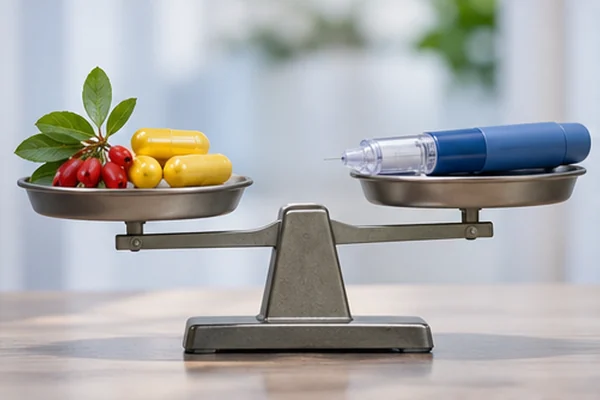
Berberine is often called a natural metformin. Here is what the research actually shows, why the two are not interchangeable and what to know before combining them.
VitaBrief editorial · Last reviewed November 2026 · Sources listed below
Reader-supported. This page may contain affiliate links. If you buy through one, we may earn a commission at no extra cost to you. It never changes what we write. Affiliate disclosure
Search for berberine and you will quickly find it described as “nature’s metformin.” The comparison is understandable. Both are taken by mouth, both have been studied for blood sugar in type 2 diabetes, and both commonly upset the stomach. But a catchy label hides large differences in how much evidence exists, how each product is made and checked, and how safely they can be used together.
This guide compares berberine and metformin side by side, explains what a well-known head-to-head trial did and did not show, and covers the interaction question that matters most to people already taking metformin. It draws on the National Center for Complementary and Integrative Health (NCCIH), meta-analyses of berberine trials and government guidance on supplements. It is general information, not medical advice, and it is not a reason to change any prescribed treatment.
Berberine vs. metformin: the short answer
Berberine vs. metformin compared: evidence for blood sugar, how each is regulated, side effects, the goldenseal and metformin interaction study, and why you should not swap a prescription for a supplement.
At a glance
| Feature | Berberine | Metformin |
|---|---|---|
| What it is | A plant compound found in barberry, goldenseal, goldthread and related plants | A prescription diabetes medicine |
| How it is sold in the U.S. | As a dietary supplement | As an FDA-approved drug |
| Pre-market review of effectiveness | Not required for supplements | Required before approval |
| Evidence for blood sugar | Modest benefits in mostly small, mostly Chinese trials of variable quality | Long, extensive clinical use; a standard first-line option |
| Common side effects | Nausea, diarrhea, bloating, constipation | Digestive upset is also common |
| Dose consistency | Can vary between products | Standardized, pharmacy-dispensed doses |
| Medical monitoring | Usually none unless you tell your doctor | Prescribed and monitored by a clinician |
Why the two get compared
Berberine is a yellow alkaloid found in several plants, including barberry, goldenseal, goldthread, Oregon grape and tree turmeric. According to NCCIH, plants containing berberine have been used in Ayurvedic and traditional Chinese medicine for thousands of years. Modern interest centers on metabolic health, and most of the clinical research looks at blood sugar in people with type 2 diabetes.
Metformin is a prescription medicine that has been used for type 2 diabetes for decades. Because both are discussed for blood sugar and both are pills taken with meals, berberine is often marketed as a natural stand-in. Laboratory research has suggested that the two may affect some of the same cellular energy pathways, which feeds the comparison. A shared mechanism in the lab, however, does not mean equal results in people, and it says nothing about product quality, dosing or long-term safety.
What the head-to-head research shows
The study most often cited in “berberine vs. metformin” articles is a 2008 trial by Yin and colleagues in adults with type 2 diabetes. In one part of the study, 36 adults with newly diagnosed diabetes were randomly assigned to berberine or metformin (0.5 g three times a day) for three months, and the authors reported a similar blood sugar-lowering effect. That result is often repeated as proof the two are equivalent.
It is not proof. The comparison involved a small number of participants and a short follow-up. A single small trial cannot establish that two treatments are interchangeable, and it cannot tell you about effects over years, rare side effects or outcomes such as heart disease and kidney health. Metformin’s place in diabetes care rests on a far larger and longer body of evidence.
Meta-analyses pooling many berberine trials point in the same cautious direction. Dong 2012 and Lan 2015 found that berberine added to lifestyle changes lowered blood sugar measures more than lifestyle changes alone or placebo, but did not show significantly better control than diabetes drugs such as metformin, and noted that many studies had methodological weaknesses. Guo 2021 reviewed 46 studies with 4,158 participants. As NCCIH summarizes that review, berberine may help lower blood glucose, reduce insulin resistance and improve lipid metabolism in type 2 diabetes, possibly as an add-on therapy, but the studies were mostly among Chinese patients, results varied widely and some studies were of poor quality.
The fairest summary is that berberine shows modest, promising effects in trials that are generally smaller and less rigorous than the research behind metformin. For more detail on the blood sugar evidence, see berberine for blood sugar.
Drug vs. supplement: why regulation matters
Metformin is a drug. Before it could be sold, its manufacturers had to show the FDA that it works and that its benefits outweigh its risks. Each tablet contains a set amount of the active ingredient, and a pharmacist dispenses it under a prescription.
Berberine in the U.S. is sold as a dietary supplement. The FDA explains that supplements do not need approval for safety or effectiveness before they are marketed, and that companies are responsible for their own products. In practice, the amount of berberine, its purity and the presence of other ingredients can differ from brand to brand. NCCIH’s goldenseal page notes that some commercial goldenseal products, a common berberine-containing herb, have been found to contain herbs or ingredients not listed on the label. If you are weighing products, our guide on how to choose a berberine supplement covers label reading and third-party testing.
Can you take berberine with metformin?
This is the question that matters most for people already on metformin, and the honest answer is: only with your doctor’s knowledge and guidance. There are two main concerns.
The first is additive effects. If berberine lowers blood sugar and you are already taking a medicine that lowers blood sugar, the combined effect could be larger than expected. The risk of blood sugar going too low rises further for people on insulin or drugs such as sulfonylureas.
The second is interactions. NCCIH reports that an NCCIH-funded study found metformin levels fell about 25 percent in healthy adults given goldenseal extract plus metformin, a drop large enough to potentially hinder glucose control in people with type 2 diabetes, according to its goldenseal fact sheet.
It is important to describe this accurately: the study used goldenseal, an herb that contains berberine along with other compounds, not purified berberine. NCCIH also notes that very little berberine may be absorbed from goldenseal taken by mouth. So the finding cannot be applied directly to berberine supplements, but it is a clear signal that herbs in this family can change how the body handles metformin.
More broadly, NCCIH says berberine may interact with some medicines, and a 2026 narrative review by Dumitru and colleagues discusses how berberine may affect drug-processing enzymes and transporters. See berberine interactions for the full picture.
Side effects compared
Both substances can cause digestive problems, which is another reason they are lumped together. NCCIH lists mild-to-moderate nausea, diarrhea, bloating and constipation as common side effects of berberine supplements. Metformin is also well known for stomach upset, especially when first started. If you were to take both, these effects could stack up.
Berberine also has a specific safety warning that matters for anyone who could become pregnant: NCCIH says it should not be used during pregnancy or breastfeeding and should not be given to infants, because exposure has been linked to a harmful buildup of bilirubin in infants that can cause brain damage. Laboratory work by Chan 1993 showed that berberine can displace bilirubin from albumin, the blood protein that carries it. Read more in berberine side effects.
Making a safe decision
If your doctor has prescribed metformin, do not stop it or replace it with berberine. Diabetes that is not well controlled can damage the eyes, kidneys, nerves and heart over time, as NIDDK explains, and a supplement with a thinner evidence base is not a like-for-like substitute.
If you are curious about berberine, bring it to your next appointment. Your doctor or pharmacist can check it against your medicines, decide whether extra blood sugar checks are needed and help you watch for side effects. This applies with special force if you also take medicines for cholesterol or blood pressure, or immune-suppressing drugs after a transplant. In kidney transplant recipients, Wu 2005 found that berberine raised blood levels of cyclosporine.
Contact a doctor promptly if you notice signs of low blood sugar, such as shakiness, sweating, confusion or a fast heartbeat, or if digestive side effects are severe or do not settle. For general dosing information, see berberine dosage.
Frequently asked questions
Is berberine as effective as metformin?
That has not been shown. A small 2008 trial reported similar short-term effects on blood sugar markers, but the overall berberine evidence comes mostly from small trials of variable quality. Metformin has far more and longer research behind it.
Can I switch from metformin to berberine?
Do not make that change on your own. Stopping a prescribed diabetes medicine can let blood sugar rise. Any change should be planned with the clinician who manages your diabetes.
Is it safe to take berberine and metformin together?
It may not be. Combined effects could push blood sugar lower than expected, and a goldenseal extract lowered metformin levels by about 25 percent in an NCCIH-funded study. Talk with your doctor first.
Did the NCCIH study use berberine?
No. It used goldenseal extract, an herb that contains berberine plus other compounds. The result is a warning sign for this group of herbs, not a direct measure of berberine supplements.
Why do both cause stomach upset?
Both act partly in the digestive tract, and nausea, diarrhea and bloating are common with each. Taking them together could make these effects worse.
Sources
- NCCIH. Diabetes and dietary supplements.
- NCCIH. Goldenseal.
- NIDDK. Diabetes.
- FDA. Dietary supplements.
- Yin, et al. Efficacy of berberine in patients with type 2 diabetes mellitus. Metabolism. 2008.
- Dong, et al. Berberine in the treatment of type 2 diabetes mellitus: a systemic review and meta-analysis. Evid Based Complement Alternat Med. 2012.
- Lan, et al. Meta-analysis of the effect and safety of berberine in type 2 diabetes, hyperlipemia and hypertension. J Ethnopharmacol. 2015.
- Guo, et al. Effect of berberine on metabolic profiles in type 2 diabetic patients. Oxid Med Cell Longev. 2021.
- Dumitru, et al. Berberine-drug interactions: mechanisms, clinical relevance and risk stratification. Pharmaceuticals. 2026.
- Wu, et al. Effects of berberine on blood concentration of cyclosporin A in renal transplant recipients. Eur J Clin Pharmacol. 2005.
- Chan. Displacement of bilirubin from albumin by berberine. Biol Neonate. 1993.
Last reviewed November 2026. VitaBrief is educational and is not medical advice. Talk with a doctor, registered dietitian or pharmacist before starting a supplement, especially if you are pregnant, take medication or have kidney disease.
Not medical advice. This guide is for general education. Talk to your doctor or pharmacist before taking a supplement, especially if you are pregnant or breastfeeding, take medication or have a health condition. Medical disclaimer