Ingredient guides
Ginseng: a practical guide to types, evidence and safety
Asian and American ginseng, red and white preparations, what the research shows and who should avoid it.
VitaBrief editorial · Last reviewed November 2026 · Sources listed below
Reader-supported. This page may contain affiliate links. If you buy through one, we may earn a commission at no extra cost to you. It never changes what we write. Affiliate disclosure
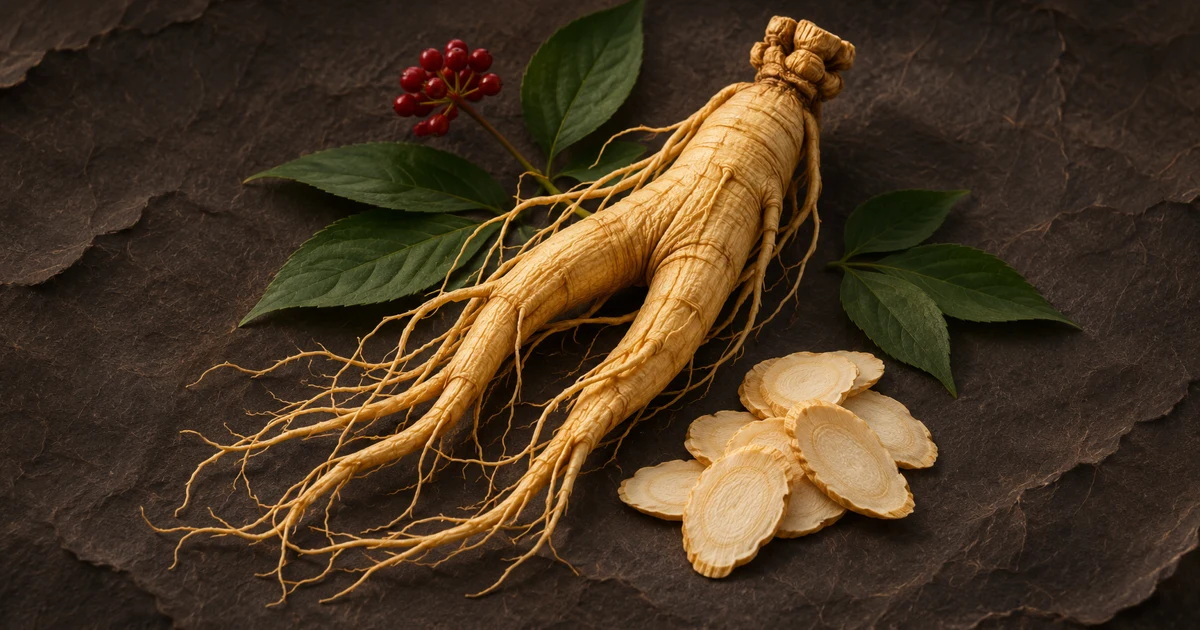
Ginseng is one of the best-known herbal supplements in the world. The label word “ginseng” can mean more than one plant, though, and the research behind it is more modest than the marketing suggests.
This guide explains the main types of ginseng, what red and white ginseng are, what the better studies have found, and who should be careful. It draws on the National Center for Complementary and Integrative Health (NCCIH), the MedlinePlus monographs on Panax ginseng and American ginseng, and published reviews. It is general information, not medical advice.
What is ginseng?
Ginseng usually refers to plants in the Panax genus, and the root is the part most often used for health purposes. Two species dominate the supplement market. Asian ginseng (Panax ginseng) is native to the Far East, including Korea, northeastern China and far-eastern Siberia, according to NCCIH. It is also sold as Korean ginseng or Chinese ginseng. American ginseng (Panax quinquefolius) grows mainly in North America, and MedlinePlus notes it is an endangered species in some states because of high demand.
Both are described as adaptogens, a term for substances believed to help the body resist physical and emotional stress. That is a traditional idea rather than a proven medical effect.
MedlinePlus warns not to confuse Panax ginseng with other plants sometimes called ginseng, such as eleuthero, and says these are different plants with different effects. If a label does not name the species, you cannot know what you are getting. Our guide on how to choose a ginseng supplement covers label reading in more detail.
Types of ginseng at a glance
| Type | Latin name | Where it grows | Key notes from the sources |
|---|---|---|---|
| Asian ginseng | Panax ginseng | Korea, northeastern China, far-eastern Siberia | Short-term oral use up to 6 months appears safe for most people (NCCIH) |
| Red ginseng | Panax ginseng | Same plant | One of two ways of preparing Asian ginseng |
| White ginseng | Panax ginseng | Same plant | The other common preparation of Asian ginseng |
| American ginseng | Panax quinquefolius | Mainly North America | Likely safe short-term; 100 to 3,000 mg daily used for up to 12 weeks |
| Eleuthero | Eleutherococcus senticosus | Not covered here | A different plant with different effects, per MedlinePlus |
Red vs. white ginseng
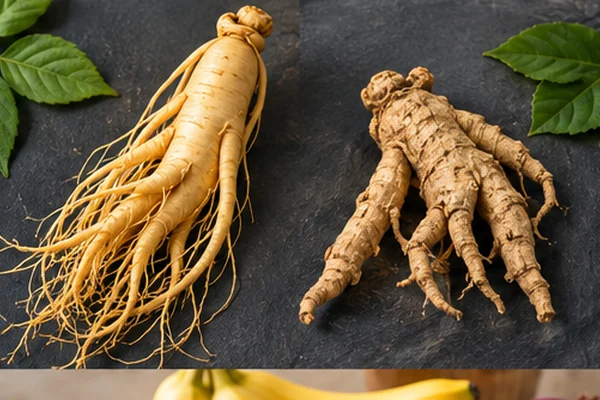
Red and white ginseng are not separate species. NCCIH explains that the terms refer to Asian ginseng prepared in two different ways. The sources reviewed here do not show that one preparation works better than the other.
For a side-by-side look at the two main species and the red and white preparations, see Asian vs. American ginseng. Tea drinkers can see ginseng tea.
Ginsenosides: the main active compounds
Ginseng contains many substances, and NCCIH says the ones thought to be most important are called ginsenosides (or panaxosides). MedlinePlus says the same for Panax ginseng and notes that ginsenosides in American ginseng seem to affect insulin levels and lower blood sugar. MedlinePlus also says ginsenosides can act like estrogen, which is why people with hormone-sensitive conditions are told to avoid ginseng products that contain them.
MedlinePlus notes that some American ginseng extracts have had the ginsenosides removed, so two products sold as “ginseng” may not be equivalent. That is one reason study results can be hard to compare.
What the research shows
NCCIH sums up the evidence base plainly: most clinical trials of Asian ginseng have been small, with fewer than 200 participants, and shorter than 3 months. With that caveat, here is how the main uses stack up.
| Use | What the evidence suggests | Main sources |
|---|---|---|
| General fatigue | Possibly a small benefit; pooled result across all studies not significant | NCCIH; Li 2023 |
| Cancer-related fatigue | American ginseng 2,000 mg/day beat placebo at 8 weeks in one large trial | Barton 2013 |
| Memory and thinking | Small memory effect; no effect on overall cognition, attention or executive function | Zeng 2024; Geng 2010; NCCIH |
| Erectile dysfunction | Trivial effect on validated scores; mostly low-certainty evidence | Lee 2021; NCCIH |
| Blood sugar | Lower fasting glucose in one review; overall research inconclusive and conflicting | Naseri 2022; NCCIH |
| Athletic performance | Does not appear to improve it | NCCIH; MedlinePlus |
Fatigue. A 2023 review by Li and colleagues pooled 19 randomized trials. Across all studies, ginseng did not significantly reduce fatigue severity, but subgroups showed small effects, including for general (non-disease-specific) fatigue and for ginseng herbal formulas in chronic fatigue. In a trial of 364 cancer survivors, Barton and colleagues found that 2,000 mg a day of American ginseng improved cancer-related fatigue at 8 weeks, with no discernible toxicities. More detail is in ginseng for energy.
Memory. NCCIH says a small amount of research suggests Asian ginseng may improve some thinking skills in middle-aged adults but not young adults, and that any memory benefit has appeared to depend on adding ginkgo. A 2024 meta-analysis by Zeng and colleagues (15 trials, 671 people) found a small effect on memory but none on overall cognition. A Cochrane review by Geng and colleagues concluded there was a lack of convincing evidence of a cognitive enhancing effect in healthy people. See ginseng for memory.
Erectile dysfunction. NCCIH says oral Asian ginseng seems to improve sexual function in people with ED, but a Cochrane review by Lee and colleagues (9 studies, 587 men, up to 12 weeks) judged the effect on erectile function trivial, based mostly on low-certainty evidence. ED can have several causes, sometimes including conditions such as heart disease or diabetes, so it is worth raising with a doctor. See ginseng for ED.
Blood sugar. A 2022 review by Naseri and colleagues (20 trials) found ginseng lowered fasting glucose and some other markers in people with prediabetes or type 2 diabetes. NCCIH still describes research on blood sugar control as overall inconclusive and conflicting. Ginseng is not a diabetes treatment. For the full picture, read ginseng benefits.
Safety and side effects
NCCIH says short-term oral use of Asian ginseng, up to 6 months, appears safe for most people. MedlinePlus rates Panax ginseng possibly unsafe when taken for more than 6 months, partly because of possible hormone-like effects. American ginseng is likely safe short-term, and MedlinePlus says doses of 100 to 3,000 mg daily have been used safely for up to 12 weeks, with headache as a possible side effect.
Insomnia is the most common side effect of Asian ginseng. Uncommon reports include severe rash, liver damage and severe allergic reactions. NCCIH adds that Asian ginseng may worsen autoimmune disorders, interfere with blood clotting and lower blood sugar.
Pregnancy, breastfeeding and children. NCCIH says Asian ginseng may be unsafe in pregnancy, because one of its chemicals caused birth defects in animals, and little is known about breastfeeding. Some experts recommend against its use in infants, children, and during pregnancy or breastfeeding. MedlinePlus says Panax ginseng is likely unsafe in infants and children and has been linked to fatal poisoning in newborns. The full list is in ginseng side effects.
Medication interactions
Ginseng can interact with common medicines. MedlinePlus lists American ginseng with warfarin as a major interaction (“do not take this combination”), and says Panax ginseng might decrease warfarin’s effects. In a small trial of healthy volunteers, Yuan and colleagues found that 2 weeks of American ginseng lowered the INR (a blood clotting measure) and plasma warfarin levels compared with placebo in 20 healthy volunteers. Other listed concerns include diabetes medicines and insulin (blood sugar may drop too low), MAOI antidepressants, caffeine with Panax ginseng, estrogens, immunosuppressants and drugs that affect heart rhythm. MedlinePlus advises stopping American ginseng at least 2 weeks before scheduled surgery. If you take any medicine, ask a pharmacist or doctor first, and see ginseng interactions.
Dosage and product quality
There is no single established dose. Amounts reported in the sources include 100 to 3,000 mg of American ginseng daily for up to 12 weeks (MedlinePlus) and 2,000 mg a day in the Barton fatigue trial. These are amounts that were studied, not recommendations. For Panax ginseng, keep the 6-month limit in mind. Our ginseng dosage article goes further.
Quality matters because, as NCCIH explains, dietary supplements are not approved by the FDA before they are sold. Manufacturers and distributors are responsible for evaluating the safety and labeling of their products before marketing, and the FDA can act against an adulterated or misbranded product after it reaches the market. Look for a label that names the species and plant part. If you are comparing ginseng with other popular herbs, see ginseng vs. ashwagandha, our ashwagandha guide and our functional mushrooms guide.
Frequently asked questions
Is red ginseng a different plant from Asian ginseng?
No. NCCIH says red and white ginseng are Asian ginseng prepared in two different ways.
Does ginseng give you energy?
The evidence suggests at most a small effect on general fatigue. Persistent tiredness should be checked by a doctor rather than self-treated.
How long can I take ginseng?
Short-term use of Asian ginseng, up to 6 months, appears safe for most people. MedlinePlus rates longer use of Panax ginseng as possibly unsafe.
Who should avoid ginseng?
People who are pregnant or breastfeeding, infants and children, people with autoimmune or bleeding conditions, and anyone taking warfarin or diabetes medicines without medical advice.
Sources
- National Center for Complementary and Integrative Health. Asian ginseng.
- MedlinePlus. Panax ginseng.
- MedlinePlus. American ginseng.
- Li, et al. Ginseng and ginseng herbal formulas for symptomatic management of fatigue: a systematic review and meta-analysis. J Integr Complement Med. 2023.
- Barton, et al. Wisconsin ginseng (Panax quinquefolius) to improve cancer-related fatigue: a randomized, double-blind trial, N07C2. J Natl Cancer Inst. 2013.
- Zeng, et al. Effects of ginseng on cognitive function: a systematic review and meta-analysis. Phytother Res. 2024.
- Geng, et al. Ginseng for cognition. Cochrane Database Syst Rev. 2010.
- Lee, et al. Ginseng for erectile dysfunction. Cochrane Database Syst Rev. 2021.
- Naseri, et al. The efficacy of ginseng (Panax) on human prediabetes and type 2 diabetes mellitus: a systematic review and meta-analysis. Nutrients. 2022.
- Yuan, et al. American ginseng reduces warfarin’s effect in healthy patients: a randomized, controlled trial. Ann Intern Med. 2004.
- U.S. Food and Drug Administration. Dietary supplements.
Last reviewed November 2026. VitaBrief is educational and is not medical advice. Talk with a doctor, registered dietitian or pharmacist before starting a supplement, especially if you are pregnant, take medication or have kidney disease.
Not medical advice. This guide is for general education. Talk to your doctor or pharmacist before taking a supplement, especially if you are pregnant or breastfeeding, take medication or have a health condition. Medical disclaimer