Supplement basics
How much protein do you need per day?
Daily protein targets by body weight, age and goal, how much to eat per meal, and when protein powder helps.
VitaBrief editorial · Last reviewed November 2026 · Sources listed below
Reader-supported. This page may contain affiliate links. If you buy through one, we may earn a commission at no extra cost to you. It never changes what we write. Affiliate disclosure
“How much protein do I need a day?” is one of the most searched nutrition questions in the US, and the answer depends on who you are. The official minimum is lower than many people expect, while targets for active people, those losing weight and older adults are considerably higher. This guide explains the numbers, how to calculate your own target, how to spread protein across meals and when a protein powder makes sense. It is based on MedlinePlus, the International Society of Sports Nutrition (ISSN) (Jäger 2017), the PROT-AGE study group (Bauer 2013) and meta-analyses of protein and muscle.
How Much Protein Per Day: the quick answer
| Who | g per kg body weight per day | g per lb | Example: 70 kg (154 lb) |
|---|---|---|---|
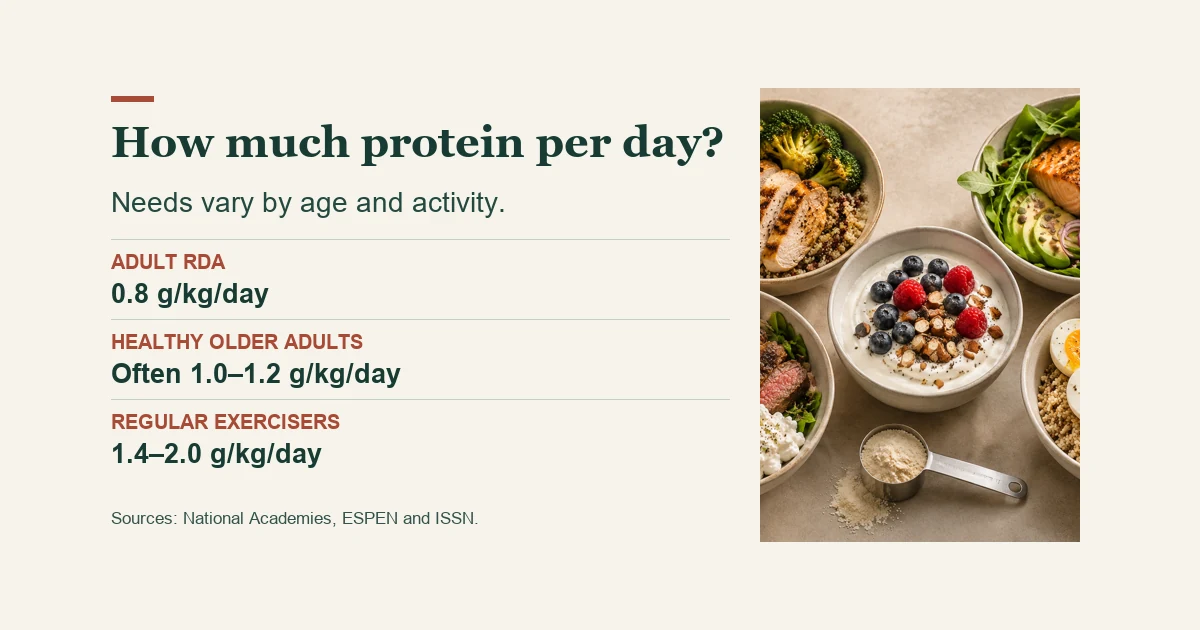
| Sedentary adults (RDA minimum) | 0.8 | 0.36 | 56 g |
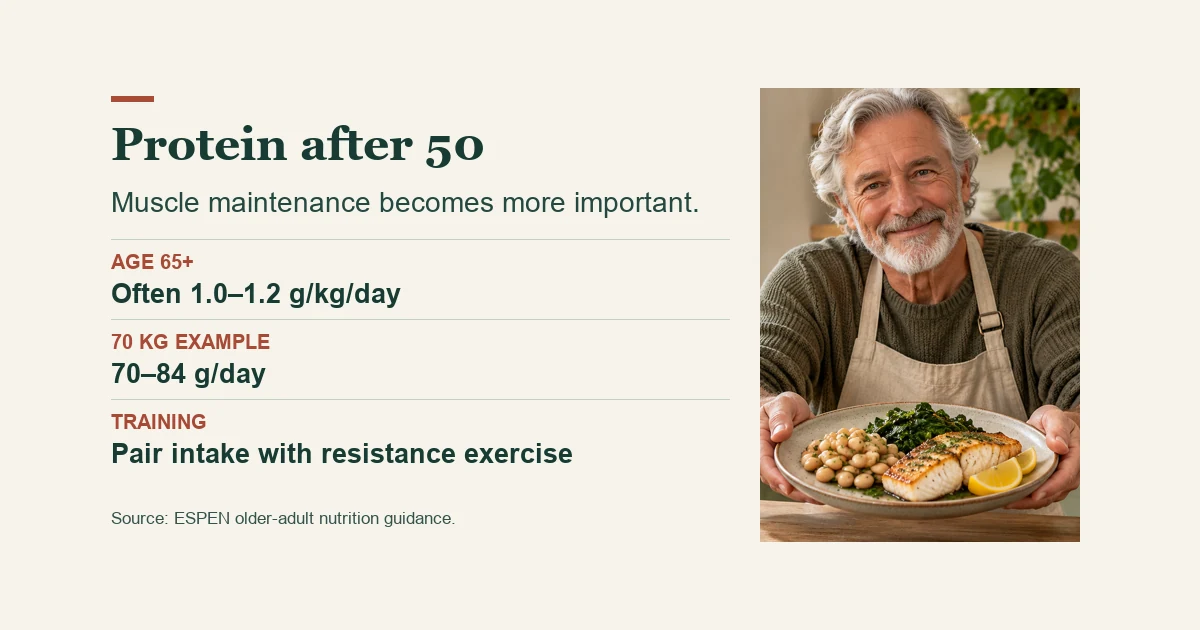
| Healthy adults over 65 | 1.0–1.2 | 0.45–0.55 | 70–84 g |
| Older adults with illness | 1.2–1.5 | 0.55–0.7 | 84–105 g |
| Regular exercisers | 1.4–2.0 | 0.65–0.9 | 98–140 g |
| Losing weight while training | Often 1.6–2.4 | 0.7–1.1 | 112–168 g |
If you are significantly overweight, calculating from your current weight can overstate needs. Many dietitians use a goal or adjusted body weight instead.
What the RDA means
The Recommended Dietary Allowance of 0.8 grams per kilogram is the amount needed to prevent deficiency in nearly all healthy adults. It is a minimum, not an optimal target for muscle, aging or weight loss. MedlinePlus expresses it simply: about 46 grams a day for most women and 56 grams for most men. Many Americans already eat more than this, but intake is often uneven, with little protein at breakfast and a lot at dinner.
Protein for exercise and muscle
The ISSN recommends 1.4 to 2.0 grams per kilogram per day for most people who exercise (Jäger 2017). A meta-analysis of 49 trials found that gains in muscle from resistance training increased with protein intake up to about 1.6 grams per kilogram per day, after which extra protein added little on average. The researchers noted that some people may benefit from up to about 2.2 grams (Morton 2018).
Endurance athletes also need more than the RDA for repair and adaptation, generally in the lower part of the range.
How much protein per meal
Muscle building responds to each protein-containing meal. Research suggests about 0.4 grams per kilogram per meal, spread over at least four meals, is a practical way to reach about 1.6 grams per kilogram a day (Schoenfeld 2018). For a 70 kg adult, that means roughly 25 to 30 grams per meal.
| Body weight | Per meal (0.4 g/kg) | Four meals a day |
|---|---|---|
| 55 kg (121 lb) | 22 g | 88 g |
| 70 kg (154 lb) | 28 g | 112 g |
| 85 kg (187 lb) | 34 g | 136 g |
| 100 kg (220 lb) | 40 g | 160 g |
Older adults appear to need more protein per meal to get the same muscle-building response, roughly 0.4 grams per kilogram compared with about 0.24 in younger men (Moore 2015). See protein after 50.
Protein when losing weight
When calories are reduced, the body breaks down some muscle along with fat. Higher-protein diets reduce this loss and slightly increase fat loss (Wycherley 2012). Protein is also more filling than carbohydrate or fat (Leidy 2015). People losing weight with GLP-1 medicines often eat much less, which makes reaching protein targets harder. See protein powder for weight loss.
What 25 to 30 grams looks like
| Food | Approximate protein |
|---|---|
| Chicken breast, cooked, 4 oz (113 g) | 35 g |
| Canned tuna, 1 can (about 140 g drained) | 25–30 g |
| Greek yogurt, plain, 1 cup | 20–23 g |
| Eggs, 3 large | 18–19 g |
| Lentils, cooked, 1 cup | 18 g |
| Firm tofu, 1 cup | 20 g or more |
| Cottage cheese, 1 cup | 25 g |
| Protein powder, 1 scoop | 20–30 g |
One egg provides about 6 grams of protein, and a 4-ounce chicken breast about 35 grams, two of the most-searched protein questions on Google.
How to calculate your target
- Convert your weight to kilograms (pounds ÷ 2.2).
- Pick a multiplier: 0.8 if inactive, 1.0–1.2 if over 65, 1.4–2.0 if you exercise regularly, toward the top if you are losing weight while training.
- Multiply. For example, 150 lb ÷ 2.2 = 68 kg; 68 × 1.6 = about 109 grams a day.
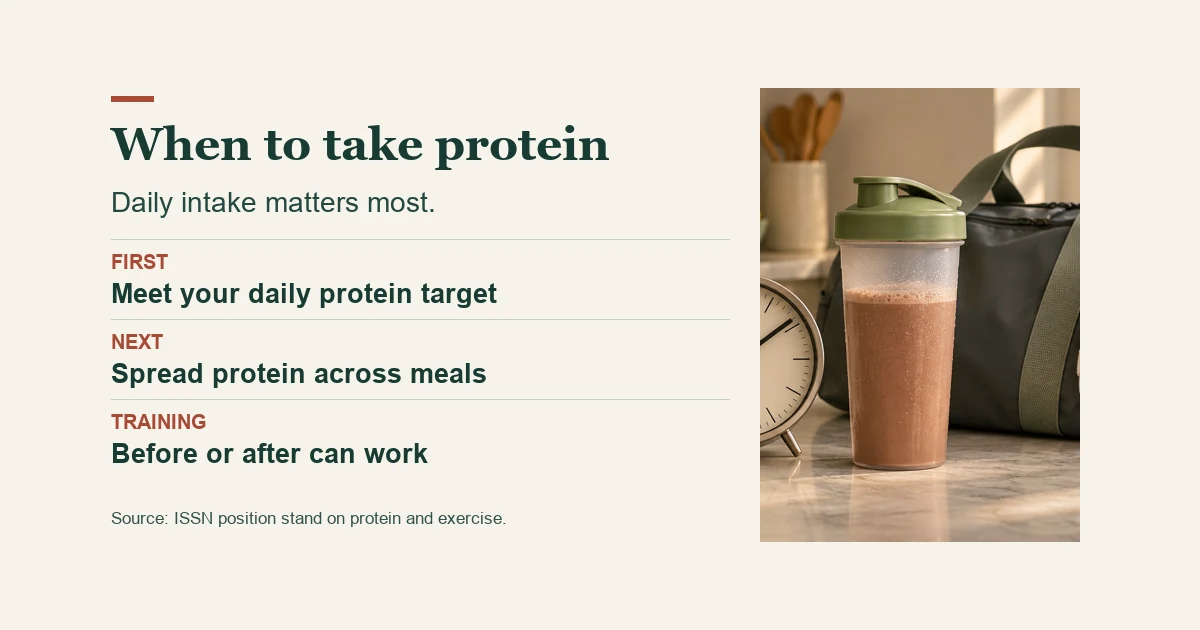
- Divide across your meals and snacks, aiming for 20 to 40 grams at each main meal.
Can you eat too much protein?
For healthy people, higher protein intakes appear safe. A meta-analysis found that higher-protein diets did not change kidney function differently from normal-protein diets in people with healthy kidneys (Devries 2018), and a one-year study in trained men eating very high amounts found no harmful effects on blood markers (Antonio 2016). People with chronic kidney disease are different and often need to limit protein under medical guidance (Ko 2020). See protein and kidneys.
Very high protein diets can crowd out fiber-rich plant foods, so balance still matters.
When protein powder helps
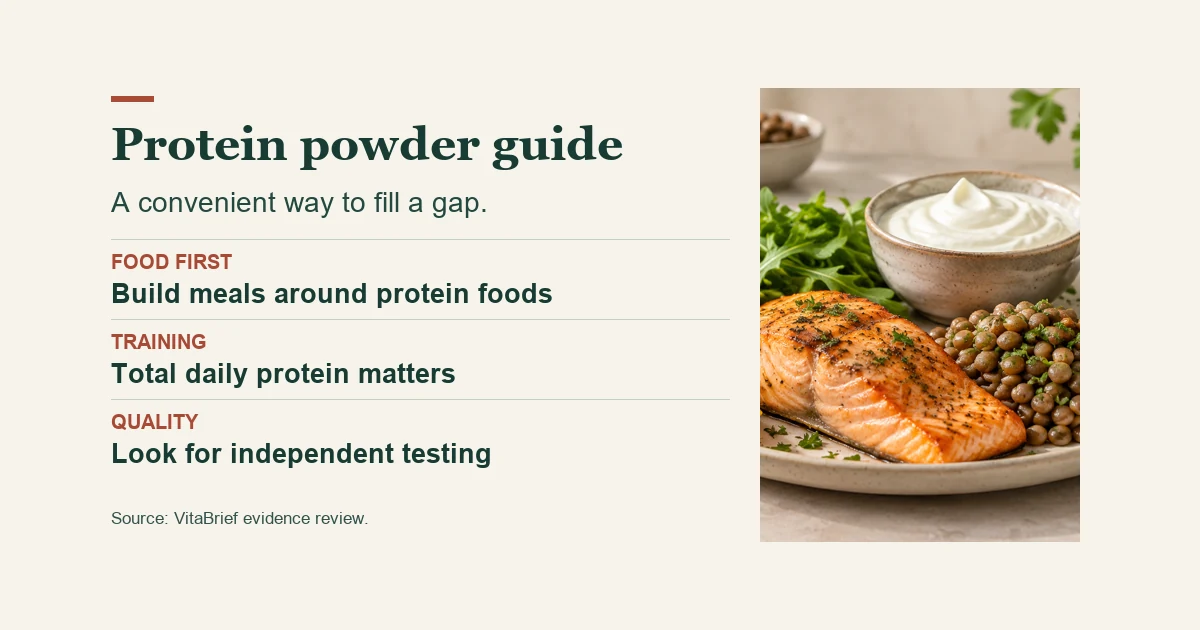
Protein powder is useful when food alone falls short: a breakfast that is mostly carbohydrate, a busy day without time to cook, a small appetite, or a plant-based diet where protein needs planning. A scoop added to oatmeal, a smoothie or yogurt can turn a low-protein meal into a 25 to 30 gram meal. See our protein powder guide.
Signs you may not be getting enough
Most people in the US meet the RDA, but some groups often fall short of the higher targets, including older adults, people on restrictive diets, people losing weight on GLP-1 medicines and some vegetarians. Possible signs of low intake include gradual loss of strength or muscle, slow recovery from exercise or illness, and feeling hungry soon after meals. These signs have many causes, so a diet review is more useful than guessing.
The bottom line
The RDA of 0.8 grams per kilogram is a minimum. Most active adults do better with 1.4 to 2.0 grams per kilogram a day, older adults with at least 1.0 to 1.2, and people losing weight toward the higher end. Spread protein across meals at about 20 to 40 grams each. Food should come first, with protein powder as a convenient top-up. If you have kidney disease, ask your doctor what target is right for you.
Frequently asked questions
Is 100 grams of protein a day too much?
For most healthy, active adults it is within the recommended range. For a small, inactive person it is more than needed but not harmful if kidneys are healthy.
Is 1 gram per pound necessary?
That is about 2.2 grams per kilogram, the upper end of the evidence. Most people get the full muscle benefit at around 1.6 grams per kilogram (0.7 grams per pound).
Do women need less protein than men?
Per kilogram of body weight, needs are similar. Total grams are often lower because women tend to weigh less. See protein for women.
Should I eat more protein on rest days?
Keep intake about the same. Muscle repair continues for a day or more after training.
Does the body absorb only 30 grams at once?
No. The body absorbs larger amounts; it just uses them more slowly. Spreading protein over meals may still be better for muscle building.
How much protein do I need to build muscle?
About 1.6 g/kg per day for most people, with some benefiting from up to about 2.2 g/kg.
Is plant protein counted the same?
Yes, by grams. Plant-based eaters may aim slightly higher to account for lower digestibility.
Sources
- MedlinePlus. Protein in diet.
- Jäger R, et al. International Society of Sports Nutrition position stand: protein and exercise. J Int Soc Sports Nutr. 2017;14:20.
- Morton RW, et al. A systematic review, meta-analysis and meta-regression of the effect of protein supplementation on resistance training-induced gains in muscle mass and strength in healthy adults. Br J Sports Med. 2018;52(6):376-84.
- Schoenfeld BJ, Aragon AA. How much protein can the body use in a single meal for muscle-building? Implications for daily protein distribution. J Int Soc Sports Nutr. 2018;15:10.
- Bauer J, et al. Evidence-based recommendations for optimal dietary protein intake in older people: a position paper from the PROT-AGE Study Group. J Am Med Dir Assoc. 2013;14(8):542-59.
- Moore DR, et al. Protein ingestion to stimulate myofibrillar protein synthesis requires greater relative protein intakes in healthy older versus younger men. J Gerontol A Biol Sci Med Sci. 2015;70(1):57-62.
- Wycherley TP, et al. Effects of energy-restricted high-protein, low-fat compared with standard-protein, low-fat diets: a meta-analysis of randomized controlled trials. Am J Clin Nutr. 2012;96(6):1281-98.
- Leidy HJ, et al. The role of protein in weight loss and maintenance. Am J Clin Nutr. 2015;101(6):1320S-9S.
- Devries MC, et al. Changes in kidney function do not differ between healthy adults consuming higher- compared with lower- or normal-protein diets: a systematic review and meta-analysis. J Nutr. 2018;148(11):1760-75.
- Antonio J, et al. A high protein diet has no harmful effects: a one-year crossover study in resistance-trained males. J Nutr Metab. 2016;2016:9104792.
- Ko GJ, et al. The effects of high-protein diets on kidney health and longevity. J Am Soc Nephrol. 2020;31(8):1667-79.
Last reviewed November 2026. VitaBrief is educational and is not medical advice. Talk with a doctor, registered dietitian or pharmacist before starting a supplement, especially if you are pregnant, take medication or have kidney disease.
Not medical advice. This guide is for general education. Talk to your doctor or pharmacist before taking a supplement, especially if you are pregnant or breastfeeding, take medication or have a health condition. Medical disclaimer