Comparisons
How to choose a turmeric supplement: forms, labels and testing
What to look for on a turmeric or curcumin label, how the main forms differ, why enhanced absorption cuts both ways, and how third-party testing helps with lead and quality concerns.
VitaBrief editorial · Last reviewed November 2026 · Sources listed below
Reader-supported. This page may contain affiliate links. If you buy through one, we may earn a commission at no extra cost to you. It never changes what we write. Affiliate disclosure
Searches for the “best turmeric supplement” for inflammation, joint pain or knee pain are common, and store shelves offer dozens of options: plain powder capsules, standardized extracts, products with black pepper, and formulas that promise many times better absorption. There is no single best product, and VitaBrief does not recommend brands. What you can do is learn to read a label, understand the trade-offs between forms, and pick a product that has been independently tested. This guide explains how, drawing on the National Center for Complementary and Integrative Health (NCCIH), the FDA, MedlinePlus and published research.
How to choose a turmeric supplement: the short answer
How to choose a turmeric supplement: powder vs extract, standardized curcuminoids, black pepper and enhanced-absorption forms, third-party testing, lead chromate adulteration, and who should skip supplements.
First question: do you need a supplement?
Turmeric as a spice in food is considered safe for most people, and it is a fine part of a varied diet. Supplements are different. They deliver far more curcumin than food, and most of the benefits claimed for them are based on preliminary research. The area with the most evidence is knee osteoarthritis pain, where reviews suggest a modest benefit with low-certainty evidence (Shirinsky 2026). See turmeric for joint pain and turmeric benefits.
Before buying, check whether you are in a group that should be cautious. NCCIH says conventionally formulated turmeric or curcumin supplements taken by mouth are likely safe in recommended amounts for up to 2 to 3 months, but that liver damage has been reported in some people using formulations designed for better absorption, and that turmeric supplements may be unsafe during pregnancy (NCCIH).
NCCIH also advises anyone who takes medicine to talk with a health care provider before using herbal products, because some herbs and medicines interact. As a general precaution, people who take blood thinners, are having surgery or have gallbladder problems should also ask first. People with liver disease should also talk to a doctor first. See turmeric interactions.
The main forms of turmeric supplements
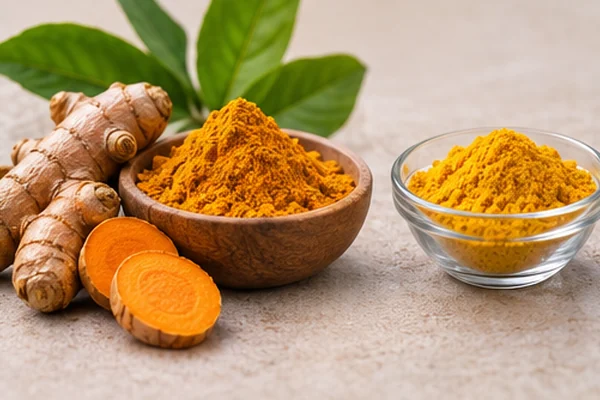
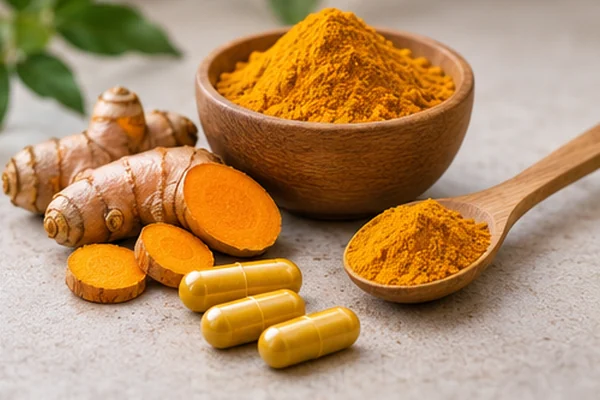
Turmeric root powder contains only a small percentage of curcuminoids. Extracts concentrate them. Because curcumin on its own is poorly absorbed (Anand 2007), many products add ingredients or use technologies to raise blood levels.
| Form | What it is | Things to weigh |
|---|---|---|
| Turmeric root powder | Ground dried root in a capsule | Low curcumin content; closest to food use |
| Standardized extract | Extract with a stated percentage of curcuminoids | Form used in many trials; much more curcumin than powder |
| Extract with black pepper (piperine) | Extract plus black pepper extract | Raises curcumin levels; also linked to many liver injury cases |
| Enhanced-absorption formulas | Curcumin combined with fats, other compounds or particle technologies | Higher blood levels; same liver caution applies |
| Combination products | Turmeric plus ginger, boswellia or other herbs | Harder to judge each ingredient; more potential interactions |
For more on the difference between the spice and its extract, see turmeric vs curcumin.
Enhanced absorption cuts both ways
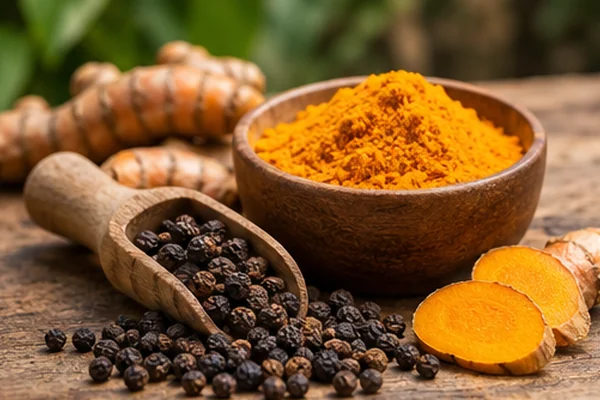
Absorption is the main selling point for many turmeric products. In a small study in human volunteers, adding piperine raised blood levels of curcumin considerably compared with curcumin alone (Shoba 1998). Since then, many proprietary formulations have been developed to achieve the same goal.
More absorbed curcumin may sound purely positive, but it also means more exposure. Liver injury linked to turmeric supplements is rare, yet it is documented and appears to be increasing. In a case series from the US Drug-Induced Liver Injury Network, many of the products involved contained black pepper or were high-bioavailability formulations (Halegoua-DeMarzio 2023). A review of Italian phytovigilance reports and published case reports raised similar concerns (Lombardi 2021).
That does not mean enhanced products should never be used, but it does mean a “stronger” label is not automatically a better choice. Avoid stacking several turmeric products, and stay within amounts used in research. See turmeric and black pepper, turmeric and the liver and turmeric dosage.
How to read the label
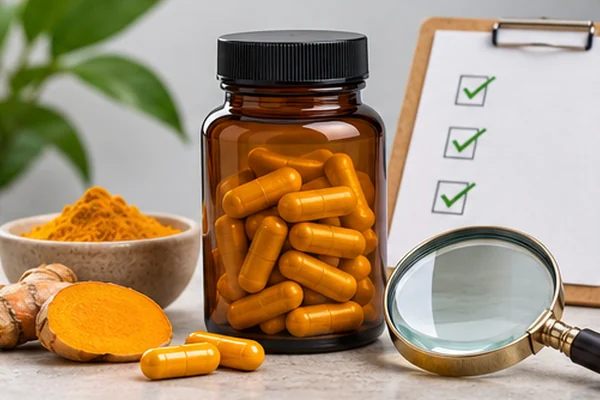
A clear label makes it possible to compare products and to tell your doctor exactly what you take. Look for:
- Curcuminoid content. A useful label states the amount of turmeric extract and the percentage or milligrams of curcuminoids, not just “turmeric root.”
- Absorption enhancers. Check whether it contains black pepper extract (piperine) or a named enhanced-absorption form.
- Serving size. Some products list amounts per several capsules. Do the math per serving and per day.
- Other ingredients. Note any added herbs, which bring their own effects and interactions.
- Proprietary blends. Blends that hide individual amounts make it hard to know what you are getting.
- Claims. Be wary of products that promise to treat, cure or prevent disease. Supplements are not allowed to make such claims, and they are a red flag.
Remember that in the US, dietary supplements do not need FDA approval for safety or effectiveness before they are sold, and manufacturers are responsible for their own products (FDA). The label is a claim, not a guarantee.
Third-party testing and lead contamination
Because the FDA does not test supplements before sale, independent testing is one of the most useful quality signals available. Several independent organizations offer certification programs that check whether a product contains what its label says and whether it is free of certain contaminants. Look for a verification seal from a recognized independent tester on the bottle, and check the tester’s own website to confirm the listing.
Contamination is a real concern for turmeric specifically. Researchers found evidence that turmeric in parts of South Asia has been adulterated with lead chromate, a bright yellow pigment added to improve color (Forsyth 2024). Lead is harmful at any level, especially for children and during pregnancy, and the FDA monitors lead in foods and spices (FDA). Choosing third-party tested products, and spices from established suppliers, reduces this risk. An unusually bright color is not a sign of quality.
Price, marketing and other quality clues
A higher price does not guarantee a better or safer product, and neither does a long list of impressive-sounding claims. Words such as “clinically studied,” “pharmaceutical grade” or “maximum strength” are marketing language, not proof. If a product says it is clinically studied, it is fair to ask what was studied, in whom, at what amount, and whether the results were published. Often the research was done on an ingredient in general, not on the specific product in the bottle.
Other useful clues include a clear manufacturer name and contact information, a lot number and expiration date on the bottle, and a willingness to share a certificate of analysis on request. A certificate of analysis is a lab report showing what was measured in a batch; one from an independent lab carries more weight than an in-house test. Be cautious with products sold only through social media ads or with dramatic before-and-after stories.
Finally, more is not better. Taking several products that each contain turmeric, such as a joint formula, a general wellness blend and a separate curcumin capsule, can add up to far more than any trial used. Check every label in your cabinet before adding a new one.
A simple buying checklist
- Check with your doctor or pharmacist first if you take medicines, are pregnant, or have liver or gallbladder problems.
- Decide why you are taking it, and whether evidence supports that use.
- Choose a product with a clear curcuminoid amount and no hidden blends.
- Look for third-party testing for identity and contaminants, including heavy metals.
- Think twice about high-absorption or black pepper formulas, and never combine several turmeric products.
- Skip products with disease-treatment claims.
- Set a trial period, and stop if you notice no benefit.
You can report a suspected problem with a supplement to the FDA, and MedlinePlus has general guidance on using supplements safely.
When to stop and see a doctor
Stop taking a turmeric supplement and contact a doctor promptly if you develop yellowing of the skin or eyes, dark urine, pain in the upper abdomen, nausea or unusual fatigue, which can be signs of liver injury. Also seek advice for unusual bruising or bleeding, especially if you take a blood thinner. Bring the bottle with you so your clinician can see exactly what you took. For milder issues such as stomach upset, see turmeric side effects.
Frequently asked questions
What is the best turmeric supplement for inflammation?
No product is proven best. Look for a clearly labeled, third-party tested extract and be cautious with high-absorption formulas.
Should I buy turmeric with black pepper?
Black pepper raises curcumin levels, but many liver injury cases involved such products. Discuss it with a doctor, especially if you take medicines.
Is curcumin better than turmeric powder?
Extracts deliver much more curcumin and were used in most trials. That also means more exposure. See turmeric vs curcumin.
How can I avoid lead in turmeric?
Choose third-party tested supplements and spices from established suppliers. Unusually bright color is not a quality sign.
Are organic turmeric supplements safer?
Organic labels relate to how the plant was grown. They do not guarantee curcumin content or freedom from lead, so third-party testing still matters.
Sources
- NCCIH. Turmeric.
- FDA. Dietary Supplements.
- FDA. Lead in Food and Foodwares.
- MedlinePlus. Dietary Supplements.
- Shirinsky et al. Curcuma longa (turmeric) or its active ingredients for osteoarthritis. Cochrane Database Syst Rev. 2026.
- Anand et al. Bioavailability of curcumin: problems and promises. Mol Pharm. 2007.
- Shoba et al. Influence of piperine on the pharmacokinetics of curcumin in animals and human volunteers. Planta Med. 1998.
- Halegoua-DeMarzio et al. Liver injury associated with turmeric, a growing problem. Am J Med. 2023.
- Lombardi et al. Acute liver injury following turmeric use in Tuscany. Br J Clin Pharmacol. 2021.
- Forsyth et al. Evidence of turmeric adulteration with lead chromate across South Asia. Sci Total Environ. 2024.
Last reviewed November 2026. VitaBrief is educational and is not medical advice. Talk with a doctor, registered dietitian or pharmacist before starting a supplement, especially if you are pregnant, take medication or have kidney disease.
Not medical advice. This guide is for general education. Talk to your doctor or pharmacist before taking a supplement, especially if you are pregnant or breastfeeding, take medication or have a health condition. Medical disclaimer