Supplement basics
How to choose an ashwagandha supplement: root, extracts, forms and testing
Root or leaf, standardized extract or powder, capsule or gummy: what the label tells you, what it does not, and who should skip ashwagandha altogether.
VitaBrief editorial · Last reviewed November 2026 · Sources listed below
Reader-supported. This page may contain affiliate links. If you buy through one, we may earn a commission at no extra cost to you. It never changes what we write. Affiliate disclosure
Ashwagandha labels can be confusing. One bottle lists “root powder,” another a “standardized extract” with a withanolide percentage, a third a gummy with a trademarked ingredient name, and a fourth a tea blend. Prices and doses vary widely. Because supplements are not approved by the FDA before they are sold, much of the job of judging quality falls to you.
This guide explains how to read an ashwagandha label, which features line up with the products used in research, and which warning signs to watch for. It does not recommend brands, and it is general information, not medical advice. Before buying, it is worth reading our overview of ashwagandha side effects, since choosing well starts with deciding whether you should take it at all.
How to choose ashwagandha: the short answer
How to choose ashwagandha: root vs. leaf, standardized extracts and withanolide percentages, powder vs. capsule vs. gummy vs. tea, third-party testing, label red flags, FDA oversight, and who should not buy it.
Quick checklist
| Label feature | What to look for | Why it matters |
|---|---|---|
| Plant part | Root, clearly stated | Most trials used root extracts |
| Form | Extract with an amount per serving | Lets you compare with doses used in studies |
| Standardization | Withanolide percentage stated | Suggests more consistent batches |
| Ingredient list | Each ingredient with its own amount | Proprietary blends can hide doses |
| Testing | Independent third-party quality seal | Checks identity, amount and contaminants |
| Claims | Modest wording plus the FDA disclaimer | Big disease claims are a warning sign |
Root vs. leaf
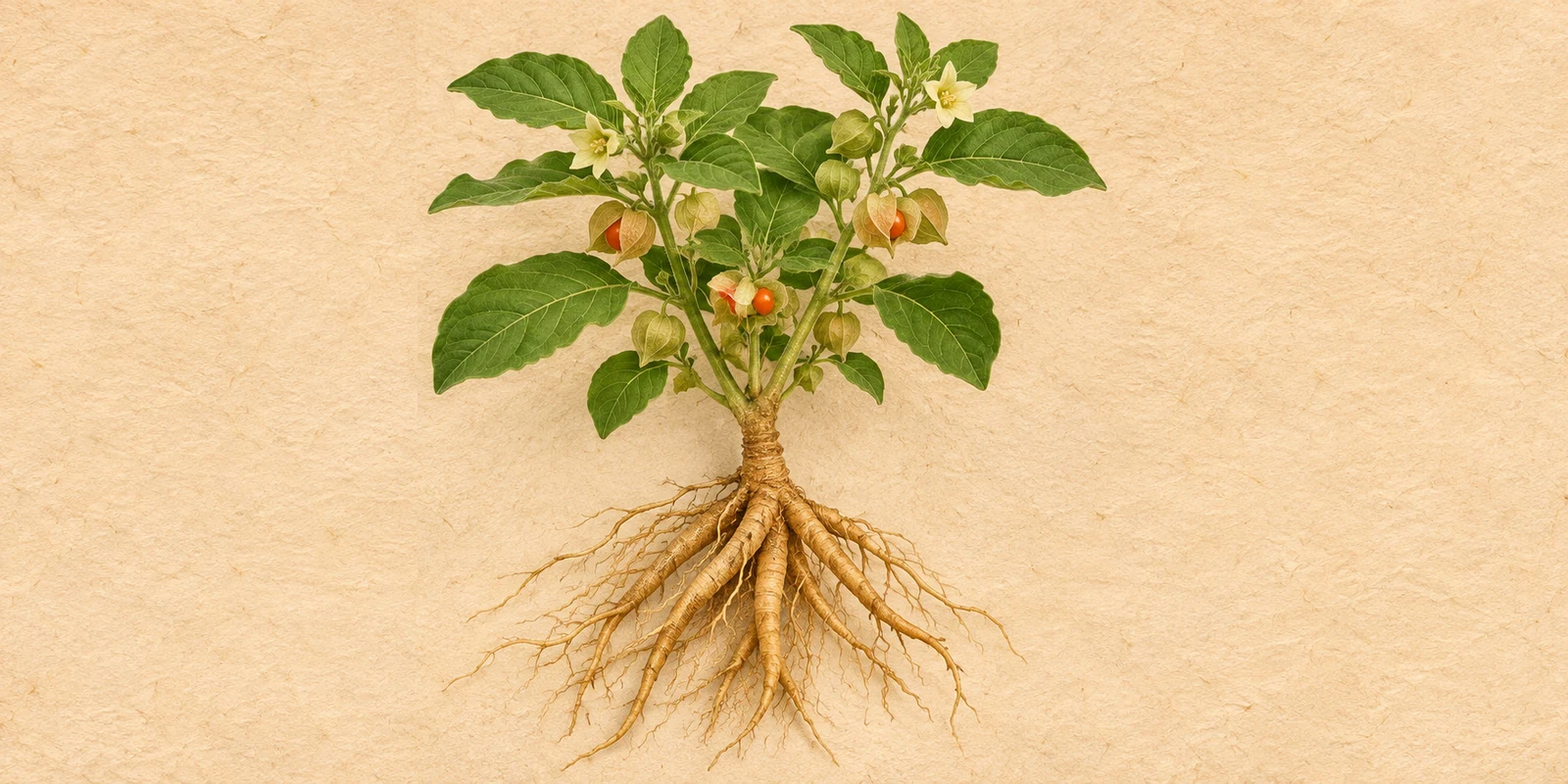
Ashwagandha (Withania somnifera) is a small shrub. Traditionally, the root is the part most used in Ayurvedic practice, and most modern clinical trials also used root extracts. Examples include the stress trials by Chandrasekhar 2012 and Salve 2019 and the insomnia trial by Langade 2019, all of which tested root extracts.
Some products use leaf, or a mix of root and leaf. Leaves contain a different profile of compounds, and fewer human trials have tested leaf-based products. That does not prove leaf products are unsafe or ineffective, but the research behind them is thinner. If you want a product that resembles what was studied, look for one that clearly says “root” and does not hide the plant part.
Standardized extracts and withanolides
Withanolides are a group of naturally occurring compounds in ashwagandha that are thought to contribute to its effects. Plants vary in how much they contain depending on growing conditions, harvest time and processing. A “standardized” extract is processed so that each batch contains a stated percentage of withanolides, often a figure in the low single digits, which helps make batches more consistent.
A few points help put those percentages in context:
- Higher is not automatically better. Different extraction methods measure and concentrate withanolides differently, so percentages across products are not always directly comparable.
- The extract amount matters too. A label should state how many milligrams of extract are in each serving, not just a percentage.
- Branded extracts. Some trials used branded, trademarked root extracts made by specific manufacturers. Results from one extract may not apply to another, even if both are standardized. We do not name or compare brands here.
- Plain root powder is the dried, ground root without concentration. It is less studied, and a much larger amount is typically needed to approach the doses of extract used in trials.
For the doses used in research, see ashwagandha dosage.
Powder vs. capsule vs. gummy vs. tea
| Form | Pros | Cons |
|---|---|---|
| Capsule or tablet (extract) | Closest to what most trials used; easy dosing | Quality still varies by maker |
| Loose powder | Inexpensive; traditional use in milk or food | Bitter, earthy taste; harder to dose; usually not standardized |
| Gummy | Easy to take | Added sugar; often small doses; harder to verify contents; looks like candy to children |
| Tea | Gentle ritual | Unknown and likely low dose; rarely studied |
| Liquid extract or tincture | Flexible dosing | May contain alcohol; concentration varies |
If your goal is to match the research, a capsule or tablet with a clearly labeled standardized root extract is the closest fit. Gummies and teas are convenient, but their doses are often lower or unclear, and gummies should be stored out of children’s reach. Timing and food matter less than consistency; see when to take ashwagandha.
Third-party testing
Because the FDA does not test supplements before they are sold, independent testing adds a useful layer of assurance. Several independent organizations offer quality certification programs for dietary supplements. A seal from one of these programs generally means the product was checked to contain the listed ingredients in the stated amounts, without harmful levels of certain contaminants such as heavy metals, and was made under good manufacturing practices.
A seal is not a guarantee that a product works or that it is safe for you personally. It says nothing about whether ashwagandha suits your health, and it does not remove the risk of rare liver or thyroid reactions. Be wary of vague phrases like “lab tested” or “clinically proven” with no named independent tester behind them. Herbal products grown in soil can pick up contaminants, so testing for heavy metals is especially worth looking for.
A few other details on the label and package can also help. Look for a lot or batch number and an expiration date, which suggest the maker tracks production. Check that the company lists a way to contact it, such as a U.S. address or phone number.
Compare the serving size carefully: some products list a two- or three-capsule serving, so the dose per capsule is smaller than it first appears. Finally, the price per day of a standardized extract, rather than the price per bottle, is the fairer way to compare products. A very cheap price for a high-dose extract can be a reason for caution rather than a bargain.
Label red flags
- Proprietary blends. A “blend” lists a total weight but not how much ashwagandha it contains. You cannot tell whether the dose is meaningful.
- Big claims. Promises to cure anxiety, insomnia, thyroid problems or infertility, or to “boost testosterone” dramatically, go beyond the evidence. Evidence for testosterone, muscle and fertility is thinner than for stress and sleep.
- Missing plant part or extract details. No mention of root, leaf or extract amount.
- Very high doses well above those used in trials, or stacking with several other stimulating or sedating herbs.
- No FDA disclaimer next to structure or function claims, or language suggesting the product is “FDA approved.”
What FDA oversight does and does not mean
In the U.S., ashwagandha is sold as a dietary supplement. As the FDA explains, it does not approve dietary supplements for safety or effectiveness before they reach the market. Manufacturers are responsible for making sure their products are safe and accurately labeled, and the FDA can act against unsafe or misbranded products after they are sold. Supplements may carry claims about supporting body structure or function, but those claims must be paired with a disclaimer stating that the FDA has not evaluated them, and they cannot claim to treat or cure disease.
If you think a supplement made you ill, tell your doctor, and you can report the problem to the FDA. If you plan to use an FSA or HSA, check with your plan administrator.
Who should not buy ashwagandha
The best product is no product if ashwagandha is not right for you. According to NCCIH and the ODS, skip it or talk to a doctor first if you:
- Are pregnant, trying to conceive or breastfeeding. It is not recommended in pregnancy.
- Have liver disease or have had liver problems. Rare liver injury has been reported (Björnsson 2020). See ashwagandha and the liver.
- Have thyroid disease or take thyroid medicine such as levothyroxine. See ashwagandha and thyroid.
- Have an autoimmune disease, or take immunosuppressants.
- Take sedatives, antidepressants, or medicines for blood pressure or diabetes. See ashwagandha interactions.
- Have surgery coming up.
Stop taking it and seek care promptly if you notice yellowing of the skin or eyes, dark urine, itching, or unusual tiredness.
Frequently asked questions
Is root or leaf ashwagandha better?
Most clinical trials used root extracts, so root products most closely match the research. Leaf products have been studied less.
What withanolide percentage should I look for?
There is no single correct figure. A stated percentage suggests standardization, but extraction methods differ, so percentages are not always comparable across products.
Are ashwagandha gummies as good as capsules?
Gummies are convenient but often contain smaller or less clear doses plus added sugar. Capsules with a standardized root extract are closer to what trials used.
Does a third-party seal mean a product is safe?
It means the product was checked for identity, amount and certain contaminants. It does not prove the product works or rule out rare reactions.
Is ashwagandha FDA approved?
No. The FDA does not approve dietary supplements before they are sold. Any product claiming FDA approval is a red flag.
Sources
- U.S. Food and Drug Administration. Dietary Supplements.
- National Center for Complementary and Integrative Health. Ashwagandha.
- NIH Office of Dietary Supplements. Ashwagandha: Fact Sheet for Health Professionals.
- MedlinePlus. Ashwagandha.
- MedlinePlus. Levothyroxine.
- Chandrasekhar K, et al. High-concentration full-spectrum ashwagandha root extract in reducing stress and anxiety in adults. Indian J Psychol Med. 2012.
- Salve J, et al. Adaptogenic and anxiolytic effects of ashwagandha root extract in healthy adults. Cureus. 2019.
- Langade D, et al. Efficacy and safety of ashwagandha root extract in insomnia and anxiety. Cureus. 2019.
- Björnsson HK, et al. Ashwagandha-induced liver injury: a case series from Iceland and the US DILIN. Liver Int. 2020.
Last reviewed November 2026. VitaBrief is educational and is not medical advice. Talk with a doctor, registered dietitian or pharmacist before starting a supplement, especially if you are pregnant, take medication or have kidney disease.
Not medical advice. This guide is for general education. Talk to your doctor or pharmacist before taking a supplement, especially if you are pregnant or breastfeeding, take medication or have a health condition. Medical disclaimer