Comparisons
Methylfolate vs. folic acid: what the evidence says
Methylfolate (5-MTHF) is the main form of folate in the blood. Here is how it compares with folic acid, what is known about MTHFR, and why folic acid is still advised before pregnancy.
VitaBrief editorial · Last reviewed November 2026 · Sources listed below
Reader-supported. This page may contain affiliate links. If you buy through one, we may earn a commission at no extra cost to you. It never changes what we write. Affiliate disclosure

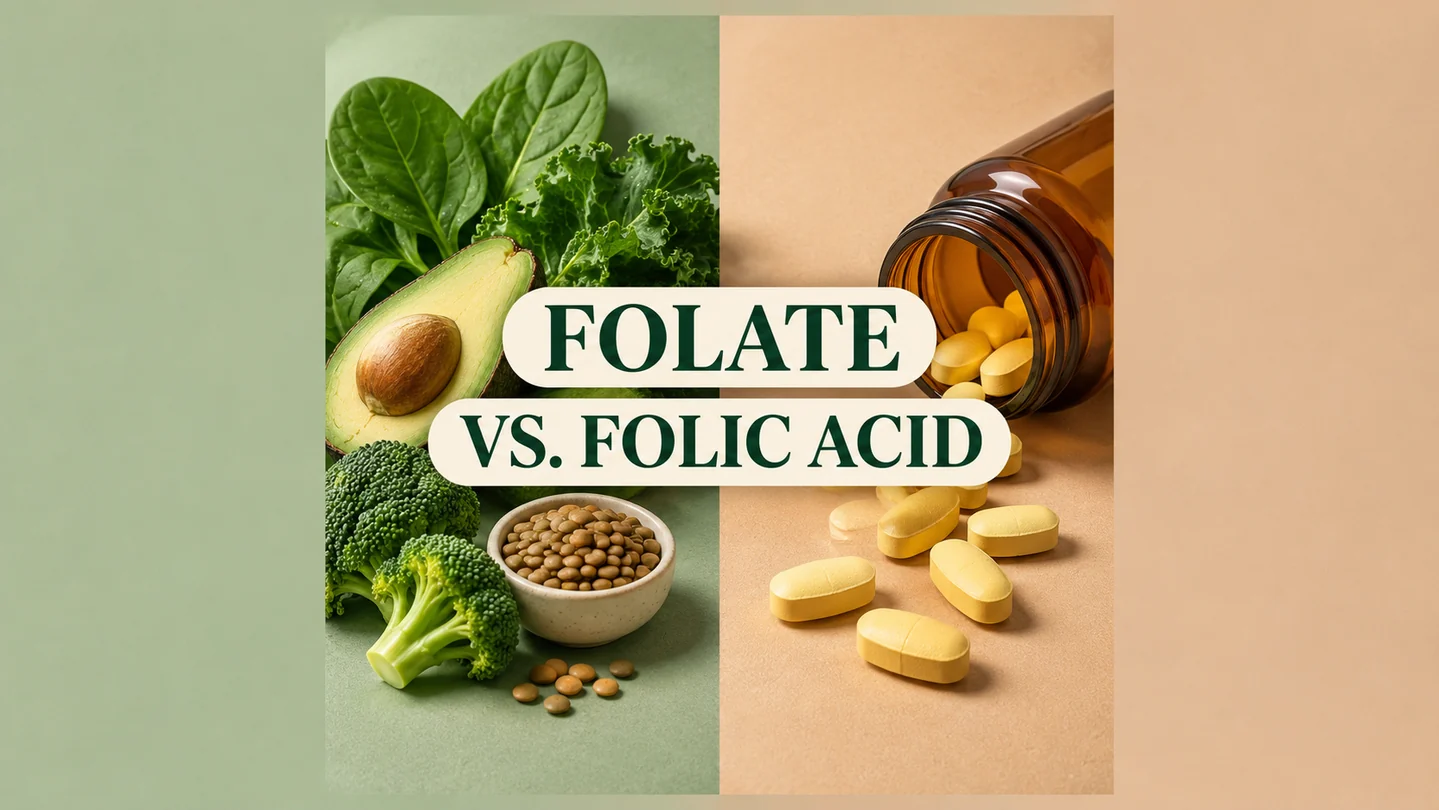
Methylfolate is often marketed as the “active” or “natural” form of folate and as a better choice than folic acid, especially for people with an MTHFR gene variant. Some of that framing has a basis: methylfolate is the main form of folate circulating in the blood, and, in our reading of ODS, it skips some of the conversion steps folic acid needs. But the claims often run ahead of the evidence, and one recommendation matters a great deal: for people who could become pregnant, folic acid remains the advised form.
This comparison relies on the NIH Office of Dietary Supplements (ODS) fact sheet for health professionals, the ODS consumer fact sheet and published research. It is general information, not medical advice.
At a glance
| Feature | Folic acid | Methylfolate (5-MTHF) |
|---|---|---|
| What it is | Synthetic, fully oxidized form | Monoglutamyl 5-methyltetrahydrofolate |
| Other names | Vitamin B9 (synthetic) | L-5-MTHF, 5-methyl-folate, L-methylfolate |
| Where used | Fortified foods and most supplements | Some supplements |
| Bioavailability | At least 85% with food | Same as or greater than folic acid |
| DFE conversion | Formally established (x1.7 with food) | Not formally established |
| Advised before pregnancy | Yes: 400 mcg/day (CDC, as reported by ODS) | Not advised instead of folic acid |
What is methylfolate?
Folate is vitamin B9. ODS explains that food folates are absorbed and then converted, with help from the enzyme dihydrofolate reductase, into methyl or formyl forms. The main form of folate in plasma is 5-MTHF, short for 5-methyltetrahydrofolate. Some supplements contain this form directly. ODS lists several names used for it: L-5-MTHF, 5-methyl-folate, L-methylfolate and methylfolate. ODS treats these as names for the same form, 5-MTHF.
ODS notes that homocysteine levels rise when the body cannot convert homocysteine to methionine because of a 5-MTHF deficiency. Our interpretation is that this is where the “pre-activated” label comes from. It describes the chemistry, but it does not by itself show that methylfolate leads to better health outcomes for most people.
You may also see folinic acid on labels. Our sources do not compare folinic acid with methylfolate, so we do not cover it here.
Absorption and labeling
ODS states that the bioavailability of 5-MTHF in supplements is the same as or greater than that of folic acid. On that basis, methylfolate is not a weaker form.
Labeling is less tidy. Folate amounts on labels are given in micrograms of dietary folate equivalents (mcg DFE), defined by ODS as 1 mcg food folate, 0.6 mcg folic acid with food or 0.5 mcg folic acid on an empty stomach. ODS notes that conversion factors between mcg and mcg DFE for 5-MTHF have not been formally established. FDA allows manufacturers to use either a factor of 1.7, to be comparable to folic acid, or their own established factor not exceeding 1.7.
Our interpretation: two methylfolate products listing the same mcg DFE might contain different amounts of 5-MTHF by weight, depending on the factor used. Our guide on how to choose a folate supplement explains how to read these labels.
One possible difference with folic acid concerns unmetabolized folic acid. ODS explains that when folic acid intake exceeds the capacity of dihydrofolate reductase, unmetabolized folic acid can appear in the blood, but whether it has any biological activity is not known. ODS adds that potential negative consequences of unmetabolized folic acid are not well understood and warrant further research. Our sources do not establish that avoiding it improves health, so treat this as an open question rather than a reason to switch.
MTHFR: what ODS actually says
MTHFR (methylenetetrahydrofolate reductase) is the enzyme that produces 5-MTHF. ODS describes a common variant in the MTHFR gene, 677C>T, that makes the enzyme less active, so people with it have a reduced ability to convert folate to 5-MTHF. According to ODS, about 25% of Hispanics, 10% of Caucasians and Asians, and 1% of African Americans are homozygous for this variant (they carry two copies).
ODS says this variant results in less available 5-MTHF and reduced methylation potential, leading to elevated homocysteine levels and an increased risk of neural tube defects. It then adds the key qualification: research on the benefits of folate supplementation for people with this variant is inconclusive, although some of them might benefit from supplementation with 5-MTHF. The ODS consumer page puts it simply: 5-MTHF supplements might be better than folic acid for some people with the MTHFR C677T variant because their bodies can use this form more easily.
That is the extent of what our sources support. Claims online that MTHFR variants cause depression, anxiety, ADHD, autism, fatigue or infertility, or that people need special “methylation protocols,” go well beyond it. If you have questions about MTHFR, talk with your doctor rather than ordering tests or high-dose products on your own.
Methylfolate and pregnancy
This is where the comparison has the clearest practical answer. ODS reports that the Centers for Disease Control and Prevention (CDC) recommends 400 mcg/day of folic acid, not 5-MTHF, for people who could become pregnant, even if they have a 677C>T MTHFR variant. ODS also states that consuming 400 mcg/day folic acid helps prevent neural tube defects even in women with this variant.
The trial evidence behind neural tube defect prevention uses folic acid. A 2015 Cochrane review by De-Regil and colleagues, covering five trials with 7,391 women, concluded that folic acid, alone or with other vitamins and minerals, prevents neural tube defects but has no clear effect on other birth defects. Methylfolate has not been shown in our sources to provide the same protection.
If your prenatal vitamin contains methylfolate, or your clinician has prescribed a specific product or dose, do not change it on your own. Ask your clinician whether it meets the folic acid recommendation for you. See folic acid in pregnancy.
What about depression?
L-methylfolate comes up often in discussions of mood. ODS reports that studies of 5-MTHF as an add-on to antidepressants suggest it might have more promise than folic acid, and that guidelines from two professional groups state 5-MTHF might be effective as an adjunct to SSRI treatment. However, one trial of 7,500 then 15,000 mcg a day found no improvement while a second trial did, a meta-analysis conclusion rested on low-quality evidence, and ODS says many of the doses used in depression studies exceed the UL and should be taken only under medical supervision. Methylfolate is not a substitute for treatment, and anyone with depression should make decisions with their prescriber.
Safety and the B12 question
ODS states that the FNB set the adult UL of 1,000 mcg a day for the synthetic forms of folate in supplements and fortified foods, based on the folate and B12 interaction, and that ULs do not apply to people taking high doses under medical supervision. Our sources do not say explicitly how the UL applies to 5-MTHF. Large amounts of folate can correct the anemia of B12 deficiency but not the nerve damage, so they might mask it, and ODS says concern has shifted toward folate possibly worsening B12-deficiency anemia and cognitive symptoms.
Much of that research involves folic acid. A 2024 review by Miller and colleagues found the evidence for excess folic acid worsening B12 deficiency mainly correlative, but enough to warrant vigilance for B12 deficiency in at-risk people, including older adults and others with low B12 intake. A 2025 review by Castillo and colleagues describes how folate and B12 work together in one-carbon metabolism and notes a recent proposal that elevated serum folate may worsen neurocognitive effects of B12 deficiency. Our sources do not show that methylfolate removes the B12 concern, so if you take high-dose folate in any form, ask about your B12 status. See folate and B12 and our vitamin B12 guide.
ODS lists interactions for folate supplements with methotrexate, antiepileptic drugs and sulfasalazine. Check with your prescriber if you take these. More in folate side effects.
Which should you choose?
For most adults who are not planning pregnancy, either form can supply folate. ODS reports that most people in the US get enough folate, and Castillo and colleagues note that folate deficiency is not common in the US because of mandatory fortification. If you could become pregnant, the folic acid recommendation applies. If a clinician has suggested methylfolate for a specific reason, follow that advice. The evidence we reviewed does not show a general health advantage for methylfolate. According to the FDA, supplement firms are responsible for evaluating the safety and labeling of their products before marketing, and FDA can take action against adulterated or misbranded products after they reach the market.
FAQ
Is methylfolate better than folic acid?
ODS says its bioavailability is the same as or greater than folic acid’s, and some people with an MTHFR variant might benefit from it, per ODS. But the neural tube defect trial evidence we reviewed is for folic acid, which is the form advised before pregnancy.
Is L-methylfolate the same as methylfolate?
ODS lists L-methylfolate, L-5-MTHF, 5-methyl-folate and methylfolate as names for the same form, 5-MTHF.
Should I get tested for MTHFR?
That is a question for your doctor. ODS reports that CDC advice to take 400 mcg folic acid before pregnancy applies whether or not you have the variant.
Can I take methylfolate during pregnancy?
Follow your prenatal clinician’s plan. ODS reports CDC recommends folic acid, not 5-MTHF, for people who could become pregnant.
Does methylfolate have an upper limit?
ODS sets the adult UL of 1,000 mcg for synthetic forms of folate from supplements and fortified foods. Our sources do not say explicitly whether or how it applies to 5-MTHF, and DFE conversion for 5-MTHF is not formally established, so ask a clinician about high doses.
Sources
- National Institutes of Health Office of Dietary Supplements. Folate: fact sheet for health professionals.
- National Institutes of Health Office of Dietary Supplements. Folate: fact sheet for consumers.
- De-Regil, et al. Effects and safety of periconceptional oral folate supplementation for preventing birth defects. Cochrane Database Syst Rev. 2015.
- Miller, et al. Excess folic acid and vitamin B12 deficiency: clinical implications? Food Nutr Bull. 2024.
- Castillo, et al. New insights into folate-vitamin B12 interactions. Annu Rev Nutr. 2025.
- U.S. Food and Drug Administration. Dietary supplements.
Last reviewed November 2026. VitaBrief is educational and is not medical advice. Talk with a doctor, registered dietitian or pharmacist before starting a supplement, especially if you are pregnant, take medication or have kidney disease.
Not medical advice. This guide is for general education. Talk to your doctor or pharmacist before taking a supplement, especially if you are pregnant or breastfeeding, take medication or have a health condition. Medical disclaimer