Comparisons
Mushroom coffee: benefits, side effects and how it compares to regular coffee
Mushroom coffee is one of the fastest-growing supplement trends. No human trials have tested the drinks themselves.
VitaBrief editorial · Last reviewed November 2026 · Sources listed below
Reader-supported. This page may contain affiliate links. If you buy through one, we may earn a commission at no extra cost to you. It never changes what we write. Affiliate disclosure

Mushroom coffee has gone from niche to mainstream in just a few years. The pitch is appealing: your usual cup, plus lion’s mane for focus, cordyceps for energy or reishi for calm, sometimes with less caffeine and fewer jitters.
The reality is more modest. We found no human trials of mushroom coffee products themselves. Any benefit would depend on the mushrooms inside and how much of them you get, and research on those mushrooms is limited, mostly small, short trials with mixed results. This guide explains what is in mushroom coffee, what the evidence on its ingredients shows, how it compares to regular coffee and what to watch for. It is general information, not medical advice.
What is mushroom coffee?
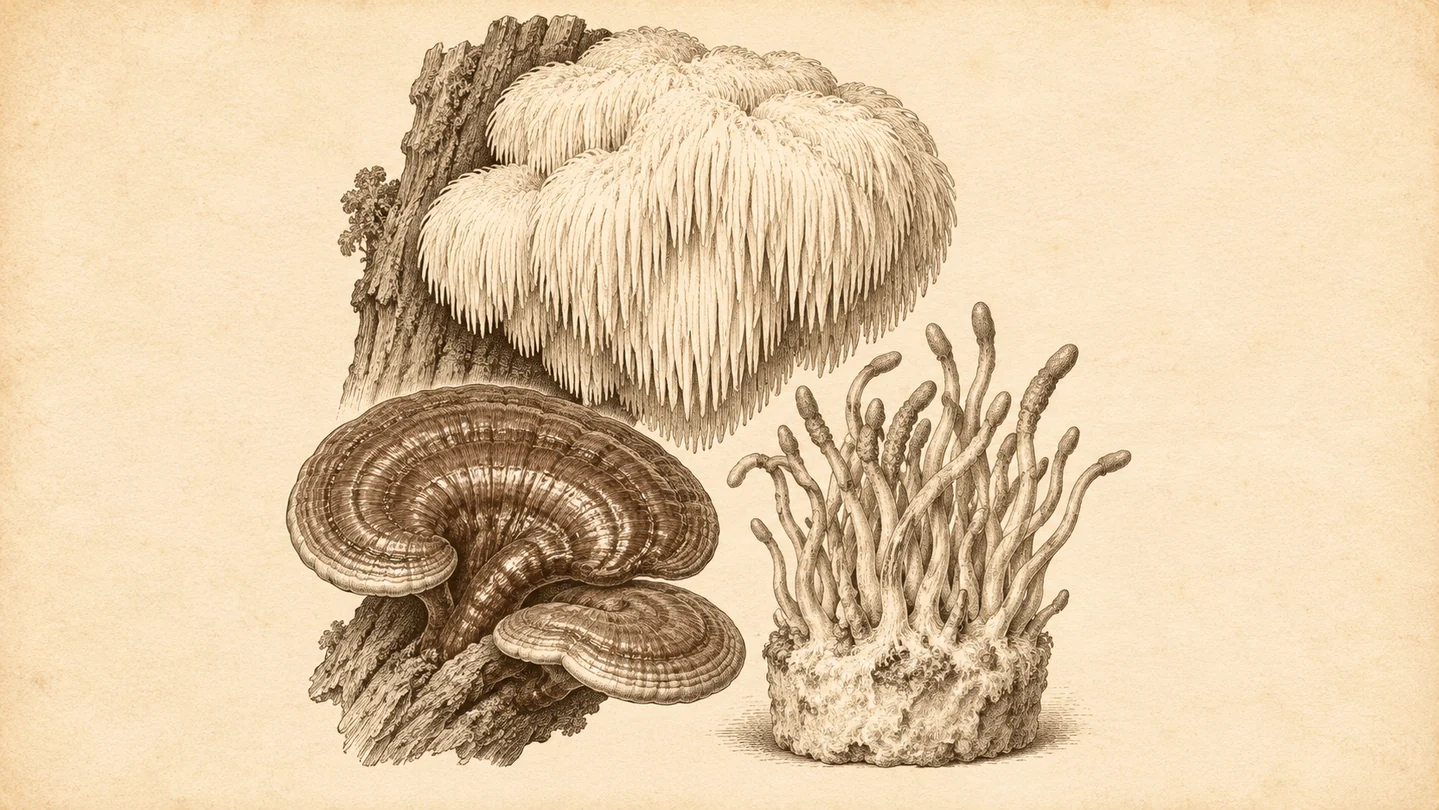
Mushroom coffee is usually ground or instant coffee blended with powdered mushroom extracts. Some products are mostly coffee with a small amount of mushroom; others replace part or all of the coffee with mushroom powder and other ingredients such as cocoa or herbs. Mushrooms named on labels include lion’s mane, cordyceps, reishi and others.
Importantly, unless a product is clearly labeled caffeine-free or decaf, mushroom coffee still contains coffee and caffeine. Check the label for whether caffeine content is stated. If the mushroom amount per serving is not listed, there is no way to compare it with the doses used in research. Some brands also sell mushroom “coffee alternatives” with no coffee at all, which are a different product even if the packaging looks similar.
Mushroom coffee vs regular coffee
| Feature | Regular coffee | Mushroom coffee |
|---|---|---|
| Main ingredients | Coffee | Coffee (usually) plus mushroom extracts and sometimes other additives |
| Caffeine | Yes, unless decaf | Yes, unless labeled otherwise; amount depends on the product |
| Human trials of the drink | Not reviewed here | None found |
| Mushroom dose | None | Often small or undisclosed (proprietary blends) |
| Regulation (US) | Food | Varies by product; for supplements, makers are responsible for safety and labeling before sale (FDA) |
| Cost | Usually lower | Usually higher |
Some products say they have less caffeine than regular coffee. That can be true if part of the coffee is replaced by other ingredients, but it depends entirely on the product. Compare the caffeine amount on the label, if one is given, with what you normally drink.
What the research says about the mushrooms inside
Since mushroom coffee itself has not been tested, the closest evidence comes from trials of the mushrooms as supplements. Those trials used specific doses, while the amount of mushroom in a coffee serving is often small or undisclosed.
Lion’s mane. In a small trial in older Japanese adults with mild cognitive impairment, Mori and colleagues (2009) found improved cognitive scores at weeks 8, 12 and 16 with lion’s mane tablets taken three times a day, but scores fell after people stopped. A pilot study in young adults by Docherty and colleagues (2023) using 1.8 g found tentatively quicker performance on one task and a trend toward less subjective stress (p = 0.051), a trend that did not reach statistical significance, alongside null and some negative findings. A study by Surendran and colleagues (2025) found a single 3 g dose of extract did not improve overall cognition or mood. See lion’s mane for memory and focus for detail.
Cordyceps. Two small exercise trials, by Chen (2010) and Hirsch (2017), found modest changes in some lab measures of exercise capacity; in the Hirsch study, the main analysis found no significant effects after one week, with VO2max improving after three weeks. These trials did not measure everyday energy. Read more in our cordyceps guide.
Reishi. The main human evidence is a Cochrane review of cancer trials, which is not relevant to a morning coffee. We found no human trials in our sources supporting reishi for calm, sleep or stress. See our reishi guide.
The takeaway: even for the mushrooms with some research, evidence is limited and mixed, and no one has shown that the small amounts in a coffee blend produce any effect.
Possible benefits, realistically
Marketing often lists benefits for focus, energy, immunity, gut health, the liver, women or men. Based on the evidence we reviewed, none of these are established for mushroom coffee. Realistic reasons people choose it include:
- Taste and ritual: some people simply like the flavor or the idea of a blended drink.
- Possibly less caffeine: if a product genuinely contains less coffee, you may consume less caffeine, which some people find easier on sleep or jitters. Switching to half-caf or decaf coffee would achieve the same thing.
- Curiosity: trying the trend is fine, as long as expectations stay modest.
If you feel calmer or more focused after switching, keep in mind that changes in caffeine intake, expectation and routine can all play a role.
Side effects and who should be careful
Searches for mushroom coffee side effects mention diarrhea, headaches, anxiety, blood pressure and the liver. There are no safety studies of mushroom coffee products in our sources, so we cannot say how common any of these are. Some general points apply:
- Caffeine: mushroom coffee usually still contains caffeine, so the usual caffeine cautions apply, including for sleep, anxiety and heart rhythm.
- Digestive upset: any new powder or blend may not agree with everyone. Stop if it causes problems.
- Liver: rare case reports describe liver injury with reishi powder (Guedikian 2023, Wanmuang 2007). Other substances were involved and causation was not proven, but if you notice yellowing of the skin or eyes or dark urine, stop and see a doctor.
- Medications: interactions between these mushrooms and medicines are not well studied. If you take blood thinners, diabetes or blood pressure medicines, antidepressants or other prescription drugs, check with a doctor or pharmacist.
- Pregnancy and breastfeeding: the safety of the mushroom ingredients has not been established.
For more on precautions, see our mushroom supplement safety guide.
How to read a mushroom coffee label
According to the FDA, supplement manufacturers and distributors are responsible for evaluating the safety and labeling of their products before marketing, and the FDA can act against adulterated or misbranded products after they reach the market. Quality and labeling therefore vary. When comparing products, check:
- Mushroom amount per serving: a “proprietary blend” without individual amounts makes it impossible to know what you are getting.
- Species and part used: the label should name each mushroom and say whether it uses fruiting body, mycelium or both.
- Extract type: whether it is a whole powder or an extract, and the extract ratio.
- Caffeine: whether the amount is stated, and whether the product contains regular coffee, decaf or none.
- Testing: independent third-party testing is a plus.
- Claims: avoid products that promise to treat or prevent any disease.
If you are mainly interested in the mushrooms, a separate supplement with a clearly stated dose may be easier to evaluate than a coffee blend. Our guide on how to choose a mushroom supplement explains the details, and the functional mushrooms guide covers the category as a whole.
Frequently asked questions
Is mushroom coffee healthier than regular coffee?
There is no evidence in our sources that it is. No human trials of mushroom coffee products were found, and mushroom doses are often small or undisclosed.
Does mushroom coffee have caffeine?
Usually yes, because most products contain coffee. Only products clearly labeled caffeine-free or decaf avoid it. Check the label for the amount.
Does mushroom coffee help focus?
This has not been tested. Small lion’s mane supplement trials found mixed results, and the amount of mushroom in a coffee serving is often small or undisclosed.
Can mushroom coffee cause side effects?
It can cause the usual caffeine effects, and any new blend may upset digestion. Rare liver case reports exist for reishi powder. Stop and see a doctor if you notice jaundice or dark urine.
Is mushroom coffee safe in pregnancy?
The safety of the mushroom ingredients in pregnancy and breastfeeding has not been established, so talk with your doctor first.
Sources
- U.S. Food and Drug Administration. Dietary supplements.
- Mori, et al. Improving effects of the mushroom Yamabushitake (Hericium erinaceus) on mild cognitive impairment: a double-blind placebo-controlled clinical trial. Phytother Res. 2009.
- Docherty, et al. The acute and chronic effects of lion’s mane mushroom supplementation on cognitive function, stress and mood in young adults: a double-blind, parallel groups, pilot study. Nutrients. 2023.
- Surendran, et al. Acute effects of a standardised extract of Hericium erinaceus (lion’s mane mushroom) on cognition and mood in healthy younger adults: a double-blind randomised placebo-controlled study. Front Nutr. 2025.
- Chen, et al. Effect of Cs-4 (Cordyceps sinensis) on exercise performance in healthy older subjects: a double-blind, placebo-controlled trial. J Altern Complement Med. 2010.
- Hirsch, et al. Cordyceps militaris improves tolerance to high-intensity exercise after acute and chronic supplementation. J Diet Suppl. 2017.
- Guedikian, et al. Ganoderma lingzhi (reishi mushroom)-induced acute liver injury in the setting of alcohol use: a case report and review of the literature. Cureus. 2023.
- Wanmuang, et al. Fatal fulminant hepatitis associated with Ganoderma lucidum (Lingzhi) mushroom powder. J Med Assoc Thai. 2007.
Last reviewed November 2026. VitaBrief is educational and is not medical advice. Talk with a doctor, registered dietitian or pharmacist before starting a supplement, especially if you are pregnant, take medication or have kidney disease.
Not medical advice. This guide is for general education. Talk to your doctor or pharmacist before taking a supplement, especially if you are pregnant or breastfeeding, take medication or have a health condition. Medical disclaimer