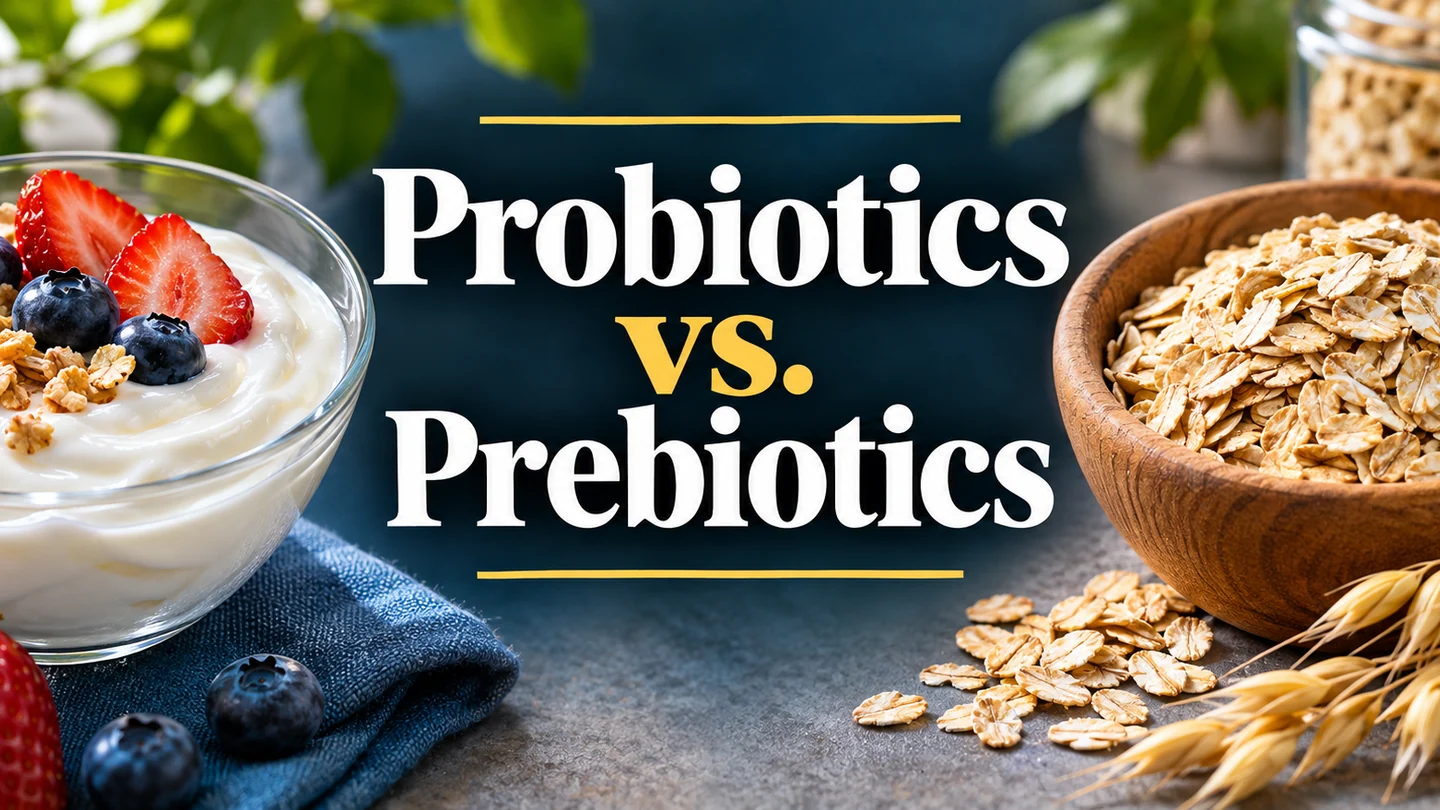
Ingredient guides
Probiotics: what they are, what the evidence shows and who should be careful
This probiotics guide explains: probiotic effects depend on the strain and the condition. Here is what they are, where the evidence is strongest and weakest, and how to use them safely.
VitaBrief editorial · Last reviewed November 2026 · Sources listed below
Reader-supported. This page may contain affiliate links. If you buy through one, we may earn a commission at no extra cost to you. It never changes what we write. Affiliate disclosure

Probiotics are one of the best-selling supplement categories in the United States, and they are also one of the most misunderstood. The word covers dozens of different microbes, sold in capsules, powders, drinks and foods, with very different amounts of research behind them. A product that helped in one trial for one problem tells you little about a different product for a different problem.
This guide explains what probiotics are, which microbes are most common, why the specific strain matters so much, and where research is strong, mixed or weak. It draws on consensus statements from the International Scientific Association for Probiotics and Prebiotics (ISAPP), systematic reviews, and consumer information from the National Center for Complementary and Integrative Health (NCCIH) and the NIH Office of Dietary Supplements (ODS). It is general information, not a substitute for advice from your own clinician.
Probiotics guide: the short answer
Probiotics guide: a practical, evidence-based guide to probiotics: the scientific definition, common genera, why strain specificity matters, where evidence is strongest and weakest, acid reflux, safety, label viability and how to choose.
What probiotics are
The definition most scientists use comes from a 2014 ISAPP expert panel: probiotics are live microorganisms that, when given in adequate amounts, confer a health benefit on the host (Hill 2014). Each part of that sentence matters. The microbes must be alive when you take them, there must be enough of them, and there must be evidence of a benefit.
By that standard, not every food with live cultures counts as a probiotic. Yogurt, kefir, sauerkraut and kimchi contain live microbes, but unless specific, characterized strains have been tested for a health effect, they are better described as fermented foods with live cultures. Our guide to probiotic foods covers the difference in more detail.
In the United States, probiotics are sold as dietary supplements, foods or ingredients, not as FDA-approved drugs. That means manufacturers do not have to prove a product works before selling it, and quality can vary, as NCCIH points out.
Common probiotic genera
Most products on the shelf draw from a handful of groups. Names are written as genus, species and strain, for example Lactobacillus reuteri DSM 17938. Note that many Lactobacillus species were reclassified into new genera in 2020, so you may see newer names such as Lacticaseibacillus or Limosilactobacillus on labels.
| Group | Type of microbe | Where you commonly see it |
|---|---|---|
| Lactobacillus and related genera | Bacteria | Yogurt, kefir, many supplements |
| Bifidobacterium | Bacteria | Supplements, some dairy products, infant formulas |
| Saccharomyces boulardii | Yeast | Supplements, often for diarrhea |
| Streptococcus thermophilus | Bacteria | Yogurt starter cultures, some blends |
| Bacillus species | Spore-forming bacteria | Some supplements and fortified foods |
Why the strain matters
If there is one idea to take away, it is that probiotic effects are strain-specific and condition-specific. A 2018 systematic review and meta-analysis led by Lynne McFarland grouped trials by strain and by disease and found that efficacy differed by both (McFarland 2018).
This is why broad claims such as “probiotics help digestion” are hard to evaluate. The useful question is narrower: has this particular strain, or this exact blend, been tested in people like me, for the problem I have? Two examples where a listed review supports a named strain are Saccharomyces boulardii in adults (2010 meta-analysis) and L. reuteri DSM 17938 for colic in breastfed infants (Sung 2018).
Where the evidence is strongest and weakest
Research quality varies widely by condition. The table below summarizes our condition articles; follow the links for details, including which strains were studied.
| Use | Evidence picture | Read more |
|---|---|---|
| Preventing antibiotic-associated diarrhea | Among the more consistent findings in meta-analyses, though results vary by strain | Probiotics and antibiotics |
| Infant colic (breastfed babies) | Supportive for one specific strain | Probiotics for kids |
| IBS symptoms | Some strains and blends may help; overall evidence is uncertain | Probiotics for IBS and bloating |
| Constipation | Modest, inconsistent effects in adults | Probiotics for constipation |
| Acute infectious diarrhea | Recent Cochrane review found little clear benefit | Probiotics for diarrhea |
| Vaginal health | Limited, mostly low-certainty evidence | Probiotics for women |
| Weight loss | Small or no meaningful effect | Probiotics for weight loss |
The strongest-looking area is antibiotic-associated diarrhea. A JAMA meta-analysis found probiotics were associated with a lower risk of diarrhea during antibiotic treatment (Hempel 2012), and Cochrane reviews reached supportive conclusions for children (Guo 2019) and for C. difficile-associated diarrhea (Goldenberg 2017). By contrast, a Cochrane review of probiotics for treating acute infectious diarrhea concluded they probably make little or no difference to how long it lasts (Collinson 2020).
Are probiotics good for you?
For a healthy adult with no specific problem, there is little evidence that a daily probiotic supplement improves overall health. NCCIH notes that while some probiotics may help with some conditions, there is not enough evidence to support many of the uses people take them for.
Diet may matter more. A small Stanford trial found that a diet high in fermented foods increased microbiome diversity and lowered several markers of inflammation over ten weeks (Wastyk 2021), and reviews describe fermented foods as having potential benefits beyond any live microbes they carry (Marco 2017). Fiber, which feeds the microbes you already have, is covered in probiotics vs. prebiotics.
Probiotics and acid reflux
Many people search for probiotics for heartburn or acid reflux (GERD). The honest answer is that evidence here is limited. None of the major reviews we rely on establish probiotics as a treatment for reflux, and we are not aware of a strain with strong, consistent support for it.
If you have frequent heartburn, the better-established steps are lifestyle measures and proven medicines discussed with a clinician. See a doctor promptly for trouble or pain when swallowing, vomiting blood, black stools, unexplained weight loss, or chest pain, which should never be assumed to be reflux.
Safety and who should be careful
For most healthy people, probiotics are well tolerated. The most common effects are temporary gas and bloating in the first days or weeks; our article on probiotic side effects covers what is normal. NCCIH notes that the risk of harmful effects is greater in people with severe illnesses or weakened immune systems.
Rare but serious infections have been reported. A systematic review of Saccharomyces bloodstream infections found cases linked to probiotic use, often in critically ill or hospitalized patients, including those with central venous catheters (2023 review). A review in people with cancer also urged caution (2014 review). In 2023 the FDA warned about probiotic products given to hospitalized preterm infants after a fatal infection.
Talk to a clinician before taking probiotics if you have a weakened immune system (for example from chemotherapy, transplant drugs or advanced HIV), a central line, a damaged heart valve, recent major surgery, or a critical illness, or before giving them to a premature infant. Pregnancy and breastfeeding are covered in a separate article.
Label viability and how to choose
Because probiotics must be alive to work, what is on the label may not match what is in the bottle. A 2021 study that cultured and identified bacteria in dietary supplements found that some products did not contain the viable species listed, or contained species that were not declared (2021 viability study).
A good label names each strain (genus, species and strain code), gives the CFU count guaranteed through the expiration date rather than at manufacture, and lists storage instructions. Third-party testing can add confidence. Probiotic supplements may count as FSA/HSA-eligible only in limited cases, so check with your plan administrator. For a step-by-step checklist, see how to choose a probiotic, and for timing, see when to take probiotics.
Frequently asked questions
Should I take a probiotic every day?
Only if you have a specific reason backed by evidence, such as during a course of antibiotics. For general health, evidence of benefit in healthy adults is weak.
Do more CFUs mean a better probiotic?
Not necessarily. The right strain at the dose used in trials matters more than a large number on the front of the bottle.
Can probiotics help acid reflux?
Evidence is limited, and probiotics are not an established reflux treatment. Speak with a clinician about frequent heartburn.
Who should not take probiotics?
People who are critically ill, severely immunocompromised, have a central line, or are caring for a preterm infant should talk to a clinician first.
Sources
- NCCIH. Probiotics: what you need to know.
- NIH Office of Dietary Supplements. Probiotics: fact sheet for health professionals.
- FDA. FDA raises concerns about probiotic products sold for use in hospitalized preterm infants. 2023.
- Hill C, et al. ISAPP consensus statement on the scope and appropriate use of the term probiotic. Nat Rev Gastroenterol Hepatol. 2014.
- McFarland LV, et al. Strain-specificity and disease-specificity of probiotic efficacy. Front Med. 2018.
- Hempel S, et al. Probiotics for the prevention and treatment of antibiotic-associated diarrhea. JAMA. 2012.
- Guo Q, et al. Probiotics for the prevention of pediatric antibiotic-associated diarrhea. Cochrane. 2019.
- Goldenberg JZ, et al. Probiotics for the prevention of Clostridium difficile-associated diarrhea. Cochrane. 2017.
- Collinson S, et al. Probiotics for treating acute infectious diarrhoea. Cochrane. 2020.
- Systematic review and meta-analysis of Saccharomyces boulardii in adult patients. World J Gastroenterol. 2010.
- Sung V, et al. Lactobacillus reuteri to treat infant colic: a meta-analysis. Pediatrics. 2018.
- Goodoory VC, et al. Efficacy of probiotics in irritable bowel syndrome. Gastroenterology. 2023.
- Dimidi E, et al. The effect of probiotics on functional constipation in adults. Am J Clin Nutr. 2014.
- Xie HY, et al. Probiotics for vulvovaginal candidiasis in non-pregnant women. Cochrane. 2017.
- Borgeraas H, et al. Effects of probiotics on body weight, body mass index, fat mass and fat percentage. Obes Rev. 2018.
- Wastyk HC, et al. Gut-microbiota-targeted diets modulate human immune status. Cell. 2021.
- Marco ML, et al. Health benefits of fermented foods: microbiota and beyond. Curr Opin Biotechnol. 2017.
- Epidemiology of Saccharomyces fungemia: a systematic review. Med Mycol. 2023.
- The efficacy and safety of probiotics in people with cancer: a systematic review. Ann Oncol. 2014.
- Evaluation of dietary supplements containing viable bacteria by cultivation/MALDI-TOF and PCR identification. Front Microbiol. 2021.
Last reviewed November 2026. VitaBrief is educational and is not medical advice. Talk with a doctor, registered dietitian or pharmacist before starting a supplement, especially if you are pregnant, take medication or have kidney disease.
Not medical advice. This guide is for general education. Talk to your doctor or pharmacist before taking a supplement, especially if you are pregnant or breastfeeding, take medication or have a health condition. Medical disclaimer