Supplement basics
When to take creatine: does timing matter?
Before or after training, morning or night, with or without food: what the research says about creatine timing.
VitaBrief editorial · Last reviewed November 2026 · Sources listed below
Reader-supported. This page may contain affiliate links. If you buy through one, we may earn a commission at no extra cost to you. It never changes what we write. Affiliate disclosure
When to Take Creatine: the short answer
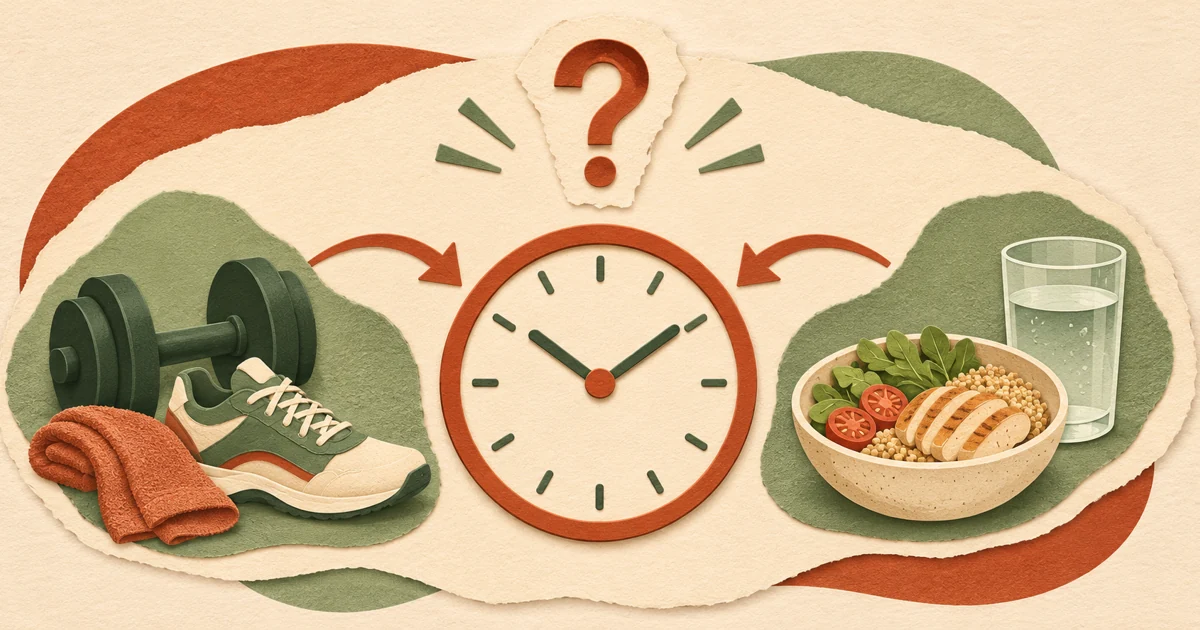
The best time to take creatine is the time you will remember every day. If you want to fine-tune it, take it around your workout with a meal or protein shake, which may give a small edge and is easier on the stomach. Take it on rest days too. Timing matters much less than taking 3 to 5 grams consistently.
Search for creatine timing and you will find strong opinions: take it before you train, take it right after, take it in the morning, never take it with coffee. The research is calmer. Creatine works by gradually filling your muscle stores, so taking it consistently matters far more than the exact hour you take it. Timing may make a small difference, and a few practical choices can make it easier to stick with. This guide draws on the International Society of Sports Nutrition (ISSN) position stand on creatine (Kreider 2017), the NIH Office of Dietary Supplements (ODS) and the timing trials that exist.
Why timing matters less than you think
Caffeine works within an hour and wears off. Creatine does not work that way. A single dose does not deliver an immediate boost in the gym. Instead, daily doses raise the creatine and phosphocreatine stored in your muscles over days to weeks. Once those stores are full, they stay full as long as you keep taking a maintenance dose. Your performance on any given day depends on how full your stores are, not on when you swallowed your last scoop.
This is why studies comparing timing find, at most, small differences. The bigger factors are taking an adequate dose (usually 3 to 5 grams of creatine monohydrate) and not skipping days. See how much creatine per day.
Before or after a workout?
The best-known study gave recreational bodybuilders 5 grams of creatine either immediately before or immediately after training for four weeks. The post-workout group gained slightly more lean mass and lost slightly more fat, but the study was small and the differences were modest (Antonio 2013). Other small studies suggest that taking creatine close to training, before or after, may work slightly better than taking it at a time far from exercise.
| Timing | Possible advantage | Evidence |
|---|---|---|
| Right after training | Exercise increases blood flow to muscle; post-workout meals can boost uptake | Small studies show a slight edge; not conclusive |
| Right before training | Convenient if mixed into a pre-workout drink | Similar results to post-workout in most comparisons |
| Any consistent time | Easiest to remember | Muscle stores fill either way |
Practical takeaway: if it is convenient, take creatine around your workout, ideally with a post-workout meal or shake. If that is not convenient, take it whenever you will remember it every day.
With food or on an empty stomach?
Taking creatine with a meal that contains carbohydrates, or carbohydrates and protein, may slightly increase how much is taken up into muscle. Insulin, which rises after eating, helps move creatine into muscle cells. Early studies used very large amounts of sugar to show this effect, more than most people want, but a normal meal likely helps a little.
Food also reduces the chance of stomach upset. If creatine bothers your stomach on its own, taking it with a meal is the simplest fix.
With protein or a protein shake?
Yes. Mixing creatine into a protein shake is convenient and may modestly support uptake. Creatine and protein do different jobs: protein provides building blocks for muscle, while creatine increases the energy available for hard sets. They work well together and do not interfere with each other.
Morning or night?
There is no clear advantage to either. Creatine is not a stimulant, so for most people it does not affect sleep. When people say creatine keeps them awake, the cause is often a pre-workout product that also contains caffeine. If you take plain creatine monohydrate and notice sleep problems, move it earlier in the day.
| Your routine | A simple option |
|---|---|
| Morning workouts | With breakfast or a post-workout shake |
| Evening workouts | With dinner after training |
| No training that day | With any meal you eat every day |
| Loading phase | Four 5 g doses spread across meals |
| Forgetful | Keep it next to your coffee maker or toothbrush |
Should you take creatine on rest days?
Yes. Rest days are when muscles recover, and the goal is to keep creatine stores full at all times. Skipping rest days slowly lowers stores. On rest days, take it with any meal.
Can you take creatine with coffee?
Some older studies suggested caffeine might blunt creatine’s performance benefits, especially during loading. More recent research is mixed, and many people take both without problems. Caffeine and creatine can each cause stomach upset in some people, so combining large doses may be uncomfortable. A moderate cup of coffee with your daily creatine is unlikely to be an issue. See the ISSN’s review of common creatine questions.
When should women take creatine?
The same rules apply: take it daily, ideally around training or with a meal. There is no evidence that women need to time creatine to their menstrual cycle. Researchers have noted that creatine stores and needs may shift across the cycle, pregnancy and menopause, which is another reason a steady daily habit works well (Smith-Ryan 2021). See creatine for women.
Timing for brain health
Research on creatine and the brain has mostly used daily doses over weeks, so consistency is again what matters. One notable experiment gave a single large dose during a night of sleep deprivation and found improvements in cognitive performance within hours (Gordji-Nejad 2024). That dose was far higher than standard and should not be copied without medical advice. See creatine and the brain.
Timing with gummies or capsules
Gummies and capsules usually contain 1 to 1.5 grams each, so a full dose may be 3 to 5 pieces. You can take them all at once or spread them across the day. The timing advice is the same. What matters is reaching your total daily dose. See gummies vs. powder.
Does creatine affect lab tests?
Creatine is not a banned substance and does not cause a positive drug test. It can raise blood creatinine slightly, which may make a kidney-function test look worse than it is. Tell your doctor you take creatine before blood work. If they need an accurate kidney reading, they may suggest pausing it for a short time first. See creatine and kidneys and MedlinePlus on the creatinine test.
Building the habit
Because consistency is what makes creatine work, the most useful timing advice is about habit, not physiology. Pair creatine with something you already do every day, like breakfast, your morning coffee or a post-workout shake. Keep the tub where you will see it. Some people pre-measure a week of doses into small containers. If you travel, single-serve packets or capsules can be easier than a tub of powder.
The bottom line
The best time to take creatine is the time you will remember every day. If you want to fine-tune it, take it around your workout with a meal or protein shake, which may give a small edge and is easier on the stomach. Take it on rest days too. Timing matters much less than taking 3 to 5 grams consistently.
Frequently asked questions
Can I take creatine right before bed?
Yes. Creatine is not a stimulant. If you notice sleep changes, try taking it earlier in the day.
Can I take creatine while fasting?
Creatine monohydrate has no calories, so it is unlikely to break a fast in the metabolic sense. Some people get stomach upset taking it without food.
Should I take creatine with juice?
You can. The carbohydrate may slightly improve uptake, but juice is not necessary. Water works fine.
Is it OK to mix creatine with pre-workout?
Many pre-workouts already contain creatine, often in small amounts. Check the label so you know your total dose, and be aware of the caffeine content.
Should I take creatine all at once or split it?
A 3 to 5 gram dose can be taken at once. Split larger doses, such as during loading, into 5 gram portions to reduce stomach upset.
Can creatine be mixed into hot drinks?
Yes. Creatine monohydrate dissolves more easily in warm liquid. Brief heating does not meaningfully break it down, but do not leave it mixed in liquid for days.
Sources
- Antonio J, Ciccone V. The effects of pre versus post workout supplementation of creatine monohydrate on body composition and strength. J Int Soc Sports Nutr. 2013;10:36.
- Kreider RB, et al. International Society of Sports Nutrition position stand: safety and efficacy of creatine supplementation in exercise, sport, and medicine. J Int Soc Sports Nutr. 2017;14:18.
- Antonio J, et al. Common questions and misconceptions about creatine supplementation: what does the scientific evidence really show? J Int Soc Sports Nutr. 2021;18(1):13.
- Smith-Ryan AE, et al. Creatine supplementation in women’s health: a lifespan perspective. Nutrients. 2021;13(3):877.
- Gordji-Nejad A, et al. Single dose creatine improves cognitive performance and induces changes in cerebral high energy phosphates during sleep deprivation. Sci Rep. 2024;14(1):4937.
- MedlinePlus. Creatinine Test.
- NIH Office of Dietary Supplements. Dietary Supplements for Exercise and Athletic Performance.
Last reviewed November 2026. VitaBrief is educational and is not medical advice. Talk with a doctor, registered dietitian or pharmacist before starting a supplement, especially if you are pregnant, take medication or have kidney disease.
Not medical advice. This guide is for general education. Talk to your doctor or pharmacist before taking a supplement, especially if you are pregnant or breastfeeding, take medication or have a health condition. Medical disclaimer