Ingredient guides
Zinc: a practical guide
What zinc does, how much you need, the best food sources, what it can and cannot do for colds, skin and hormones, and how to supplement safely.
VitaBrief editorial · Last reviewed November 2026 · Sources listed below
Reader-supported. This page may contain affiliate links. If you buy through one, we may earn a commission at no extra cost to you. It never changes what we write. Affiliate disclosure
Zinc Guide: the short answer
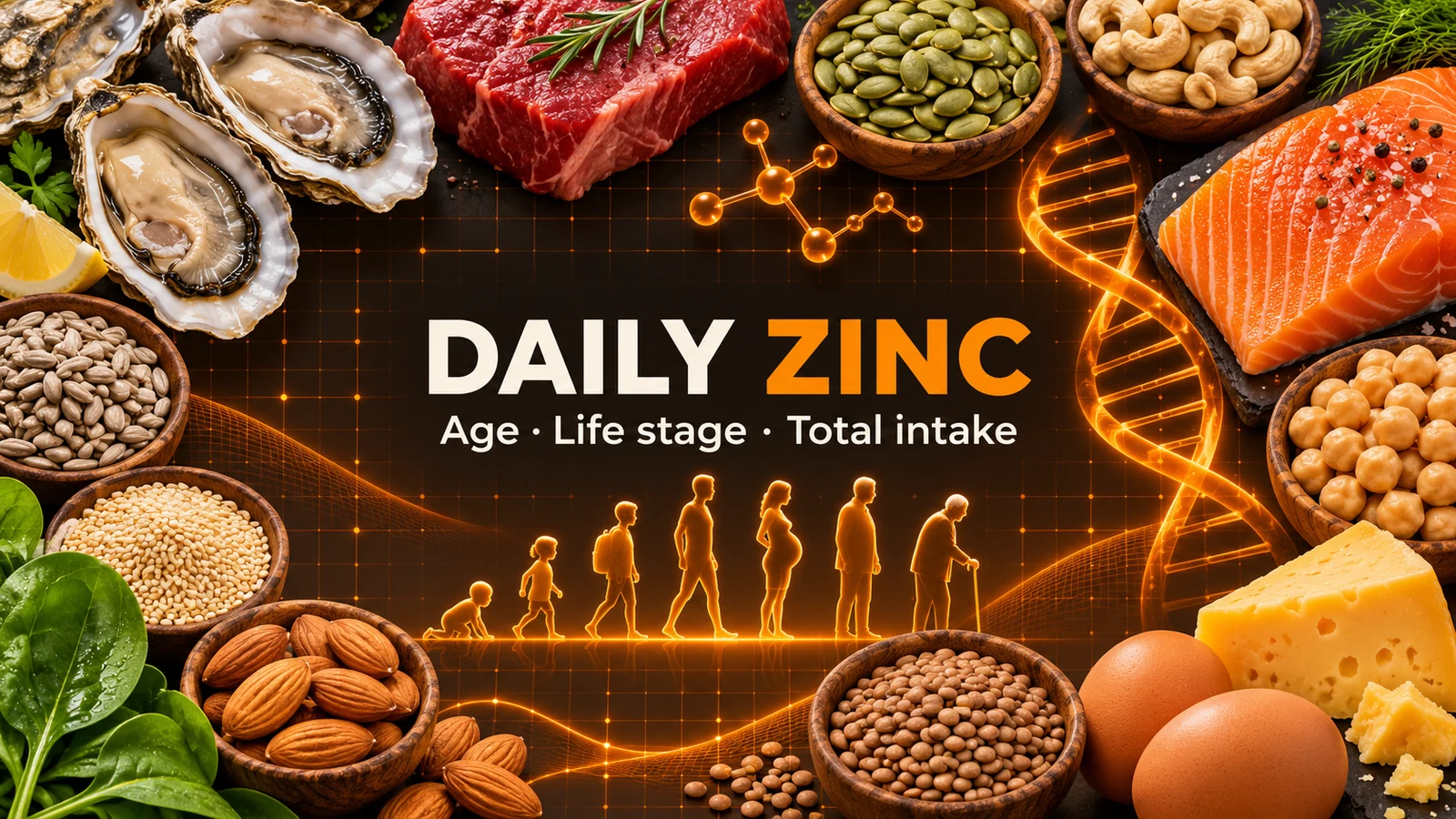
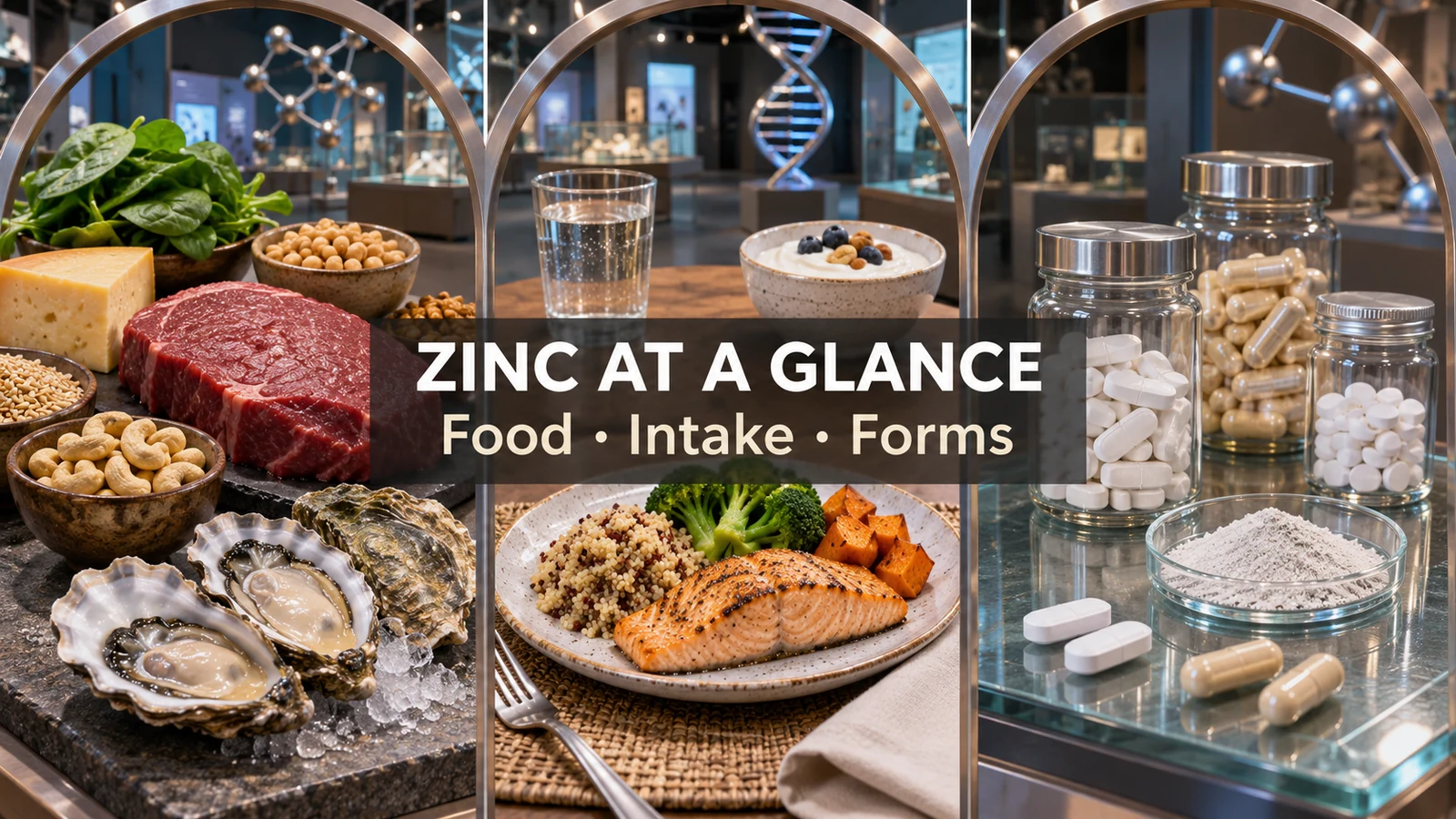
Zinc is essential for immunity, healing, growth, taste and reproduction. Most adults need 8 to 11 mg a day, easily met by meat, seafood, dairy, fortified cereals, beans and nuts. Vegetarians, people with digestive diseases, and pregnant and breastfeeding people are more likely to run low. Supplements help when intake is low; lozenges may modestly shorten colds.
Zinc has become one of the fastest-growing supplements in the US: searches for “zinc supplement” are up about 70% in five years, and Google’s autocomplete is full of questions about zinc for colds, hair, acne, testosterone and women. Zinc is an essential trace mineral, needed in small amounts every day, and deficiency does impair immunity, skin and growth.
But most people in the US get enough from food, and zinc has a narrower safety margin than many supplements: too much causes nausea and, over time, copper deficiency. This guide explains what zinc does, how much you need and when a supplement makes sense. It draws on the NIH Office of Dietary Supplements (ODS), MedlinePlus and key research, including the 2024 Cochrane review on zinc and colds (Nault 2024).
What zinc does
Zinc is involved in the activity of hundreds of enzymes and in making proteins and DNA. The body has no dedicated zinc store, so a steady daily intake matters (ODS). Its main roles include:
- Immune function: development and activity of immune cells; deficiency increases infection risk.
- Wound healing and skin: cell growth, repair and the skin barrier.
- Growth and development: especially in pregnancy, infancy, childhood and adolescence.
- Taste and smell: deficiency can dull both.
- Reproduction: sperm production and normal testosterone levels.
How much you need
| Group | Recommended daily amount | Upper limit |
|---|---|---|
| Men 19+ | 11 mg | 40 mg |
| Women 19+ | 8 mg | 40 mg |
| Pregnancy (19+) | 11 mg | 40 mg |
| Breastfeeding (19+) | 12 mg | 40 mg |
| Teens 14–18 | 11 mg (boys), 9 mg (girls) | 34 mg |
| Children 4–8 | 5 mg | 12 mg |
| Children 1–3 | 3 mg | 7 mg |
Notice how close the upper limit is to typical supplement doses: many zinc tablets contain 25 to 50 mg. See how much zinc per day.
Food sources
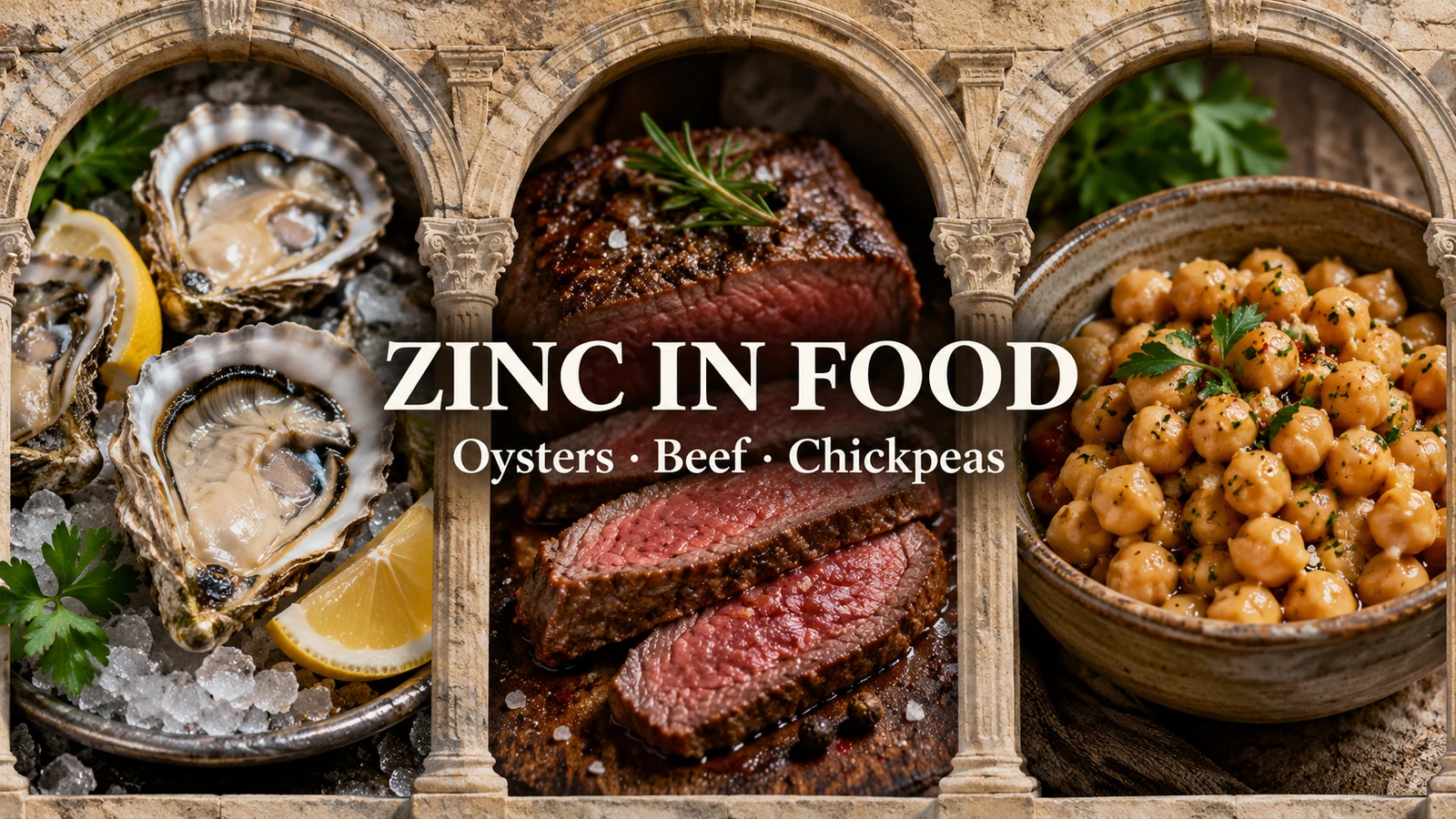
Oysters contain far more zinc per serving than any other food. Red meat, poultry, crab and lobster, and fortified breakfast cereals are major sources in US diets. Beans, nuts, seeds and whole grains contain zinc too, but phytates in these foods reduce absorption (ODS).
| Food | Approximate zinc |
|---|---|
| Oysters, cooked, 3 oz | About 28–32 mg |
| Beef, roasted, 3 oz | About 4–7 mg |
| Crab, cooked, 3 oz | About 3–6 mg |
| Fortified breakfast cereal, 1 serving | About 3 mg (varies) |
| Pork chop, 3 oz | About 3 mg |
| Pumpkin seeds, 1 oz | About 2 mg |
| Chicken, dark meat, 3 oz | About 2 mg |
| Chickpeas, ½ cup | About 1 mg |
See zinc food sources.
What the research supports
| Use | Strength of evidence | What studies show |
|---|---|---|
| Treating deficiency | Strong | Restores immunity, growth, taste and healing |
| Shortening colds (lozenges started early) | Moderate, mixed | Some trials show faster recovery; certainty is low |
| Preventing colds | Weak | Little evidence of fewer colds |
| Age-related macular degeneration (with antioxidants) | Moderate | High-dose formula slowed progression in people with intermediate disease |
| Acne | Moderate | Modest improvement; less effective than antibiotics |
| Hair loss | Weak | Helps only if deficient |
| Testosterone | Weak in well-nourished men | Raises levels mainly in deficient men |
For details, see zinc for colds, zinc for acne and skin, zinc for hair and zinc and testosterone.
Who may run low
The ODS identifies several groups at higher risk of inadequate zinc (ODS):
- Vegetarians and vegans, who may need up to 50% more zinc because of phytates in plant foods
- People with digestive diseases such as Crohn’s disease, ulcerative colitis or after some bariatric surgery
- Pregnant and breastfeeding people, whose needs rise
- Older infants who are exclusively breastfed after about 6 months
- People with alcohol use disorder
- People with sickle cell disease
- Older adults with poor diets
See zinc deficiency and zinc for women.
If you take a supplement
- Check elemental zinc. Labels list elemental zinc; 15 to 25 mg is plenty for most supplement users.
- Count all sources. Multivitamins, lozenges and fortified foods add up. Stay under 40 mg a day unless supervised.
- Form: zinc citrate, gluconate and picolinate are well absorbed; zinc oxide somewhat less so (Wegmüller 2014). See types of zinc.
- Take with food if it causes nausea.
- Look for USP or NSF certification.
Safety
Short-term high doses cause nausea, vomiting, stomach cramps and a metallic taste. Long-term intake above 40 mg a day can cause copper deficiency, leading to anemia, low white blood cell counts and nerve problems, and may reduce immune function and HDL cholesterol (ODS, Fosmire 1990). Zinc nasal sprays have been linked to permanent loss of smell. Zinc interacts with some antibiotics, penicillamine and thiazide diuretics. See zinc side effects.
Common zinc myths
| Myth | What the evidence shows |
|---|---|
| Zinc prevents colds | Little evidence it reduces how often you catch colds |
| More zinc means a stronger immune system | Excess zinc can actually impair immunity and cause copper deficiency |
| Zinc boosts testosterone in all men | Mainly raises levels in men who are deficient |
| Zinc regrows hair | Helps hair only when deficiency is the cause |
| Zinc oxide cream is the same as a zinc supplement | Zinc oxide on skin is a barrier and sunscreen; it does not supply your body’s needs |
Reading a zinc label
US Supplement Facts panels list elemental zinc in milligrams and as a percentage of the Daily Value, which is 11 mg for adults. A 50 mg tablet therefore shows 455% DV. Check the serving size (some gummies and capsules need two or three pieces), the form of zinc listed, other minerals added such as copper or magnesium, and any certification seal from USP or NSF. Multivitamins and “immune” or “hair, skin and nails” blends frequently contain zinc as well, so read every label you use and add the totals. Claims such as “supports immune health” are structure-function claims, not evidence that the product prevents or treats disease (ODS).
Quick safety checklist
- Count zinc from every product you take
- Keep daily total under 40 mg unless supervised
- Take zinc with food if it upsets your stomach
- Separate zinc from quinolone or tetracycline antibiotics
- Never use zinc nasal sprays
- Prefer USP or NSF certified products
Zinc and eye health
In the Age-Related Eye Disease Study, a high-dose supplement containing zinc (80 mg), copper and antioxidants reduced the risk of progression to advanced age-related macular degeneration in people who already had intermediate disease (AREDS 2001). It is not a preventive supplement for people with healthy eyes, and the dose is well above the upper limit, so it should be used only on an eye doctor’s advice.
The bottom line
Zinc is essential for immunity, healing, growth, taste and reproduction. Most adults need 8 to 11 mg a day, easily met by meat, seafood, dairy, fortified cereals, beans and nuts. Vegetarians, people with digestive diseases, and pregnant and breastfeeding people are more likely to run low. Supplements help when intake is low; lozenges may modestly shorten colds. Keep total intake under 40 mg a day to avoid nausea and copper deficiency.
Frequently asked questions
What are the benefits of zinc?
Zinc supports immunity, wound healing, growth, taste and smell, and reproduction. Supplements mainly help people who do not get enough.
Should I take zinc every day?
Only if your diet falls short or a clinician recommends it. Most people get enough from food.
Does zinc help you sleep?
There is not good evidence that zinc improves sleep in people with adequate levels.
Is zinc a vitamin?
No. Zinc is an essential trace mineral, although it is often included in multivitamins.
Can I take zinc with vitamin C?
Yes. See vitamin C and zinc.
Does zinc make you nauseous?
It can, especially on an empty stomach or at higher doses. Take it with food.
Does zinc help eyesight?
A high-dose formula with zinc slowed progression of intermediate age-related macular degeneration under medical guidance.
Sources
- NIH Office of Dietary Supplements. Zinc: Fact Sheet for Health Professionals.
- MedlinePlus. Zinc in diet.
- Nault D, et al. Zinc for prevention and treatment of the common cold. Cochrane Database Syst Rev. 2024;5(5):CD014914.
- Age-Related Eye Disease Study Research Group. A randomized, placebo-controlled, clinical trial of high-dose supplementation with vitamins C and E, beta carotene, and zinc for age-related macular degeneration and vision loss. Arch Ophthalmol. 2001;119(10):1417-36.
- Yee BE, et al. Serum zinc levels and efficacy of zinc treatment in acne vulgaris: a systematic review and meta-analysis. Dermatol Ther. 2020;33(6):e14252.
- Prasad AS, et al. Zinc status and serum testosterone levels of healthy adults. Nutrition. 1996;12(5):344-8.
- Wegmüller R, et al. Zinc absorption by young adults from supplemental zinc citrate is comparable with that from zinc gluconate and higher than from zinc oxide. J Nutr. 2014;144(2):132-6.
- Fosmire GJ. Zinc toxicity. Am J Clin Nutr. 1990;51(2):225-7.
Last reviewed November 2026. VitaBrief is educational and is not medical advice. Talk with a doctor, registered dietitian or pharmacist before starting a supplement, especially if you are pregnant, take medication or have kidney disease.
Not medical advice. This guide is for general education. Talk to your doctor or pharmacist before taking a supplement, especially if you are pregnant or breastfeeding, take medication or have a health condition. Medical disclaimer