Supplement basics
How much creatine should you take per day?
Daily doses, whether to load, doses for women and brain health, and how much is too much.
VitaBrief editorial · Last reviewed November 2026 · Sources listed below
Reader-supported. This page may contain affiliate links. If you buy through one, we may earn a commission at no extra cost to you. It never changes what we write. Affiliate disclosure
“How much creatine should I take?” is one of the most searched creatine questions, and the answer is simpler than supplement labels make it look. For most adults, 3 to 5 grams of creatine monohydrate a day is enough. This guide explains where that number comes from, when a loading phase makes sense, how dosing changes for body size, women and brain research, and what happens if you take more. It is based on the International Society of Sports Nutrition (ISSN) position stand (Kreider 2017), the NIH Office of Dietary Supplements (ODS) and MedlinePlus.
Creatine Dosage: the quick answer
| Goal | Typical dose | Notes |
|---|---|---|
| General use, strength training | 3–5 g/day | Full muscle stores in about 3–4 weeks |
| Faster saturation | 20 g/day (4 × 5 g) for 5–7 days, then 3–5 g/day | Full stores in about a week; more side effects |
| Larger athletes | Up to 5–10 g/day | Based on about 0.03–0.1 g/kg body weight |
| Brain research | Often 5–20 g/day | Experimental; doses vary widely |
Doses apply to creatine monohydrate, the form used in most studies. If a product uses another form, check how much actual creatine it provides per serving.
Why 3 to 5 grams works
Your body breaks down about 2 grams of creatine a day, about 1 to 2% of total stores, and replaces it through its own production and diet. On a typical diet, muscle creatine stores are only about 60 to 80% full. Taking 3 to 5 grams a day on top of normal intake gradually fills them.
The key study measured muscle creatine directly with biopsies. Men who took 20 grams a day for 6 days raised their muscle creatine by about 20%. Men who took 3 grams a day reached a similar level after 28 days. Once stores were full, 2 grams a day was enough to keep them there (Hultman 1996). Once your muscles are saturated, extra creatine is not stored. It is converted to creatinine and excreted in urine.
Should you do a loading phase?
Loading means taking a higher dose for about a week to fill muscle stores quickly. The standard protocol is about 0.3 g per kg of body weight per day, roughly 20 grams for a 70 kg (154 lb) person, split into four doses of 5 grams.
| Loading | No loading | |
|---|---|---|
| Time to full stores | 5–7 days | About 3–4 weeks |
| Daily amount | About 20 g, then 3–5 g | 3–5 g from day one |
| Early water weight | More noticeable (often 1–2 kg) | Gradual, often less noticeable |
| Stomach upset | More likely | Less likely |
| End result after a month | Same | Same |
Loading is optional. It makes sense if you want benefits quickly, for example before a sports season. If you are in no hurry, a steady daily dose avoids most of the stomach upset and bloating people associate with creatine. Large single doses are the main cause: one study of athletes found diarrhea was more common after a single 10 g dose than after two 5 g doses (Ostojic 2008).
Dosing by body weight
Larger people have more muscle and therefore more room to store creatine. The ISSN suggests a maintenance dose of about 0.03 g per kg per day for most people and notes that larger athletes may need 5 to 10 g a day to keep stores full.
| Body weight | Loading (0.3 g/kg, 5–7 days) | Maintenance |
|---|---|---|
| 50 kg (110 lb) | 15 g/day | 3 g/day |
| 70 kg (154 lb) | 21 g/day | 3–5 g/day |
| 90 kg (198 lb) | 27 g/day | 5 g/day |
| 110 kg (243 lb) | 33 g/day | 5–10 g/day |
For most people, 5 grams a day covers it without any calculation.
How much creatine should a woman take?
The same 3 to 5 grams a day applies to women. Women tend to have lower baseline creatine stores than men, partly because of diet and muscle mass, so they may see a meaningful increase even from modest doses. Research in women uses similar doses, and some studies in older women have used about 0.1 g/kg/day alongside strength training (Smith-Ryan 2021). Smaller women can do well with 3 grams. Our creatine for women guide covers menopause and life stages.
Dose for brain health
The brain appears to take up creatine more slowly than muscle, and some researchers think it may need higher doses. Brain studies have used a wide range: a daily 5 g dose, 20 g a day for shorter periods, and in one sleep-deprivation study a single dose of about 0.35 g/kg, roughly 25 grams for a 70 kg adult (Gordji-Nejad 2024). There is no established “brain dose.” Taking higher amounts for cognitive effects should be discussed with a clinician. See creatine and the brain.
How much creatine is too much?
There is no official upper limit for creatine. The ISSN reports that studies have used up to 30 grams a day for up to 5 years without clear evidence of harm in healthy people (Kreider 2017). That does not mean more is better. Once muscles are saturated, extra creatine is simply excreted, and high doses increase the chance of:
- Stomach cramps, nausea or diarrhea
- Bloating and water weight
- A higher creatinine result on blood tests, which can be mistaken for reduced kidney function (see creatine and kidneys)
People with kidney disease, those taking drugs that affect the kidneys and people who are pregnant or breastfeeding should not take creatine unless a clinician recommends it. MedlinePlus advises caution in these groups because evidence is limited.
How to take it
- Take it every day, including rest days. Consistency matters more than timing.
- Mix it with any drink. Water, juice, a smoothie or coffee all work. Creatine monohydrate dissolves better in warm liquid.
- Taking it with a meal may help. Carbohydrates and protein raise insulin, which may modestly increase creatine uptake into muscle, and food can reduce stomach upset.
- Split large doses. If you load or take more than 5 grams, split it into 5 gram portions across the day.
- Drink normally. There is no evidence creatine causes dehydration, but normal fluid intake is still important when training.
For more on timing, see when to take creatine.
Measuring your dose
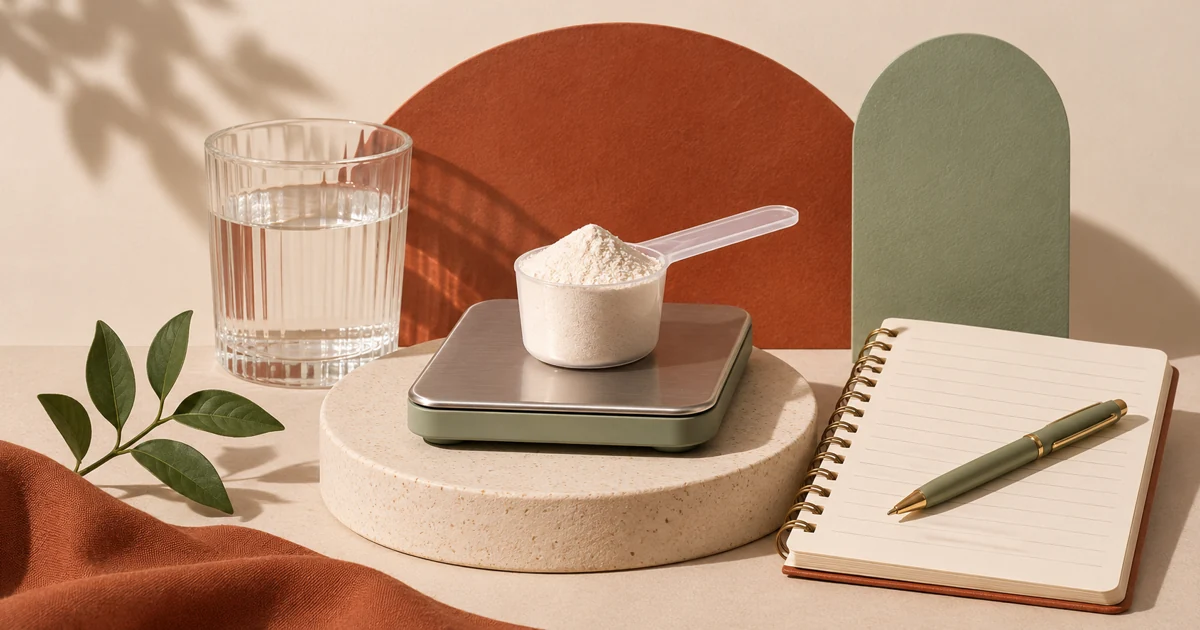
A level teaspoon of creatine monohydrate powder weighs roughly 3 to 5 grams depending on the product and how finely it is milled. Use the scoop that comes with the product, or weigh it once on a kitchen scale to check. Gummies and capsules usually contain 1 to 1.5 grams each, so check how many pieces make a full dose. See gummies vs. powder.
The bottom line
Take 3 to 5 grams of creatine monohydrate every day. Loading with about 20 grams a day for a week fills muscle stores faster but is optional and more likely to cause stomach upset. Larger athletes may use up to 10 grams. There is no benefit to taking more once muscles are saturated, and people with kidney conditions should talk to a clinician first.
Frequently asked questions
Is 10 grams of creatine a day too much?
For a healthy adult it is unlikely to be harmful, but most people do not need it. Larger athletes sometimes use 5 to 10 grams. If you take 10 grams, split it into two doses to reduce stomach upset.
Is 3 grams enough?
Yes, for many people. Three grams a day fully saturated muscle stores in about 4 weeks in a key study. Smaller adults and many women do well with 3 grams.
What if I miss a day?
Just take your normal dose the next day. Muscle stores fall slowly, over weeks, so one missed dose has little effect. There is no need to double up.
How long until creatine works?
With loading, muscle stores are full in about a week. Without loading, it takes about 3 to 4 weeks. Strength improvements build over the following weeks of training.
Do I need more creatine if I am vegetarian?
Not necessarily more, but vegetarians start with lower stores and may notice a larger effect from the standard 3 to 5 grams.
Does creatine expire?
Creatine monohydrate powder is very stable when kept dry and is often fine past its date. Liquid creatine products break down faster. Discard powder that has clumped from moisture or smells off.
Sources
- Kreider RB, et al. International Society of Sports Nutrition position stand: safety and efficacy of creatine supplementation in exercise, sport, and medicine. J Int Soc Sports Nutr. 2017;14:18.
- Hultman E, et al. Muscle creatine loading in men. J Appl Physiol. 1996;81(1):232-7.
- Antonio J, et al. Common questions and misconceptions about creatine supplementation: what does the scientific evidence really show? J Int Soc Sports Nutr. 2021;18(1):13.
- Ostojic SM, Ahmetovic Z. Gastrointestinal distress after creatine supplementation in athletes: are side effects dose dependent? Res Sports Med. 2008;16(1):15-22.
- Smith-Ryan AE, et al. Creatine supplementation in women’s health: a lifespan perspective. Nutrients. 2021;13(3):877.
- Gordji-Nejad A, et al. Single dose creatine improves cognitive performance and induces changes in cerebral high energy phosphates during sleep deprivation. Sci Rep. 2024;14(1):4937.
- NIH Office of Dietary Supplements. Dietary Supplements for Exercise and Athletic Performance.
- MedlinePlus. Creatine.
Last reviewed November 2026. VitaBrief is educational and is not medical advice. Talk with a doctor, registered dietitian or pharmacist before starting a supplement, especially if you are pregnant, take medication or have kidney disease.
Not medical advice. This guide is for general education. Talk to your doctor or pharmacist before taking a supplement, especially if you are pregnant or breastfeeding, take medication or have a health condition. Medical disclaimer