Comparisons
B-complex vs. B12: which do you need, and can you take both?
A B-complex contains B12 plus seven other B vitamins. A B12 supplement contains one. Here is how to decide between them, and what to check before combining them.
VitaBrief editorial · Last reviewed November 2026 · Sources listed below
Reader-supported. This page may contain affiliate links. If you buy through one, we may earn a commission at no extra cost to you. It never changes what we write. Affiliate disclosure
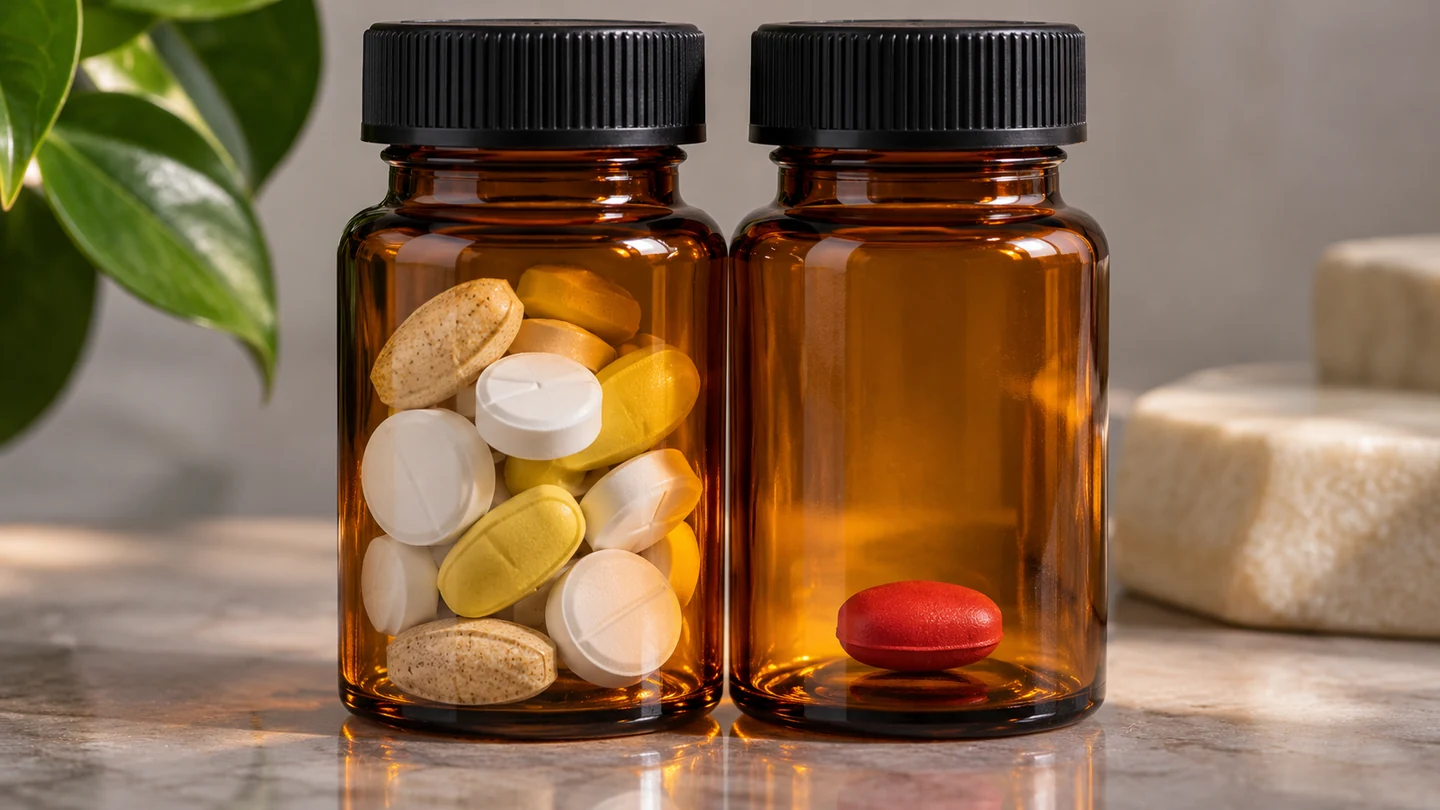
“Should I take a B-complex or just B12?” is one of the most common questions about B vitamins, and the two are often treated as rivals. They are not really alternatives in the same sense. Vitamin B12 is one of the eight B vitamins, and most B-complex products already include it. The real question is whether you need one specific nutrient or a broad mix, and whether doubling up adds anything except more of the vitamins that need watching, especially vitamin B6.
This comparison draws on fact sheets from the NIH Office of Dietary Supplements (ODS) and published research. For B12 itself, including who is at risk of low levels, see our full vitamin B12 guide. This article is general information, not medical advice.
B-complex vs. B12: the short answer
B-complex vs. B12: what each contains, who might choose a single B12, what the research on B vitamins and mood shows, B6 safety, and whether to take both together.
At a glance
| Feature | B-complex | Vitamin B12 supplement |
|---|---|---|
| What it contains | Several B vitamins, often all eight, including B12 | B12 only (sometimes with folate) |
| Typical reason to choose it | Broad coverage of the B group | A specific B12 need identified with a clinician |
| Contains vitamin B6? | Usually, sometimes at high doses | Usually not |
| Contains niacin? | Usually; nicotinic acid can cause flushing | Usually not |
| Mood and stress research | Meta-analysis found a small benefit for stress (Young 2019) | One trial found only trends for anxiety (Field 2022) |
| Main safety point | Total B6 must stay under the 100 mg/day adult UL | Check with your clinician; see our B12 guide |
What each supplement is
A B-complex is a supplement that combines several B vitamins in one tablet or capsule. The full group is thiamin (B1), riboflavin (B2), niacin (B3), pantothenic acid (B5), vitamin B6, biotin (B7), folate (B9) and vitamin B12. ODS fact sheets note that thiamin, riboflavin, niacin and B6 are each sold in multivitamin/mineral supplements, in B-complex supplements and on their own (ODS Thiamin; ODS Riboflavin).
A B12 supplement focuses on one nutrient. B12 has its own roles in the body and its own risk groups. Who is at risk, which tests are used and what forms exist are covered in our vitamin B12 guide; the sources for this cluster do not include a B12 fact sheet, so we keep B12 specifics there.
Why the B vitamins are linked
B vitamins often travel together, both in food and in deficiency. ODS notes that isolated vitamin B6 deficiency is uncommon and that inadequate B6 status is usually associated with low levels of other B-complex vitamins, such as vitamin B12 and folic acid (ODS Vitamin B6). That is part of the logic behind a B-complex: when someone’s diet is poor, it is often poor in several B vitamins at once.
The flip side is that a specific, single shortfall calls for a targeted answer. If a blood test points to low B12 alone, a broad B-complex may not be the most direct option, and it adds other vitamins you may not need. Folate and B12 also work closely together; our folate guide explains why clinicians often consider the two at the same time.
ODS also describes trials that tested B6, B12 and folic acid together to lower homocysteine, an amino acid in the blood that scientists hypothesized might link these vitamins to heart disease risk. The combinations did lower homocysteine, but most large trials did not show fewer cardiovascular events, and a review of 14 trials found insufficient evidence of an effect on cognitive function (ODS Vitamin B6). So neither a B-complex nor a B12-plus-B6 combination should be taken in the hope of protecting the heart or memory.
What the research compares
None of the studies in VitaBrief’s source list compare a B-complex directly with B12. The closest evidence comes from research on mood and stress.
A 2019 meta-analysis pooled randomized trials that gave at least three B vitamins daily for at least four weeks. Supplementation benefited stress (standardized mean difference 0.23, a small effect), but the benefit for depressive symptoms did not reach significance and there was no effect on anxiety (Young 2019).
A 2022 double-blind study in young adults is the one source that tested B12 and B6 separately. A month of high-dose B6 reduced self-reported anxiety, while high-dose B12 produced only trends toward changes in anxiety and visual processing (Field 2022). That is a single study with high doses, and it does not show that B12 is useless or that B6 treats anxiety.
A third trial gave 215 working men aged 30 to 55 a high-dose B-complex with vitamin C and minerals for 33 days. The group reported better stress, mental health and vigour ratings than the placebo group (Kennedy 2010). Because the product contained much more than B vitamins, the result cannot be pinned on any single ingredient. For more, see B-complex for stress and B-complex for energy.
None of these studies shows that a B-complex or B12 is a treatment for anxiety, depression or fatigue. Persistent low mood or tiredness deserves a medical evaluation rather than a supplement experiment.
The safety difference: B6 and niacin
The biggest practical difference between the two is not B12. It is what else comes along in a B-complex.
- Vitamin B6. ODS reports that 1 to 6 g of pyridoxine a day for 12 to 40 months can cause severe, progressive sensory neuropathy with ataxia, and that several reports show neuropathy at doses below 500 mg/day. The adult upper limit is 100 mg/day, lower for children. ODS also notes that a 2023 European Food Safety Authority (EFSA) opinion set an upper limit of 12 mg/day for all adults (ODS Vitamin B6). Seven adults in a classic case report developed ataxia and severe sensory problems from high daily pyridoxine; all improved after stopping (Schaumburg 1983).
- Niacin. ODS says supplements with 30 mg or more of nicotinic acid can cause red, burning, tingling, itchy skin, plus headache, rash and dizziness. The adult upper limit from supplements is 35 mg/day (ODS Niacin).
A plain B12 supplement usually avoids both issues. If you only need B12, choosing a B-complex means taking on B6 and niacin for no clear reason. Whatever you take, add up the B6 from every product, and stop and see a doctor if you develop tingling or numbness. Our B-complex side effects article covers the details.
Can you take a B-complex and B12 together?
Many people do, often because a clinician has recommended extra B12 and they already take a B-complex. The sources for this article do not identify a specific problem with combining them, but a few points are worth checking first:
- Check for duplication. Read both labels. If your B-complex already contains a substantial amount of B12, the extra product may be unnecessary. Ask whoever recommended it.
- Watch the other ingredients. Some B12 products include folate or B6. Count those toward your daily totals, especially B6.
- Ask about medicines. ODS lists interactions between B6 and cycloserine, certain antiepileptic drugs (including valproic acid, carbamazepine and phenytoin) and theophylline, and notes that 200 mg/day of pyridoxine may lower phenytoin and phenobarbital levels (ODS Vitamin B6). ODS also says high-dose nicotinic acid can raise blood sugar and interfere with diabetes medicines (ODS Niacin). If you take any medication, ask a pharmacist or doctor.
How to decide
| Your situation | A reasonable starting point |
|---|---|
| A clinician found low B12 or recommended B12 | Follow their advice on form and dose; a single B12 product is the direct route |
| Restricted or limited diet, no specific diagnosis | Ask about a multivitamin or a modest B-complex; see B-complex vs. multivitamin |
| Hoping for more energy or less stress | Evidence is modest; see a doctor for persistent fatigue or low mood |
| Already take several supplements | Total your B6 first and stay well under 100 mg/day |
| Pregnant, on medication or with a chronic condition | Ask your doctor or pharmacist before choosing either |
Whichever you choose, the FDA notes that manufacturers and distributors are responsible for evaluating the safety and labeling of their products before marketing, and the FDA can act against adulterated or misbranded products after they reach the market. Our guide on how to choose a B-complex supplement explains what to look for on a label.
Frequently asked questions
Does a B-complex contain B12?
Many do, since B12 is one of the eight B vitamins. Amounts vary, so check the Supplement Facts label.
Is B12 or B-complex better for energy?
Neither is proven to boost energy in people without a deficiency. One trial of a high-dose B-complex with vitamin C and minerals found better vigour ratings. Persistent tiredness needs a doctor’s assessment.
Can I take B12 and a B-complex on the same day?
The sources reviewed do not flag a problem, but check both labels for duplication and add up any B6. Ask your clinician if you take medication.
Is B12 safer than a B-complex?
A plain B12 product avoids the B6 and niacin found in many B-complex supplements, which are the ingredients with known upper limits.
Which is better for anxiety?
Neither treats anxiety. A meta-analysis found no effect of B vitamins on anxiety, and one trial found only trends for B12.
Sources
- Office of Dietary Supplements, NIH. Vitamin B6: fact sheet for health professionals.
- Office of Dietary Supplements, NIH. Niacin: fact sheet for consumers.
- Young, et al. A systematic review and meta-analysis of B vitamin supplementation on depressive symptoms, anxiety, and stress: effects on healthy and ‘at-risk’ individuals. Nutrients. 2019.
- Field, et al. High-dose vitamin B6 supplementation reduces anxiety and strengthens visual surround suppression. Hum Psychopharmacol. 2022.
- Office of Dietary Supplements, NIH. Thiamin: fact sheet for consumers.
- Office of Dietary Supplements, NIH. Riboflavin: fact sheet for consumers.
- Kennedy, et al. Effects of high-dose B vitamin complex with vitamin C and minerals on subjective mood and performance in healthy males. Psychopharmacology (Berl). 2010.
- Schaumburg, et al. Sensory neuropathy from pyridoxine abuse. A new megavitamin syndrome. N Engl J Med. 1983.
- U.S. Food and Drug Administration. Dietary supplements.
Last reviewed November 2026. VitaBrief is educational and is not medical advice. Talk with a doctor, registered dietitian or pharmacist before starting a supplement, especially if you are pregnant, take medication or have kidney disease.
Not medical advice. This guide is for general education. Talk to your doctor or pharmacist before taking a supplement, especially if you are pregnant or breastfeeding, take medication or have a health condition. Medical disclaimer