Ingredient guides
Fish oil and blood pressure
Omega-3s lower blood pressure a little, about 2 to 3 points at the doses studied. Here is who benefits most, how it compares with other steps, and what to watch for.
VitaBrief editorial · Last reviewed November 2026 · Sources listed below
Reader-supported. This page may contain affiliate links. If you buy through one, we may earn a commission at no extra cost to you. It never changes what we write. Affiliate disclosure
Fish Oil and Blood Pressure: the short answer
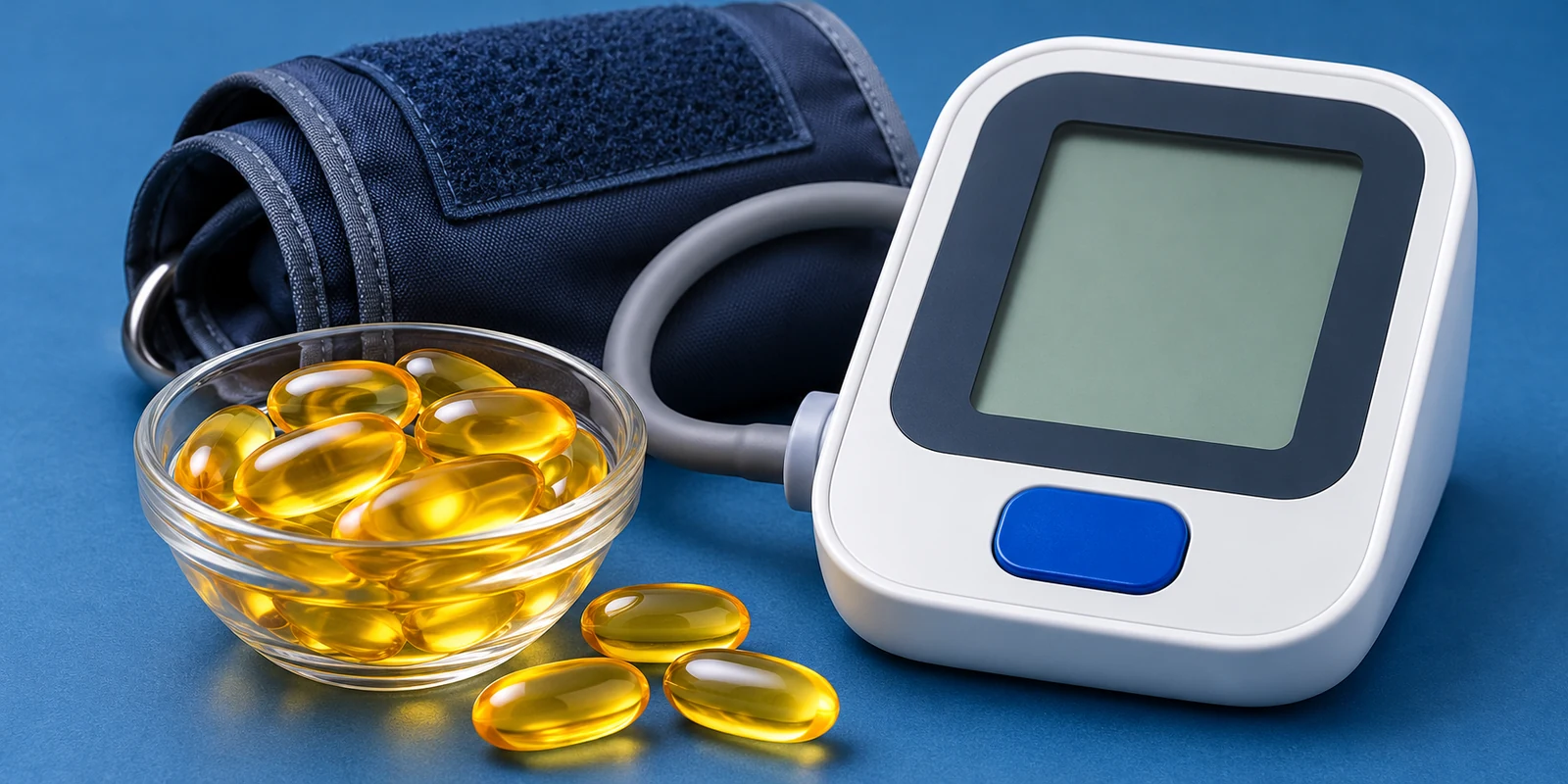
EPA and DHA lower blood pressure modestly, about 2–3 mm Hg at 2–3 g/day. Effects are larger in people with high blood pressure and in older adults. Medicines, the DASH diet, salt reduction, weight loss and exercise each lower blood pressure more. Doses that affect blood pressure are high; discuss AFib and bleeding risks with a clinician.
“Does fish oil lower blood pressure?” and “omega-3 and blood pressure” are common searches, especially from people trying to avoid or reduce blood pressure medicine. Research shows that EPA and DHA do lower blood pressure, but modestly. The effect is larger in people who already have high blood pressure and seems to plateau around 2 to 3 grams a day. This guide reviews the meta-analyses and puts the size of the effect in context, using trials indexed in PubMed and guidance from MedlinePlus.
Why omega-3s might lower blood pressure
EPA and DHA are incorporated into the cells lining blood vessels. Lab and human studies suggest they help vessels relax by increasing nitric oxide, reduce arterial stiffness and slightly slow heart rate. They also influence signaling molecules that affect blood vessel tone. These are small effects individually, which fits the modest drop seen in trials.
What the meta-analyses show
A 2014 meta-analysis of 70 randomized trials found that EPA plus DHA lowered systolic blood pressure by about 1.5 mm Hg and diastolic by about 1 mm Hg overall. In people with untreated high blood pressure, the drop was larger, about 4.5 mm Hg systolic and 3 mm Hg diastolic (Miller 2014).
A 2022 dose-response meta-analysis of 71 trials with nearly 5,000 people found that the best range was 2 to 3 grams a day of combined EPA and DHA, which lowered systolic pressure by about 2.6 mm Hg and diastolic by about 1.6 to 1.8 mm Hg. Effects were stronger and increased more steadily with dose in people with high blood pressure, high blood lipids and in older adults (Zhang 2022).
| Group or dose | Systolic change | Diastolic change | Source |
|---|---|---|---|
| All participants | About -1.5 mm Hg | About -1 mm Hg | Miller 2014 |
| Untreated high blood pressure | About -4.5 mm Hg | About -3 mm Hg | Miller 2014 |
| 2 g/day EPA+DHA | -2.6 mm Hg | -1.6 mm Hg | Zhang 2022 |
| 3 g/day EPA+DHA | -2.6 mm Hg | -1.8 mm Hg | Zhang 2022 |
| Above 3 g/day, high-risk groups | Possibly additional lowering | Possibly additional lowering | Zhang 2022 |
Putting the numbers in context
A 2 to 4 point drop is real but modest. For comparison, typical effects of other approaches are larger:
| Approach | Typical systolic reduction |
|---|---|
| Blood pressure medicine (one drug) | About 8–10 mm Hg or more |
| DASH eating pattern | About 8–11 mm Hg in people with hypertension |
| Weight loss | About 1 mm Hg per kg (2.2 lb) lost |
| Reducing sodium | About 5–6 mm Hg in people with hypertension |
| Regular aerobic exercise | About 5–8 mm Hg |
| Limiting alcohol | About 4 mm Hg |
| Omega-3s, 2–3 g/day | About 2–4 mm Hg |
Across a population, even small reductions can lower stroke and heart disease risk. For an individual with high blood pressure, fish oil is at best an add-on, not a replacement for proven treatments.
Who benefits most
- People with untreated or mild high blood pressure.
- Older adults.
- People with high triglycerides or cholesterol, who may also benefit from the triglyceride-lowering effect. See fish oil and cholesterol.
- People who eat little fish.
People with normal blood pressure see only very small changes.
How much to take
The studied range is 2 to 3 grams a day of combined EPA and DHA. That is far more than a single standard capsule: about 7 to 10 standard 1,000 mg fish oil capsules, or 3 to 4 concentrated capsules. The FDA considers up to 5 grams a day of EPA+DHA from supplements safe, but at these doses the risk of atrial fibrillation rises (Gencer 2021), and you should talk to a clinician first. See how much omega-3 per day.
Taking fish oil with blood pressure medicine
Fish oil may add slightly to the effect of blood pressure medicines. That is rarely a problem, but people who are prone to low blood pressure or dizziness should monitor their readings. Fish oil is often combined with other heart medicines, including aspirin and blood thinners, so a clinician or pharmacist should review the full list. High-dose omega-3s may slightly increase bleeding with anticoagulants. See fish oil side effects.
Fish oil compared with other “blood pressure” supplements
| Supplement | Typical effect in trials | Caution |
|---|---|---|
| Omega-3 (EPA+DHA) | About 2–4 mm Hg at 2–3 g/day | AFib risk at higher doses |
| Magnesium | Small reductions, about 2 mm Hg | Diarrhea; kidney disease |
| Potassium (food first) | Reductions in people with hypertension | Dangerous with kidney disease or some medicines |
Measuring the effect at home
If you and your clinician decide to try fish oil, measure your blood pressure at home before starting. Use a validated upper-arm cuff, sit quietly for five minutes, and take two readings morning and evening for a week to get a baseline. Repeat after 8 to 12 weeks. A small change of 2 to 3 points can easily be hidden by normal day-to-day variation, so averages matter more than single readings.
Fish, the DASH diet and blood pressure
The DASH eating pattern, which emphasizes vegetables, fruits, whole grains, low-fat dairy, legumes, nuts, poultry and fish while limiting sodium, red meat and sweets, is one of the most effective dietary approaches for lowering blood pressure, according to MedlinePlus. Eating fish two or more times a week fits naturally into DASH and also provides EPA and DHA. Combining DASH with sodium reduction lowers blood pressure more than either alone. For most people, this pattern is a better first step than adding high-dose fish oil.
If you already follow a healthy pattern and your blood pressure is still above target, the next step is usually a conversation with your clinician about medicine, not a higher supplement dose. Fish oil can be discussed as an add-on, particularly if you also have high triglycerides.
| Step | Practical example |
|---|---|
| Swap one red meat meal for fish | Salmon or sardines twice a week |
| Cut sodium | Cook at home more; check labels and aim for under 2,300 mg a day |
| Add potassium-rich foods | Beans, potatoes, bananas, leafy greens (unless told to limit potassium) |
| Move most days | About 150 minutes of brisk walking a week |
How to read blood pressure studies
Blood pressure trials of fish oil vary in who they enroll, how long they last and what dose they use, which explains why individual studies disagree. Short trials of a few weeks can miss slower effects, and trials in people with normal blood pressure have little room to show a drop. The dose-response meta-analysis helps by pooling 71 trials and modeling the effect across doses (Zhang 2022). Its finding that benefits level off around 2 to 3 grams a day for most people, but may continue to rise in high-risk groups, is a useful guide. Even so, these are averages: some people will see larger drops and others none.
The bottom line
- EPA and DHA lower blood pressure modestly, about 2–3 mm Hg at 2–3 g/day.
- Effects are larger in people with high blood pressure and in older adults.
- Medicines, the DASH diet, salt reduction, weight loss and exercise each lower blood pressure more.
- Doses that affect blood pressure are high; discuss AFib and bleeding risks with a clinician.
Frequently asked questions
Does fish oil lower blood pressure quickly?
Trials measured effects over weeks to months, not days.
Can fish oil replace blood pressure medicine?
No. The effect is too small. Never stop medicine without your clinician.
Is eating fish as good as fish oil for blood pressure?
Fish is part of heart-healthy patterns such as DASH, which lowers blood pressure more than supplements alone.
Does krill oil lower blood pressure?
It has not been well studied for blood pressure, and provides less EPA+DHA per capsule.
Can fish oil cause low blood pressure?
It is unlikely alone, but may add to medicines. Monitor if you feel dizzy.
Does flaxseed lower blood pressure?
Some trials suggest ground flaxseed may lower it a little, but evidence is less extensive than for EPA and DHA.
How much fish oil should I take for high blood pressure?
Studies used 2 to 3 g a day of EPA plus DHA. Discuss this dose with your clinician because of atrial fibrillation and bleeding risks.
Sources
- Miller PE, et al. Long-chain omega-3 fatty acids eicosapentaenoic acid and docosahexaenoic acid and blood pressure: a meta-analysis of randomized controlled trials. Am J Hypertens. 2014;27(7):885-896.
- Zhang X, et al. Omega-3 polyunsaturated fatty acids intake and blood pressure: a dose-response meta-analysis of randomized controlled trials. J Am Heart Assoc. 2022;11(11):e025071.
- Gencer B, et al. Effect of long-term marine omega-3 fatty acids supplementation on the risk of atrial fibrillation. Circulation. 2021;144(25):1981-1990.
- MedlinePlus. High blood pressure.
- NIH Office of Dietary Supplements. Omega-3 Fatty Acids: Fact Sheet for Health Professionals.
Last reviewed November 2026. VitaBrief is educational and is not medical advice. Talk with a doctor, registered dietitian or pharmacist before starting a supplement, especially if you are pregnant, take medication or have kidney disease.
Not medical advice. This guide is for general education. Talk to your doctor or pharmacist before taking a supplement, especially if you are pregnant or breastfeeding, take medication or have a health condition. Medical disclaimer