Supplement basics
How to choose a fish oil supplement
A step-by-step checklist: EPA and DHA per serving, form, freshness, third-party testing, source and allergens, capsule size, cost per gram and when to take it.
VitaBrief editorial · Last reviewed November 2026 · Sources listed below
Reader-supported. This page may contain affiliate links. If you buy through one, we may earn a commission at no extra cost to you. It never changes what we write. Affiliate disclosure

How to Choose a Fish Oil Supplement: the short answer
Choose by milligrams of EPA plus DHA per serving, not “fish oil. ”. Look for third-party testing, ideally including freshness. Pick a source that fits your diet, allergies and pregnancy status. Compare cost per gram of EPA plus DHA; fish oil is usually best value. Take with meals, store properly, and discard rancid capsules.
“Best omega-3 supplement,” “best fish oil” and “best omega-3 for women” are among the most searched omega-3 phrases. There is no single best product, but there are clear ways to tell a good one from a poor one. Testing has found that many fish oils contain less EPA and DHA than their labels claim, and that many are oxidized (Albert 2015). Because the FDA does not approve supplements before they are sold, this checklist helps you judge products yourself, using research indexed in PubMed, the NIH Office of Dietary Supplements (ODS) and the NIH Dietary Supplement Label Database.
Step 1: Know your goal and dose
| Goal | EPA + DHA per day | Product notes |
|---|---|---|
| General health, little fish in diet | 250–500 mg | Standard fish oil or algae oil |
| Pregnancy and breastfeeding | At least 200–300 mg DHA | DHA-rich fish or algae oil; never cod liver oil |
| Depression (add-on, with clinician) | About 1 g, 60%+ EPA | EPA-rich product |
| High triglycerides | About 4 g (prescription) | Ask about prescription products |
| Vegan or fish allergy | 250–500 mg | Algae oil |
Step 2: Read EPA and DHA, not “fish oil”
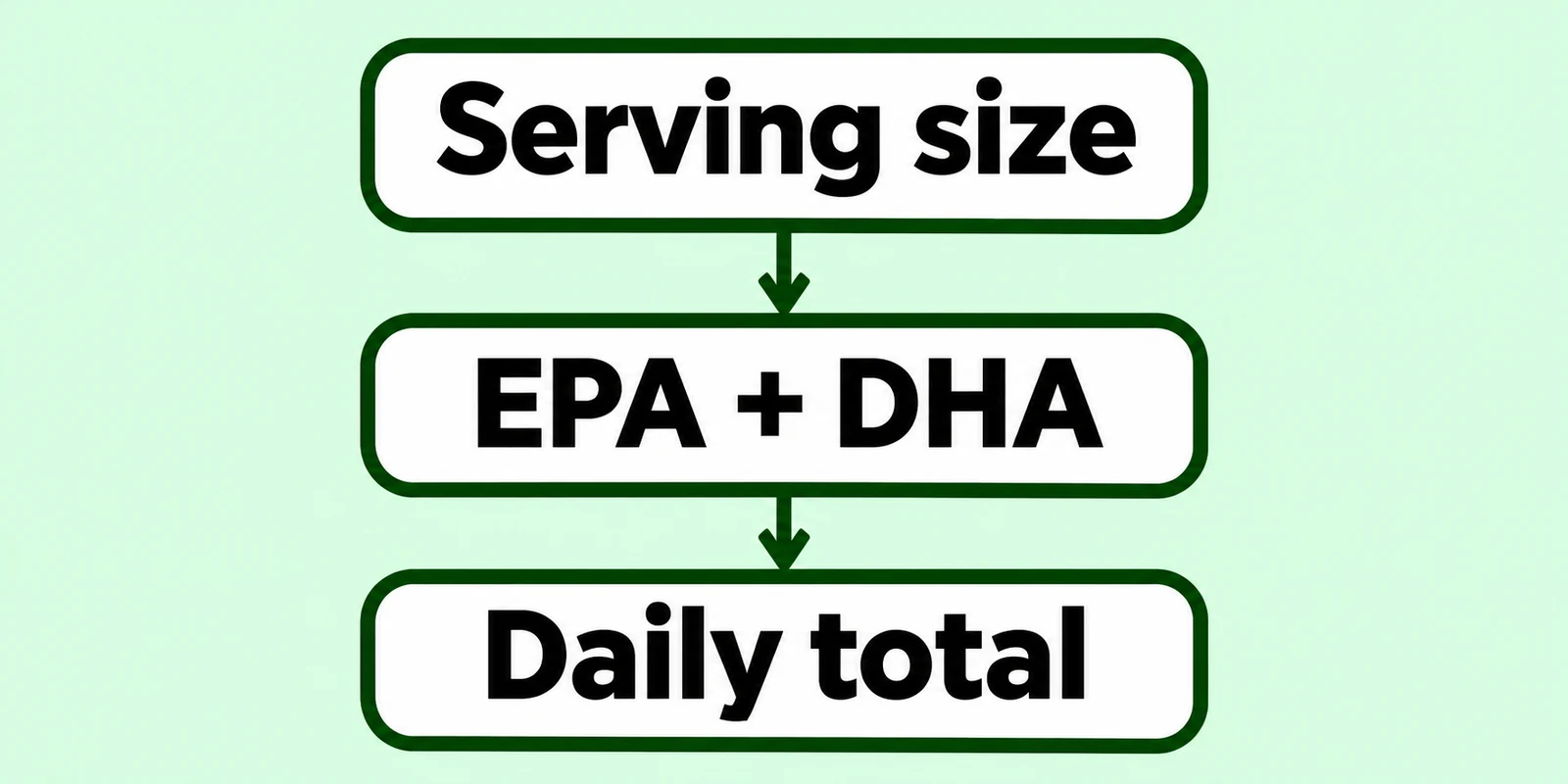
The front of the bottle usually says “1,000 mg fish oil” or “omega-3 1,200 mg.” Neither tells you how much EPA and DHA you get. Turn to the Supplement Facts panel, find EPA and DHA per serving, add them, and check how many capsules make a serving.
| Label example | EPA | DHA | EPA + DHA | Concentration |
|---|---|---|---|---|
| Standard: 1,000 mg fish oil per capsule | 180 mg | 120 mg | 300 mg | 30% |
| Concentrated: 1,000 mg per capsule | 400 mg | 300 mg | 700 mg | 70% |
| “Triple strength”: 2 capsules per serving | 650 mg | 450 mg | 1,100 mg per 2 capsules | About 55% |
Higher concentration means fewer or smaller capsules, which many people find easier to take.
Step 3: Check freshness
Omega-3s oxidize easily. Oxidized oil smells and tastes rancid, and some researchers worry it may be less effective. A study of fish oil products found 83 percent exceeded a recommended oxidation marker and only 8 percent met all international recommendations. Price, country of origin and best-before date did not predict quality (Albert 2015). A review noted that the health effects of oxidized fish oil remain uncertain (Cameron-Smith 2015).
- Break open a capsule: fresh oil smells mildly of the sea, not sharply fishy or rancid.
- Look for added antioxidants such as vitamin E (tocopherols) or rosemary extract.
- Avoid strongly flavored products that may mask rancidity.
- Choose products whose testing includes oxidation markers (peroxide value, anisidine value, TOTOX).
Step 4: Look for third-party testing
Independent certification checks label accuracy and contaminants, and some programs check oxidation.
| Program | What it checks |
|---|---|
| USP Verified | Identity, potency, purity, manufacturing practices |
| NSF (Contents Certified, Certified for Sport) | Label claims, contaminants; Sport adds banned-substance screening |
| ConsumerLab | Independent purchase and testing, including freshness (subscription) |
Step 5: Choose the form
Fish oil comes as natural triglycerides, ethyl esters or re-esterified triglycerides. Over two weeks, re-esterified triglycerides raised blood omega-3s more than natural fish oil, while ethyl esters raised them less (Dyerberg 2010). Taking any form with a fat-containing meal improves absorption and narrows differences. The total EPA plus DHA dose matters more than the form. See fish oil vs. krill oil vs. algae oil.
Step 6: Match source to your needs
- Fish oil (anchovy, sardine, mackerel): best value per gram.
- Algae oil: vegan, good for fish allergy; often DHA-rich.
- Krill oil: small capsules but low EPA+DHA per capsule; avoid with shellfish allergy.
- Cod liver oil: includes vitamins A and D; avoid in pregnancy and count vitamin A.
- Omega-3-6-9 blends: generally unnecessary; dilute the omega-3.
Step 7: Compare cost per gram of EPA + DHA
Divide the price by the total grams of EPA plus DHA in the bottle. For example, a $20 bottle of 120 capsules with 300 mg EPA+DHA each contains 36 grams, or about $0.56 per gram. A $35 bottle of 60 concentrated capsules with 700 mg each contains 42 grams, or about $0.83 per gram. Krill oil often costs several times more per gram.
Capsules, liquids and gummies
| Format | Pros | Cons |
|---|---|---|
| Softgels | Convenient, wide range | Large size; fishy burps |
| Enteric-coated softgels | Fewer fishy burps | Slightly costlier |
| Liquid oil | High dose per spoon; good for those who cannot swallow pills | Must refrigerate after opening; oxidizes faster |
| Gummies | Easy to take | Very low EPA+DHA; added sugar |
| Emulsions | Mix into drinks | Often costlier per gram |
Label red flags
- No EPA and DHA amounts listed.
- Claims to treat or cure heart disease, arthritis, ADHD or depression (illegal for supplements).
- Long proprietary blends with herbs you do not need.
- Very low prices for “high potency” claims.
- Cod liver oil marketed for pregnancy.
Storage and timing
Store fish oil in a cool, dark place, and refrigerate liquids after opening. Take it with a meal that contains some fat to improve absorption and reduce burps. Morning or evening does not matter; consistency does. Fish oil can be taken with vitamin D, magnesium and multivitamins. If you take blood thinners, discuss doses with your clinician first. See fish oil side effects.
Choosing for special situations
| Situation | What to look for |
|---|---|
| Pregnancy | DHA at least 200–300 mg; fish or algae oil; no cod liver oil |
| Vegan or vegetarian | Algae oil; check for EPA if wanted |
| Fish or shellfish allergy | Algae oil; avoid krill |
| Trouble swallowing pills | Liquid oil, small concentrated softgels or emulsions |
| On blood thinners | Keep dose modest; discuss with prescriber |
| Competitive athlete | NSF Certified for Sport |
| Kosher or halal | Certified products; note gelatin capsule source |
| Children | Pediatrician advice; avoid cod liver oil; prefer food |
Capsule shells are often made from gelatin, usually from cows or pigs, which matters for some religious and vegetarian diets. Many algae oils use plant-based capsules. Check the “other ingredients” list.
When a prescription product makes more sense
If your goal is to lower high triglycerides, particularly levels of 500 mg/dL or more, ask your clinician about prescription omega-3s. They are FDA-approved, consistently dosed at about 4 grams a day, and often covered by insurance. The American Heart Association advisory noted that supplements are not a substitute for prescription products for this purpose (Skulas-Ray 2019). See fish oil and cholesterol.
Quick buying checklist
Before you buy, run through these questions. How many milligrams of EPA plus DHA does one serving provide, and how many capsules is a serving? Is the product certified by USP, NSF or tested by an independent lab, and can you confirm that on the certifier’s website? Does the label list an antioxidant such as tocopherols, and does the oil smell fresh when you open a capsule? Is the source right for your diet, allergies and pregnancy status? What is the cost per gram of EPA plus DHA? Does it avoid unnecessary extras such as omega-6 and omega-9 blends or herbs? A product that passes these questions is a reasonable choice, whatever the brand.
The bottom line
- Choose by milligrams of EPA plus DHA per serving, not “fish oil.”
- Look for third-party testing, ideally including freshness.
- Pick a source that fits your diet, allergies and pregnancy status.
- Compare cost per gram of EPA plus DHA; fish oil is usually best value.
- Take with meals, store properly, and discard rancid capsules.
Frequently asked questions
What is the best omega-3 supplement for women?
The same quality rules apply. During pregnancy, choose a DHA-rich fish or algae oil and avoid cod liver oil.
Are expensive fish oils better?
Not necessarily. Price did not predict freshness or label accuracy in testing.
Should fish oil be refrigerated?
Liquids should be refrigerated after opening. Capsules can be stored cool and dry; refrigeration is fine.
How do I stop fishy burps?
Take with meals, try enteric-coated or frozen capsules, and choose fresh products.
Does fish oil expire?
Yes. Check the date, and discard capsules that smell rancid even before then.
Is wild-caught fish oil better?
Source species and testing matter more than “wild” labels.
Sources
- Albert BB, et al. Fish oil supplements in New Zealand are highly oxidised and do not meet label content of n-3 PUFA. Sci Rep. 2015;5:7928.
- Cameron-Smith D, et al. Fishing for answers: is oxidation of fish oil supplements a problem? J Nutr Sci. 2015;4:e36.
- Dyerberg J, et al. Bioavailability of marine n-3 fatty acid formulations. Prostaglandins Leukot Essent Fatty Acids. 2010;83(3):137-141.
- NIH Office of Dietary Supplements. Omega-3 Fatty Acids: Fact Sheet for Health Professionals.
- NIH Office of Dietary Supplements. Dietary Supplement Label Database.
- U.S. Food and Drug Administration. Dietary supplements.
- USP. USP Verified dietary supplements.
- NSF. NSF Certified for Sport.
Last reviewed November 2026. VitaBrief is educational and is not medical advice. Talk with a doctor, registered dietitian or pharmacist before starting a supplement, especially if you are pregnant, take medication or have kidney disease.
Not medical advice. This guide is for general education. Talk to your doctor or pharmacist before taking a supplement, especially if you are pregnant or breastfeeding, take medication or have a health condition. Medical disclaimer