Comparisons
Methylcobalamin vs. cyanocobalamin
The four forms of B12 on supplement labels, what the comparison studies show, and what the cyanide question really means.
VitaBrief editorial · Last reviewed November 2026 · Sources listed below
Reader-supported. This page may contain affiliate links. If you buy through one, we may earn a commission at no extra cost to you. It never changes what we write. Affiliate disclosure

Methylcobalamin vs cyanocobalamin: the short answer
In the methylcobalamin vs cyanocobalamin debate, both forms are converted to the same core molecule inside cells, and the NIH Office of Dietary Supplements says supplement forms are not known to differ in absorption. Cyanocobalamin is the best-studied and cheapest; its cyanide content is trivial. Methylcobalamin is a reasonable alternative but not proven superior.
Walk down a supplement aisle and you will see B12 sold as cyanocobalamin, methylcobalamin, and sometimes adenosylcobalamin or hydroxocobalamin. Methylcobalamin products often cost more and are marketed as “active,” “natural” or “better absorbed.” This comparison uses the NIH Office of Dietary Supplements (ODS) and published reviews to explain how the forms actually differ.
The four forms at a glance
All forms of B12 share the same core structure, a cobalt atom surrounded by a ring. They differ only in the small group attached to the cobalt.
| Form | Attached group | Where you see it | Notes |
|---|---|---|---|
| Cyanocobalamin | Cyanide | Most supplements, fortified foods, some injections | Synthetic, very stable, inexpensive, best studied |
| Methylcobalamin | Methyl | “Active” supplements, lozenges | One of two active coenzyme forms in the body; less stable to light |
| Adenosylcobalamin | Adenosyl | Some premium blends | The other active coenzyme form; main storage form in tissues |
| Hydroxocobalamin | Hydroxyl | Injections (standard in the UK and Europe) | Made by bacteria; retained longer after injection |
How the body handles each form
This is the key point most marketing skips: once inside cells, all forms are stripped down to the core cobalamin and then rebuilt into whichever active form the cell needs, methylcobalamin in the cytoplasm or adenosylcobalamin in mitochondria. So taking methylcobalamin does not deliver methylcobalamin directly to where it is used. The cell processes it first, just as it processes cyanocobalamin.
The ODS summarizes the evidence: forms of B12 in supplements are not known to differ in absorption or bioavailability, though there are some differences in how much is retained and how much is excreted.
What comparison studies show
Direct head-to-head trials in humans are surprisingly limited. A 2017 review of the comparative bioavailability of the four forms concluded that each form has potential advantages, but that the evidence does not show one form is clearly superior for general supplementation (Paul 2017).
| Question | Cyanocobalamin | Methylcobalamin |
|---|---|---|
| Absorption from the gut | Similar | Similar |
| Retention in body | Some studies show slightly more urinary loss | Some studies suggest slightly better tissue retention |
| Stability on the shelf | Very stable | Sensitive to light |
| Amount of research | Extensive, including deficiency treatment trials | Smaller; many studies in Japan on neuropathy |
| Cost | Lower | Usually higher |
| Used in large treatment trials | Yes (e.g., oral vs. injection trials) | Rarely |
The oral-versus-injection trials pooled in a Cochrane review mostly used cyanocobalamin and showed that 1,000 to 2,000 mcg a day corrects deficiency (Wang 2018). That is strong practical evidence that the common form works.
The cyanide question
The word “cyano” worries people. The cyanide group in cyanocobalamin is tiny. A 1,000 mcg tablet releases on the order of 20 micrograms of cyanide, far below the amount consumed from foods such as almonds, lima beans, cassava and apple seeds, and far below levels the body cannot detoxify. The body handles small amounts of cyanide routinely.
There is one narrow exception. People with certain rare conditions, such as Leber hereditary optic neuropathy, and some people with advanced kidney disease and heavy smoking exposure, may be advised to avoid cyanocobalamin. For them, hydroxocobalamin or methylcobalamin is preferred. For everyone else, the cyanide content is not a meaningful concern.
What about MTHFR gene variants?
Many websites claim that people with MTHFR gene variants cannot use cyanocobalamin and must take methylcobalamin. MTHFR is an enzyme in the folate pathway, not the B12 pathway. Common variants can modestly raise homocysteine, mostly when folate intake is low. None of the sources we reviewed, including the ODS fact sheet, recommend a particular B12 form based on MTHFR status. If you have been told you have an MTHFR variant, the more relevant step is adequate folate intake; see B12 and folate.
Hydroxocobalamin and injections
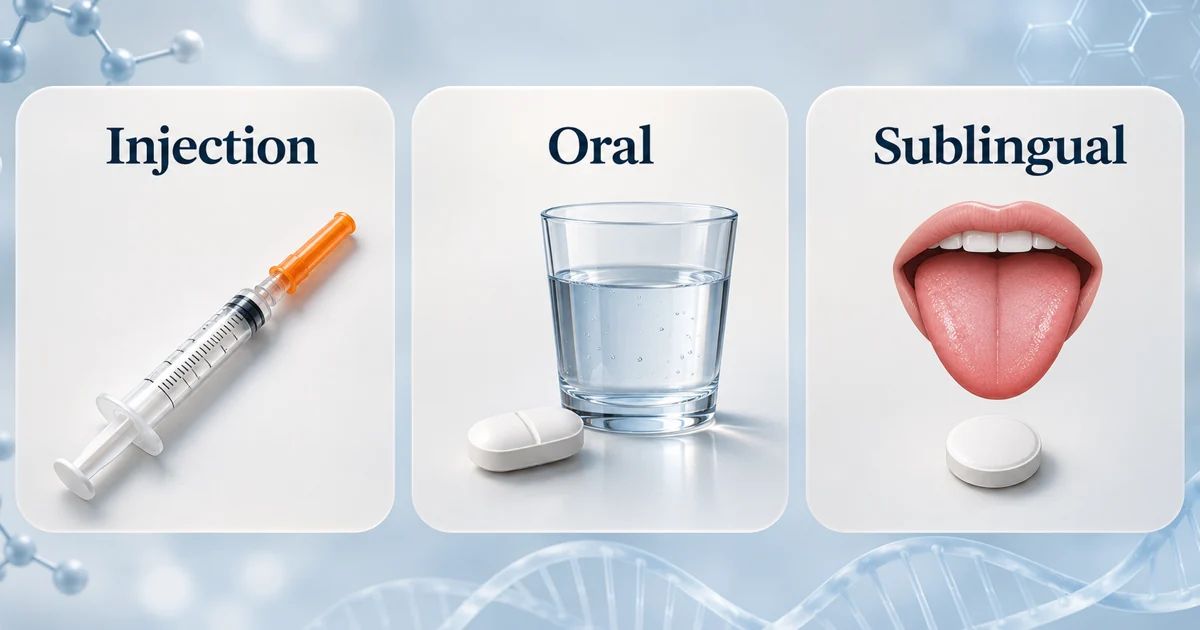
For injections, hydroxocobalamin has a practical edge: it binds more tightly to blood proteins and is retained longer, so injections can be spaced further apart. It is the standard injectable form in the UK. In the U.S., cyanocobalamin injections are more common, usually given more frequently. Both work. See B12 injections vs. oral.
Is methylcobalamin better for nerves?
Methylcobalamin is often recommended for neuropathy, partly because it has been used as a prescription treatment in Japan. Some small trials suggest benefit for nerve symptoms, but they rarely compare it directly with cyanocobalamin at similar doses. A trial in people with diabetic neuropathy taking metformin used methylcobalamin and found improvements in nerve function and symptoms (Didangelos 2021), but it compared B12 with placebo, not with another form. See B12 and neuropathy.
Which should you choose?
| Your situation | Reasonable choice |
|---|---|
| General supplement, vegan or older adult | Cyanocobalamin: proven, stable, inexpensive |
| Prefer “active” form and willing to pay more | Methylcobalamin is fine; store away from light |
| Heavy smoker, kidney disease or Leber optic neuropathy | Ask about hydroxocobalamin or methylcobalamin |
| Prescribed injections | Whatever form your clinician uses |
| Combination “methyl + adenosyl” product | Fine, but no proven extra benefit |
How to check what you are buying
The form is listed on the Supplement Facts panel, usually in parentheses after “Vitamin B12,” for example “Vitamin B12 (as methylcobalamin) 1,000 mcg.” If no form is listed, it is almost always cyanocobalamin. A few practical checks matter more than the form itself.
| Check | Why it matters |
|---|---|
| Amount per serving and serving size | Gummies and lozenges sometimes need two pieces for the listed dose |
| Third-party seal (USP, NSF or similar) | Confirms the product contains what the label says |
| Other ingredients | “Energy” blends may add caffeine, herbs or high-dose B6 |
| Vegan status of the capsule | Some capsules use gelatin |
| Price per 1,000 mcg | Methylcobalamin often costs several times more for the same amount |
Price is a fair consideration. Because the ODS reports no proven absorption advantage, paying a premium for methylcobalamin buys preference, not proven benefit. If cost would make you skip doses, the cheaper, well-studied form is the better choice. Consistency is what corrects and prevents deficiency.
Storage matters most for methylcobalamin. Keep any B12 product in its original container, away from heat, humidity and sunlight, and check the expiration date. Liquid and lozenge forms are generally more sensitive than tablets.
The bottom line
- All B12 forms are converted to the same core molecule inside cells, then rebuilt into active forms.
- The ODS says supplement forms are not known to differ in absorption or bioavailability.
- Cyanocobalamin is the best-studied and cheapest; its cyanide content is trivial for almost everyone.
- Methylcobalamin is a reasonable alternative but not proven superior; MTHFR status is not a reason to switch.
Frequently asked questions
Is methylcobalamin more natural?
It is one of the forms found in the body, but supplement methylcobalamin is manufactured, like cyanocobalamin. “Natural” does not mean more effective.
Why does my methylcobalamin need to stay out of light?
Methylcobalamin breaks down more easily when exposed to light. Keep it in its original container.
Can I switch forms?
Yes. Switching between oral forms at similar doses should not change your status meaningfully. If you are being treated for deficiency, tell your clinician.
What is adenosylcobalamin for?
It is the mitochondrial coenzyme form. Some products combine it with methylcobalamin. There is little human evidence that adding it changes outcomes.
Which form is in fortified foods?
Almost always cyanocobalamin, because it is stable during processing and storage.
Is hydroxocobalamin available as a pill?
It is mostly used as an injection, though some oral and liquid supplements contain it. Oral hydroxocobalamin has not been shown to work better than other oral forms.
Does methylcobalamin work faster?
There is no good evidence that it raises blood levels or relieves symptoms faster than cyanocobalamin at the same dose. Dose and consistency matter more than form.
Sources
- NIH Office of Dietary Supplements. Vitamin B12: Fact Sheet for Health Professionals. Updated July 2, 2025.
- Paul C, Brady DM. Comparative bioavailability and utilization of particular forms of B12 supplements with potential to mitigate B12-related genetic polymorphisms. Integr Med (Encinitas). 2017;16(1):42-9.
- Wang H, et al. Oral vitamin B12 versus intramuscular vitamin B12 for vitamin B12 deficiency. Cochrane Database Syst Rev. 2018;3:CD004655.
- Didangelos T, et al. Vitamin B12 supplementation in diabetic neuropathy: a 1-year, randomized, double-blind, placebo-controlled trial. Nutrients. 2021;13(2):395.
- MedlinePlus. Vitamin B12.
Last reviewed November 2026. VitaBrief is educational and is not medical advice. Talk with a doctor, registered dietitian or pharmacist before starting a supplement, especially if you are pregnant, take medication or have kidney disease.
Not medical advice. This guide is for general education. Talk to your doctor or pharmacist before taking a supplement, especially if you are pregnant or breastfeeding, take medication or have a health condition. Medical disclaimer