Comparisons
B12 injections vs. oral and sublingual supplements
Shots, tablets, lozenges and sprays compared, with what the trials show and who still needs injections.
VitaBrief editorial · Last reviewed November 2026 · Sources listed below
Reader-supported. This page may contain affiliate links. If you buy through one, we may earn a commission at no extra cost to you. It never changes what we write. Affiliate disclosure

Vitamin B12 injections vs oral: the short answer
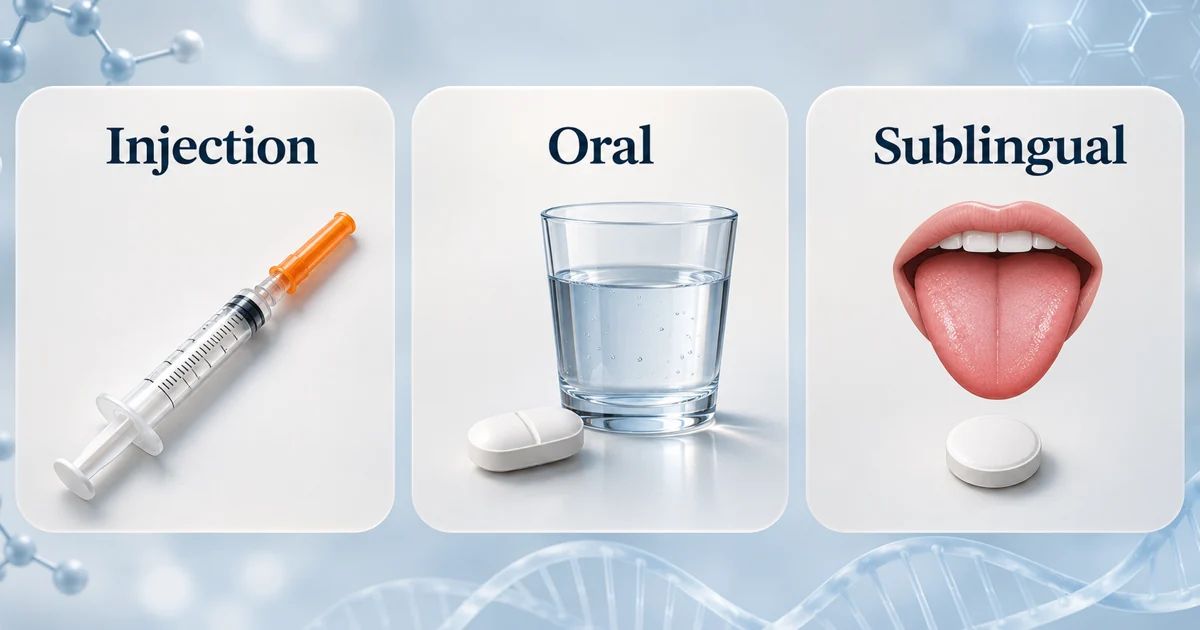
Comparing vitamin B12 injections vs oral tablets, high-dose oral B12 (1,000 to 2,000 mcg daily) corrects deficiency about as well as injections for most people, at lower cost. Sublingual products work but are not better than swallowed tablets. Injections remain the standard for severe deficiency, nerve symptoms and unreliable absorption.
For decades, people diagnosed with B12 deficiency were told they needed shots, often for life. Today, wellness clinics also sell B12 injections for energy and weight loss. Meanwhile, sublingual lozenges and sprays promise to “bypass the gut.” This guide compares the options using a Cochrane review, clinical trials, the NIH Office of Dietary Supplements (ODS) and MedlinePlus.
The options at a glance
| Route | Typical dose | How it is absorbed | Prescription? |
|---|---|---|---|
| Intramuscular injection | 1,000 mcg | Directly into the blood from muscle | Yes (can be self-injected) |
| Oral tablet | 500–2,000 mcg | Intrinsic factor (small amount) plus passive diffusion (~1% of dose) | No |
| Sublingual lozenge or tablet | 500–5,000 mcg | Mostly swallowed and absorbed in the gut, like oral | No |
| Nasal spray or gel | 500 mcg weekly | Through the nasal lining | Yes (in the U.S.) |
Oral vs. injection: what the evidence shows
The key fact is that about 1% of a large oral dose is absorbed by passive diffusion, without intrinsic factor or stomach acid. At 1,000 to 2,000 mcg a day, that adds up to more than the body needs, even in people who cannot absorb B12 normally.
| Review | Scope | Finding |
|---|---|---|
| Wang 2018 (Cochrane) | 3 randomized trials, 153 participants with deficiency | 1,000–2,000 mcg oral daily raised serum B12 similarly to injections; oral cost less; evidence quality low |
| Butler 2006 | Systematic review of randomized trials | 2,000 mcg daily oral, and 1,000 mcg daily then weekly then monthly, were as effective as injections for short-term hematologic and neurologic responses |
The ODS reflects this evidence, noting that high oral doses may be as effective as injections for treating deficiency. The trials were small and short, though, and few studied people with severe neurological symptoms, so injections remain the choice when rapid, guaranteed repletion matters.
Sublingual and lozenges
Sublingual products are designed to dissolve under the tongue. The idea is that B12 absorbs directly through the lining of the mouth. In reality, much of it is swallowed and absorbed in the gut the same way as a tablet. A study comparing sublingual cyanocobalamin with injections in people with deficiency found that sublingual treatment raised B12 levels effectively and was a reasonable alternative (Bensky 2019).
There is no strong evidence that sublingual products work better than swallowed tablets at the same dose. Choose whichever you will take consistently. Lozenges can be useful for people who have trouble swallowing pills.
Who still needs injections?
| Situation | Why injections may be preferred |
|---|---|
| Severe deficiency with neurological symptoms | Fast, guaranteed repletion to limit nerve damage |
| Uncertain adherence to daily pills | Monthly injections are easier to track |
| Severe malabsorption or after major bowel surgery | Oral absorption may be unreliable |
| Oral treatment tried without improvement | Confirms absorption is not the problem |
| Personal preference after discussion | Some people prefer infrequent shots |
British hematology guidelines still recommend injections as initial treatment for pernicious anemia and for people with neurological involvement, while acknowledging the oral evidence (Devalia 2014). An American Family Physician review notes that high-dose oral therapy is an effective alternative for many patients, including those with pernicious anemia (Langan 2017).
Typical treatment schedules
Protocols vary by country and clinician. A common U.S. pattern for injections is 1,000 mcg several times in the first weeks, then monthly. Oral treatment usually uses 1,000 to 2,000 mcg daily. People with pernicious anemia need treatment for life because the absorption problem does not go away. Follow-up blood tests confirm the response.
| Injections | High-dose oral | |
|---|---|---|
| Speed | Fastest | Fast enough for most |
| Cost | Higher (product plus visit) | Low |
| Convenience | Monthly, but needs a needle | Daily pill |
| Discomfort | Injection pain, rare reactions | None |
| Best evidence for | Severe and neurological cases | Most other deficiency |
B12 shots for energy and weight loss
Many medspas and weight-loss clinics offer B12 shots, sometimes combined with “lipotropic” ingredients. In people with normal B12 levels, there is no good evidence that injections increase energy, speed metabolism or cause weight loss. Excess B12 is excreted in urine within days. Any lift people feel may reflect expectation or other parts of a program. See B12 for energy. The ODS notes that B12 supplementation has not been shown to improve energy or athletic performance in people without a deficiency.
Nasal B12
A prescription cyanocobalamin nasal spray is FDA-approved for maintenance in people whose deficiency has already been corrected by injections. It is usually used once a week. It is an option for people who dislike needles, though it costs more than oral tablets.
Self-injection and practical tips
Many people prescribed B12 injections learn to give them at home, which avoids monthly clinic visits. Your clinician or pharmacist will show you how.
| Tip | Why |
|---|---|
| Use only the prescribed product and dose | Concentrations differ between products |
| Rotate injection sites | Reduces soreness |
| Dispose of needles in a sharps container | Safety for you and others |
| Keep a dosing log | Makes missed doses obvious |
| Report hives, swelling or breathing trouble immediately | Rare allergic reactions need urgent care |
Whichever route you use, follow-up matters. Clinicians usually recheck blood counts within a few weeks and B12 or methylmalonic acid after a few months. If symptoms do not improve on oral treatment, your clinician may switch to injections or look for another cause. See B12 blood tests.
Cost is a real consideration. A month of 1,000 mcg oral cyanocobalamin typically costs a few dollars, while injections add the cost of the product, syringes and sometimes a clinic visit. The Cochrane review noted lower costs for oral treatment (Wang 2018). For people who are comfortable with daily pills and do not have severe symptoms, that difference can add up over a lifetime of treatment.
The bottom line
- High-dose oral B12 (1,000–2,000 mcg daily) corrects deficiency about as well as injections for most people, at lower cost.
- Sublingual products work but have not been shown to beat swallowed tablets.
- Injections remain the standard for severe deficiency, nerve symptoms and unreliable absorption.
- B12 shots do not boost energy or weight loss in people with normal levels.
Frequently asked questions
Can I switch from shots to pills?
Many people can, including some with pernicious anemia, but do it with your clinician so levels can be rechecked.
Do B12 injections hurt?
They can cause brief soreness at the injection site. Serious reactions are rare.
How fast do injections work?
Blood counts begin to improve within about a week. Nerve symptoms take longer, often months.
Are B12 patches effective?
None of the sources we reviewed found good evidence that skin patches deliver meaningful B12.
Should I chew or swallow a sublingual tablet?
Follow the label. Because most B12 is absorbed in the gut either way, the method matters less than taking it consistently.
Do injections last longer than pills?
A single injection provides stores that last weeks, which is why maintenance shots are often monthly. Pills need to be taken daily.
Is a B12 nasal spray as good as a shot?
The prescription nasal spray is approved for maintenance after levels have been corrected. It is not usually used as the first treatment for severe deficiency.
Can I get B12 injections without a prescription?
In the U.S., injectable B12 generally requires a prescription. Wellness clinics that offer shots typically operate under a prescriber. For people with normal levels, oral supplements are a cheaper and needle-free option if B12 is needed at all.
Sources
- NIH Office of Dietary Supplements. Vitamin B12: Fact Sheet for Health Professionals. Updated July 2, 2025.
- Wang H, et al. Oral vitamin B12 versus intramuscular vitamin B12 for vitamin B12 deficiency. Cochrane Database Syst Rev. 2018;3:CD004655.
- Butler CC, et al. Oral vitamin B12 versus intramuscular vitamin B12 for vitamin B12 deficiency: a systematic review of randomized controlled trials. Fam Pract. 2006;23(3):279-85.
- Bensky MJ, et al. Comparison of sublingual vs. intramuscular administration of vitamin B12 for the treatment of patients with vitamin B12 deficiency. Drug Deliv Transl Res. 2019;9(3):625-30.
- Devalia V, et al. Guidelines for the diagnosis and treatment of cobalamin and folate disorders. Br J Haematol. 2014;166(4):496-513.
- Langan RC, Goodbred AJ. Vitamin B12 deficiency: recognition and management. Am Fam Physician. 2017;96(6):384-9.
- Stabler SP. Clinical practice. Vitamin B12 deficiency. N Engl J Med. 2013;368(2):149-60.
Last reviewed November 2026. VitaBrief is educational and is not medical advice. Talk with a doctor, registered dietitian or pharmacist before starting a supplement, especially if you are pregnant, take medication or have kidney disease.
Not medical advice. This guide is for general education. Talk to your doctor or pharmacist before taking a supplement, especially if you are pregnant or breastfeeding, take medication or have a health condition. Medical disclaimer