Ingredient guides
Shilajit: what the evidence says about testosterone and safety
Searches for shilajit have surged. The human evidence is one small trial, and the biggest practical concern is what else might be in the jar.
VitaBrief editorial · Last reviewed November 2026 · Sources listed below
Reader-supported. This page may contain affiliate links. If you buy through one, we may earn a commission at no extra cost to you. It never changes what we write. Affiliate disclosure
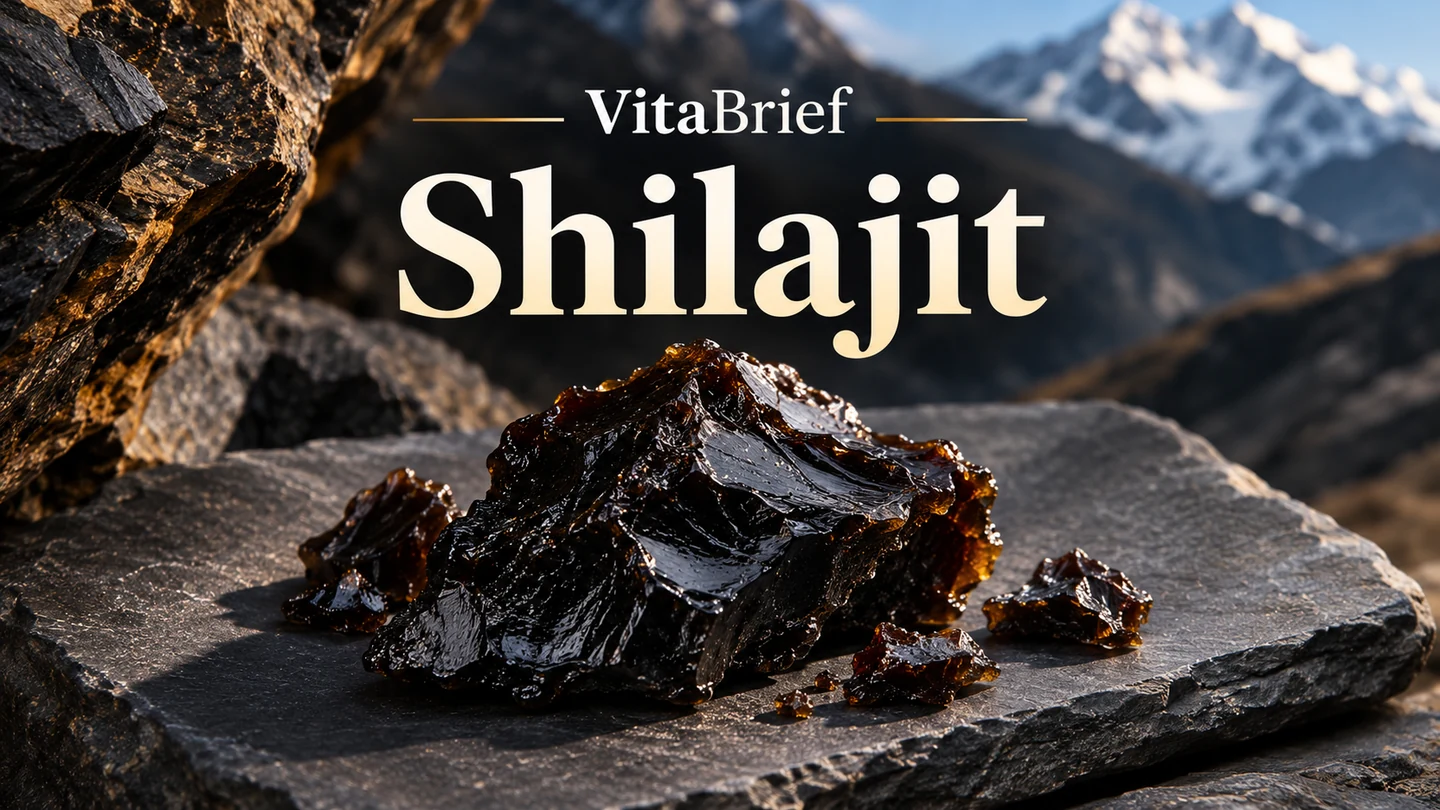
Shilajit has become one of the most searched supplements online, sold as a sticky black resin, a powder or capsules and promoted for testosterone, energy and “vitality.” Behind the marketing, the research picture is thin: a single small trial in healthy men forms most of the human testosterone evidence. Meanwhile, the practical risk that matters most is contamination, because Ayurvedic products bought online have been found to contain lead, mercury and arsenic.
This guide explains what shilajit is, what the research actually reports, why raw resin is a particular concern, and who should skip it. It is general information, not a diagnosis. If you think your testosterone is low, the reliable path is a clinician and a blood test, not a supplement, as explained in our testosterone guide.
Shilajit: the short answer
Shilajit explained: what the mountain resin is, what the one small testosterone trial reported, energy and fulvic acid claims, heavy-metal contamination risk, raw vs. purified, and who should avoid it.
Shilajit at a glance
| Question | Short answer |
|---|---|
| What is it? | A dark, tar-like resin that seeps from rock in high mountain ranges |
| Traditional use | Used in Ayurveda as a general tonic |
| Testosterone evidence | One small trial of a purified extract in healthy men; not independently replicated |
| Energy, altitude, fulvic acid claims | Little or no good human evidence |
| Main safety concern | Possible heavy-metal contamination, especially in raw or unverified products |
| Regulation | Sold as a dietary supplement; not approved to treat any condition |
What shilajit is
Shilajit is a natural substance that oozes out of rock crevices in mountainous regions, most famously the Himalayas, particularly in warm months. It is thought to form over long periods as plant material breaks down and mixes with minerals from the surrounding rock. The result is a complex, variable mixture of organic compounds and minerals rather than a single defined ingredient.
In Ayurveda, the traditional medical system of India, shilajit has long been used as a “rasayana,” a rejuvenating tonic. That history explains its reputation, but traditional use is not the same as evidence from controlled trials. Because shilajit comes from rock, its composition depends heavily on where it was collected and how it was processed, which is central to the safety discussion below.
The testosterone evidence: one small trial
The study most often cited for shilajit and testosterone is a placebo-controlled trial published in 2016 (Pandit 2016). It enrolled a small group of healthy middle-aged men who took either a purified shilajit extract or a placebo for about three months. According to the abstract, men taking the extract had higher total and free testosterone at the end of the study than the placebo group, along with changes in some related hormones.
That result is interesting, but it should be read with caution:
- It is one small study. A single trial with a modest number of participants can produce findings that do not hold up when repeated.
- It tested one specific purified extract. The results cannot be assumed to apply to raw resin or to other products with different processing.
- The men were healthy. The trial did not test shilajit as a treatment for diagnosed low testosterone (hypogonadism).
- It measured hormone levels, not outcomes. A change in a lab value does not show that men felt better, gained strength or had improved sexual function.
- Industry links are common in this area. Studies of branded extracts are often supported by the companies that sell them, which is a reason to want independent confirmation.
A broad review of testosterone booster products found that most of their ingredients and claims are not supported by the academic literature (Clemesha 2020). Shilajit fits that pattern: an intriguing early signal, far from proof. For context on how other ingredients compare, see do testosterone boosters work?
Energy, altitude and fulvic acid claims
Marketing for shilajit goes well beyond testosterone. Common claims include more energy and stamina, help adapting to high altitude, better recovery, sharper thinking and anti-aging effects. Many labels highlight “fulvic acid,” a group of organic compounds found in shilajit and in soil, as the active ingredient, sometimes with a percentage on the label.
There is little good human evidence for any of these claims. Much of the supporting material comes from laboratory and animal studies, traditional use or small studies of branded extracts. A high fulvic acid percentage tells you about composition, not about whether the product does anything in people. Treat claims about energy, altitude sickness and brain health as unproven.
Contamination: the biggest practical risk
The best-documented concern with shilajit is not what it does but what may come with it. In a study of Ayurvedic medicines bought online, researchers found that about one in five products contained detectable lead, mercury or arsenic (Saper 2008). Products from both U.S. and Indian manufacturers were affected, and some exceeded accepted daily limits for these metals. That study looked at Ayurvedic products broadly, not only shilajit, but shilajit belongs squarely to that category and is mined from mineral-rich rock.
Heavy metals can build up in the body over time. Lead and mercury can affect the nervous system, kidneys and blood, and arsenic is a known toxin. Because the effects may develop slowly and without obvious symptoms, a product can seem harmless while still adding to your exposure.
Supplements in the United States do not need FDA approval before they are sold, and the manufacturer is responsible for safety and labeling (FDA). The FDA has also repeatedly warned that products marketed for sexual enhancement or hormonal effects can contain hidden drug ingredients. Shilajit is often sold in exactly that space, so the risks of an unverified product go beyond metals. Our guide to testosterone booster side effects covers tainted products in more detail.
Raw vs. purified shilajit
Some sellers promote raw or “unprocessed” resin as more natural or potent. From a safety standpoint, that is backwards. Raw shilajit may carry soil, rock particles, microbes, fungal toxins and metals from its source. Purification is meant to remove at least some of these, and the only human testosterone trial used a purified extract.
Purified does not automatically mean safe, though. Label claims are not verified by the FDA before sale. If you decide to use shilajit anyway, the most useful protection is independent testing: look for a product verified by a third-party testing organization and, ideally, a certificate of analysis that reports heavy-metal results. The NCCIH also advises telling your doctor about any supplement you take.
Who should avoid shilajit
Given limited safety data, these groups have good reason to avoid shilajit or check with a clinician first:
- People who are pregnant, breastfeeding or trying to conceive
- Children and teenagers
- People with kidney disease, liver disease or a history of heavy-metal exposure
- Anyone with prostate cancer, breast cancer or another hormone-sensitive condition
- People with heart disease, a history of blood clots or a high red blood cell count
- Anyone taking prescription medication, including diabetes or blood pressure drugs
- Men who are planning a family and want to protect fertility; see testosterone and fertility
If you have symptoms such as low libido, erectile problems, fatigue or loss of muscle, see a doctor rather than self-treating. Low testosterone is a medical diagnosis that requires symptoms plus consistently low morning blood tests (Endocrine Society 2018; AUA 2018). Our page on low testosterone symptoms explains when testing makes sense.
Why the search spike does not equal evidence
Shilajit searches have grown far faster than any other testosterone-related supplement term. That surge reflects social media, influencer marketing and the appeal of an “ancient” remedy, not new research. The scientific record has not changed in step with popularity: it still rests largely on one small trial and a large body of traditional and laboratory claims.
If your goal is healthier testosterone levels, the measures with the strongest evidence are less exciting but more reliable. Short sleep can lower testosterone in young men (Leproult 2011), and weight loss can raise it in men with obesity (Corona 2013). Our guide on how to increase testosterone naturally covers these steps.
Frequently asked questions
Does shilajit increase testosterone?
One small trial of a purified extract in healthy men reported higher testosterone than placebo. That is not enough to say it reliably works, and it has not been shown to treat low testosterone.
Is shilajit safe?
Safety data are limited. The clearest risk is contamination with heavy metals, which has been found in Ayurvedic products sold online. Unverified and raw products carry the most uncertainty.
Is raw shilajit better than purified?
No good evidence supports that. Raw resin may contain more contaminants, and the only human testosterone trial used a purified extract.
What does fulvic acid do?
Fulvic acid is a group of compounds found in shilajit and soil. Claims about its benefits come mostly from laboratory and animal research, with little human evidence.
Can women take shilajit?
It has not been well studied in women, and it should be avoided in pregnancy and breastfeeding. Women interested in testosterone should read our guide to testosterone for women and talk with a clinician.
Sources
- Pandit et al. Clinical evaluation of purified shilajit on testosterone levels in healthy volunteers. Andrologia. 2016.
- Saper et al. Lead, mercury, and arsenic in US- and Indian-manufactured Ayurvedic medicines sold via the internet. JAMA. 2008.
- Clemesha et al. “Testosterone boosting” supplements composition and claims are not supported by the academic literature. World J Mens Health. 2020.
- Bhasin et al. Testosterone therapy in men with hypogonadism: an Endocrine Society clinical practice guideline. J Clin Endocrinol Metab. 2018.
- Mulhall et al. Evaluation and management of testosterone deficiency: AUA guideline. J Urol. 2018.
- Leproult R, Van Cauter E. Effect of 1 week of sleep restriction on testosterone levels in young healthy men. JAMA. 2011.
- Corona et al. Body weight loss reverts obesity-associated hypogonadotropic hypogonadism: a systematic review and meta-analysis. Eur J Endocrinol. 2013.
- U.S. Food and Drug Administration. Dietary supplements.
- National Center for Complementary and Integrative Health. Using dietary supplements wisely.
Last reviewed November 2026. VitaBrief is educational and is not medical advice. Talk with a doctor, registered dietitian or pharmacist before starting a supplement, especially if you are pregnant, take medication or have kidney disease.
Not medical advice. This guide is for general education. Talk to your doctor or pharmacist before taking a supplement, especially if you are pregnant or breastfeeding, take medication or have a health condition. Medical disclaimer