Ingredient guides
Turmeric: what it is, what curcumin does and what the evidence shows
This turmeric guide explains: the golden spice, its active compound curcumin, why absorption matters, what studies show for joint pain and other uses, and the safety issues worth knowing before you buy a supplement.
VitaBrief editorial · Last reviewed November 2026 · Sources listed below
Reader-supported. This page may contain affiliate links. If you buy through one, we may earn a commission at no extra cost to you. It never changes what we write. Affiliate disclosure

Turmeric is one of the most searched-for supplements in the United States, and it is also a kitchen spice that people have cooked with for thousands of years. That double life causes a lot of confusion. A teaspoon of turmeric in a curry is a very different thing from a capsule of concentrated curcumin extract, and the research, the benefits and the risks do not transfer neatly from one to the other.
This guide explains what turmeric is, what its main active compound does, what the evidence actually supports, and the safety issues that have become clearer in recent years. It draws on the National Center for Complementary and Integrative Health (NCCIH), the US Food and Drug Administration and published reviews.
Turmeric guide: the short answer
Turmeric guide: what the spice is, why curcumin is poorly absorbed, what research shows for knee osteoarthritis and other uses, liver injury reports, interactions, lead adulteration and how to choose a supplement.
What turmeric is
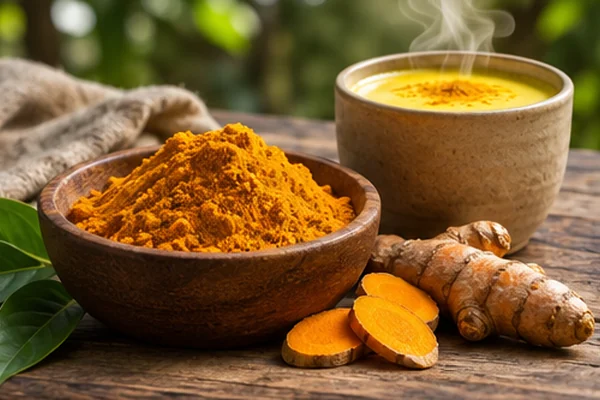
Turmeric comes from the underground stem, or rhizome, of Curcuma longa, a plant in the ginger family grown mainly in India and other parts of South and Southeast Asia. The rhizome is boiled, dried and ground into the bright yellow-orange powder used in curry blends, mustard and many other foods. It has a long history in traditional Ayurvedic and Chinese medicine, where it was used for a wide range of complaints.
The compounds that give turmeric its color are called curcuminoids. The best known of these is curcumin, which has been studied extensively in the laboratory for anti-inflammatory and antioxidant activity (Hewlings 2017). Curcuminoids make up only a small share of turmeric powder by weight, which is why supplement makers concentrate them into extracts. If you want a closer look at the difference, see turmeric vs curcumin.
Spice vs supplement
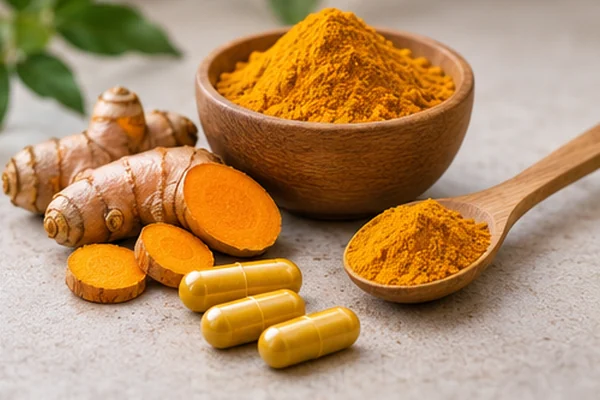
The most important distinction in this whole topic is between turmeric as a food and turmeric as a supplement. Turmeric in the amounts usually found in food is generally considered safe. Supplements are a different matter: a standardized extract can deliver far more curcumin in a single capsule than most people would ever eat in a day of cooking.
| Form | What it contains | What to know |
|---|---|---|
| Ground spice in food | Whole turmeric, with a small share of curcuminoids | Considered safe in food amounts; contamination is the main concern |
| Turmeric powder capsules | Ground root in larger amounts | Less concentrated than extracts; quality varies |
| Standardized curcumin extract | Concentrated curcuminoids | The form used in most clinical trials; poorly absorbed alone |
| Enhanced-absorption products | Curcumin with black pepper extract or special formulations | Raise blood levels; some liver injury cases involved these products |
| Teas, shots and lattes | Variable amounts of turmeric | Amounts usually closer to food than to supplements |
The absorption problem
Curcumin has a well-known weakness: on its own, very little of it reaches the bloodstream. It is poorly absorbed from the gut, broken down quickly and cleared rapidly from the body. A widely cited review described this low bioavailability as one of the main obstacles to using curcumin as a health product (Anand 2007).
One answer has been to pair curcumin with piperine, the compound that makes black pepper pungent. In a small study in human volunteers, adding piperine substantially raised blood levels of curcumin compared with curcumin alone (Shoba 1998). Manufacturers have since developed many other enhanced-absorption formulations. Higher absorption sounds like a pure win, but it may also change the safety picture, as discussed below. Our article on turmeric and black pepper covers this trade-off in detail.
What the evidence shows
Thousands of laboratory and animal studies have looked at curcumin, and that volume can make the evidence sound stronger than it is. Results in cells and animals often do not hold up in people, and many human trials have been small, short or of variable quality.
The clearest signal is for knee osteoarthritis. A 2026 Cochrane review of turmeric and its active ingredients for osteoarthritis found that they may provide modest pain relief, but rated the certainty of the evidence as low (Shirinsky 2026). Earlier meta-analyses reached broadly similar conclusions, finding improvements in pain and function while noting small trials and risk of bias (Daily 2016; Wang 2021; Paultre 2021). See turmeric for joint pain for more.
For most other uses, including depression, metabolic health, exercise recovery and general inflammation, the evidence is preliminary. A meta-analysis of small trials in depression suggested a possible benefit but called for larger studies (Ng 2017). NCCIH describes early evidence for knee osteoarthritis as positive but says there is not enough evidence to conclude whether turmeric helps most other conditions it is marketed for. Our turmeric benefits article walks through each area.
Safety: what to watch for
Turmeric supplements are generally well tolerated in short-term studies, with mild digestive complaints such as stomach upset, nausea or diarrhea the most commonly reported side effects. See turmeric side effects for the full list.
The more serious concern is liver injury. It is rare, but it is documented. Researchers from the US Drug-Induced Liver Injury Network described turmeric as a growing cause of liver injury cases, and many of the cases they reviewed involved products containing black pepper or other high-bioavailability formulations (Halegoua-DeMarzio 2023). An Italian phytovigilance study and review of case reports reached similar conclusions (Lombardi 2021). Stop taking turmeric and contact a doctor promptly if you notice yellowing of the skin or eyes, dark urine, pain in the upper abdomen or unusual fatigue. Read more in turmeric and the liver.
According to NCCIH, conventional turmeric supplements are likely safe in recommended amounts for up to 2 to 3 months, liver damage has been reported with some enhanced-absorption formulations, and turmeric supplements may be unsafe during pregnancy. NCCIH also advises anyone taking medicine to check with a provider first, because some herbs and medicines interact. As a general precaution, people on blood thinners, those with gallbladder problems and anyone scheduled for surgery should also talk with a health professional before taking turmeric supplements. See turmeric interactions.
Quality and lead contamination
Supplements in the US are not approved by the FDA for safety or effectiveness before they are sold, and the agency’s dietary supplement guidance places responsibility for quality on manufacturers. For turmeric, there is an extra issue: some turmeric from South Asia has been found adulterated with lead chromate, a yellow pigment added to brighten color (Forsyth 2024). Lead is harmful at any level, and the FDA tracks lead in food as a priority contaminant.
Choosing products that are verified by an independent third-party testing program is a practical way to lower these risks. Our guide on how to choose a turmeric supplement explains what to look for on a label.
Dosage and timing
There is no official recommended daily amount for turmeric or curcumin. Clinical trials have used a wide range of doses, often several hundred milligrams to a few grams of curcumin extract per day, usually for weeks to a few months. Those amounts tell you what was studied, not what is right or safe for you. Our turmeric dosage article explains the ranges in more detail, and when to take turmeric covers timing and taking it with food.
A sensible approach is to start by asking whether you need a supplement at all. If your goal is general wellness, cooking with turmeric carries little risk. If you are considering a supplement for a specific problem such as knee pain, talk with your doctor or pharmacist first, especially if you take any regular medication, and set a time limit to judge whether it is helping. If it is not making a noticeable difference after a couple of months, there is little reason to keep taking it.
Frequently asked questions
Is turmeric the same as curcumin?
No. Curcumin is the best-studied compound in turmeric, but turmeric powder contains only a small share of it. Most supplements used in trials are concentrated curcumin extracts.
Is cooking with turmeric safe?
Turmeric in food amounts is generally considered safe. The main concern is contamination, so buy spices from sources you trust.
Does turmeric really reduce inflammation?
Curcumin shows anti-inflammatory activity in the lab. In people, the most consistent finding is modest pain relief in knee osteoarthritis, and that evidence is rated low certainty.
Can turmeric harm the liver?
Rarely, yes. Liver injury has been reported with turmeric supplements, often involving black pepper or enhanced-absorption products. See turmeric and the liver.
Who should avoid turmeric supplements?
People taking blood thinners, those with gallbladder or liver problems, people who are pregnant and anyone facing surgery should talk with a doctor first.
Sources
- NCCIH. Turmeric.
- FDA. Dietary supplements.
- FDA. Lead in food and foodwares.
- Shirinsky, et al. Curcuma longa (turmeric) or its active ingredients for osteoarthritis. Cochrane Database Syst Rev. 2026.
- Daily, et al. Efficacy of turmeric extracts and curcumin for alleviating the symptoms of joint arthritis. J Med Food. 2016.
- Wang, et al. Efficacy and safety of turmeric extracts for knee osteoarthritis. Curr Rheumatol Rep. 2021.
- Paultre, et al. Turmeric or curcumin extract on pain and function in knee osteoarthritis. BMJ Open Sport Exerc Med. 2021.
- Anand, et al. Bioavailability of curcumin: problems and promises. Mol Pharm. 2007.
- Shoba, et al. Influence of piperine on the pharmacokinetics of curcumin in animals and human volunteers. Planta Med. 1998.
- Hewlings, et al. Curcumin: a review of its effects on human health. Foods. 2017.
- Ng, et al. Clinical use of curcumin in depression: a meta-analysis. J Am Med Dir Assoc. 2017.
- Halegoua-DeMarzio, et al. Liver injury associated with turmeric, a growing problem. Am J Med. 2023.
- Lombardi, et al. Acute liver injury following turmeric use in Tuscany. Br J Clin Pharmacol. 2021.
- Forsyth, et al. Evidence of turmeric adulteration with lead chromate across South Asia. Sci Total Environ. 2024.
Last reviewed November 2026. VitaBrief is educational and is not medical advice. Talk with a doctor, registered dietitian or pharmacist before starting a supplement, especially if you are pregnant, take medication or have kidney disease.
Not medical advice. This guide is for general education. Talk to your doctor or pharmacist before taking a supplement, especially if you are pregnant or breastfeeding, take medication or have a health condition. Medical disclaimer