Comparisons
How to choose a vitamin A supplement: forms, doses and labels
Most people do not need one. If you do, the form, the preformed share and the dose matter more than the brand.
VitaBrief editorial · Last reviewed November 2026 · Sources listed below
Reader-supported. This page may contain affiliate links. If you buy through one, we may earn a commission at no extra cost to you. It never changes what we write. Affiliate disclosure
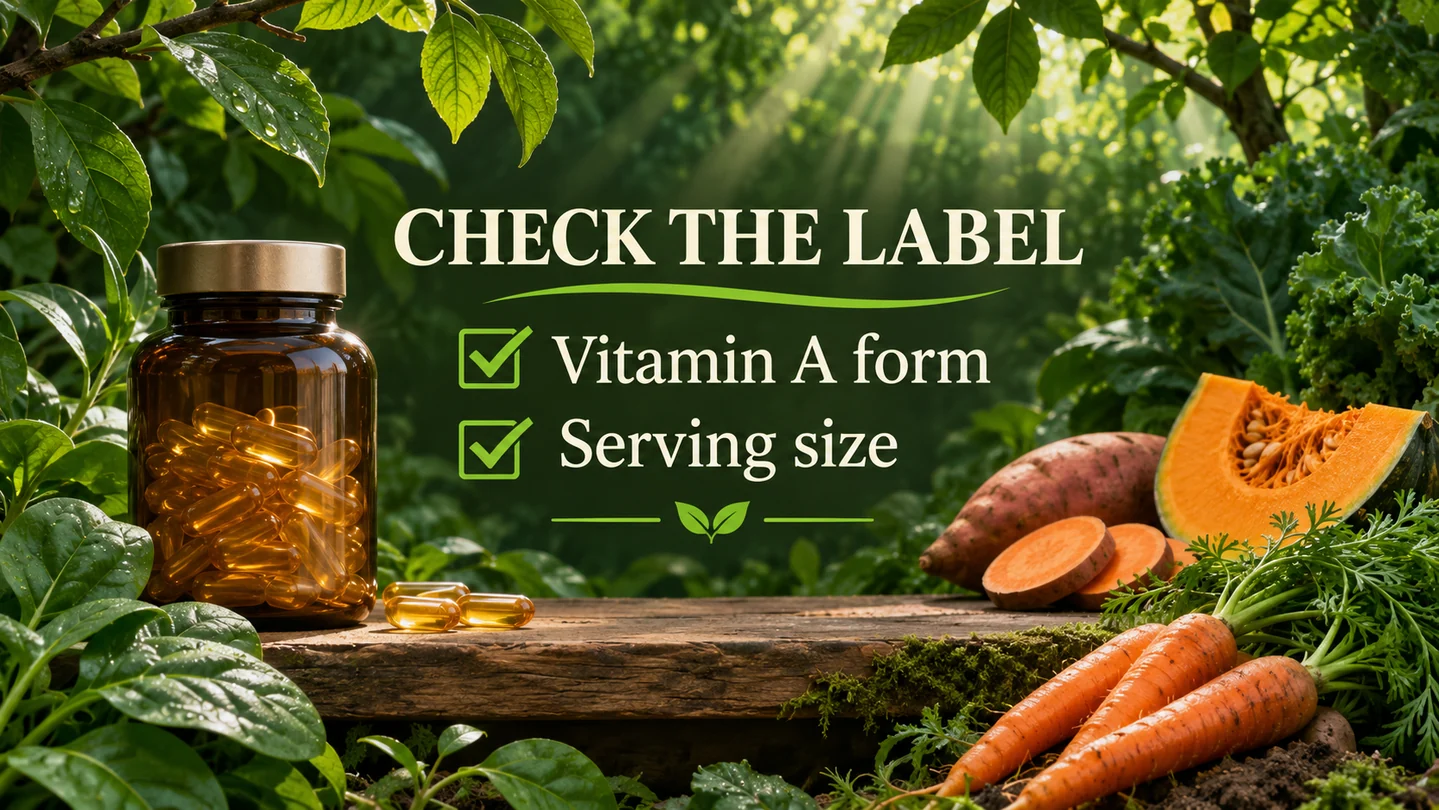
Vitamin A supplements range from multivitamins with a modest amount to stand-alone softgels that hit the adult upper limit in a single pill. Labels mix retinyl palmitate, retinyl acetate and beta-carotene, and some still use international units. Choosing well is less about finding the “best” product and more about deciding whether you need one at all, then picking a form and dose that fit your situation.
This guide walks through that decision using the NIH Office of Dietary Supplements (ODS), FDA and key clinical trials. It is general information, not medical advice. VitaBrief does not recommend specific products.
How to choose a vitamin A supplement: the short answer
How to choose a vitamin A supplement: whether you need one, retinyl palmitate or acetate vs. beta-carotene, reading mcg RAE and IU on labels, upper limits, multivitamins, and who should avoid which form.
Step 1: decide whether you need one
ODS says vitamin A deficiency is rare in the United States because most people get enough from the foods they eat. Liver, fish, eggs and dairy supply preformed vitamin A, while sweet potatoes, carrots, spinach and other colorful produce supply beta-carotene. Our vitamin A foods list shows how quickly these add up; one baked sweet potato provides 1,403 mcg RAE, per ODS.
ODS lists groups more likely to fall short: premature infants; infants, young children, and pregnant and breastfeeding women in low-income countries; people with cystic fibrosis; and people with Crohn’s disease, ulcerative colitis or celiac disease. People taking orlistat, a weight-loss medicine, may also absorb less vitamin A. If you are in one of these groups, a clinician can check your status and set a dose. For everyone else, a supplement is optional, and more is not better. See vitamin A deficiency for signs and risk groups.
Step 2: understand the forms on the label
According to ODS, supplements usually contain retinyl acetate, retinyl palmitate, beta-carotene, or a combination. The first two are preformed vitamin A; beta-carotene is provitamin A that the body converts into vitamin A.
| Form on label | Type | Absorption from supplements | Counts toward UL? | Main caution |
|---|---|---|---|---|
| Retinyl palmitate | Preformed | 70% to 90% | Yes | Toxicity and birth defects above the UL |
| Retinyl acetate | Preformed | Yes | Toxicity and birth defects above the UL | |
| Beta-carotene | Provitamin A | 8.7% to 65% | No | Lung cancer risk in smokers and former smokers |
| Mixed (both) | Both | Varies | Only the preformed share | Check the percentage from beta-carotene |
Palmitate and acetate are both retinyl esters. Our sources do not compare them directly; our inference is that the choice between them matters far less than the dose and the preformed share. The bigger choice is preformed versus beta-carotene, covered in depth in retinol vs. beta-carotene.
Step 3: read mcg RAE and IU correctly
Current labels list vitamin A in micrograms of retinol activity equivalents (mcg RAE). ODS notes that IU were used before, and gives these conversions: 1 IU retinol equals 0.3 mcg RAE, and 1 IU supplemental beta-carotene also equals 0.3 mcg RAE. By our arithmetic using those factors, a product labeled 10,000 IU of retinol provides 3,000 mcg RAE, the full adult UL, and one labeled 25,000 IU of retinol provides 7,500 mcg RAE, well above it.
The Daily Value for vitamin A on labels is 900 mcg RAE for adults and children 4 and older. ODS reports that 3,000 mcg RAE (333% of the DV) is common in stand-alone supplements, while multivitamins often contain 750 to 1,050 mcg RAE (83% to 117% of the DV). Compare these figures with the RDA for your age in our vitamin A dosage guide: 900 mcg RAE for adult men and 700 for adult women.
Step 4: check the preformed amount against the UL
The Tolerable Upper Intake Level applies only to preformed vitamin A, from food and supplements combined. ODS lists it as 600 mcg for ages 0 to 3, 900 mcg for ages 4 to 8, 1,700 mcg for ages 9 to 13, 2,800 mcg for ages 14 to 18, and 3,000 mcg for adults, including during pregnancy and breastfeeding.
ODS gives a worked example. A supplement with 3,000 mcg RAE, 60% of it from beta-carotene, provides 1,200 mcg RAE of preformed vitamin A. That is above the UL for children up to age 8 but below it for older children and adults. Look for the beta-carotene percentage on the label, and remember that food adds to the total.
Too much preformed vitamin A can cause headaches, nausea, dizziness and blurred vision after very high doses, and abnormal liver test results, painful muscles and joints, and dry skin with chronic excess, per ODS. Observational meta-analyses by Wu (2014) and Zhang (2017) linked higher retinol intake with higher hip fracture risk, though these studies cannot prove cause. More in vitamin A toxicity.
Step 5: match the form to your situation
- Smokers and former smokers: our advice is to avoid beta-carotene supplements. In the ATBC trial, male smokers taking beta-carotene had an 18% higher lung cancer incidence. In CARET, beta-carotene plus retinyl palmitate gave a relative risk of lung cancer of 1.28 and no benefit.
- Pregnant, possibly pregnant or breastfeeding: do not take high-dose preformed vitamin A; ODS notes that total intakes of preformed vitamin A above the UL can cause birth defects, while beta-carotene is not known to be teratogenic. Check your prenatal label with your clinician; see vitamin A in pregnancy.
- Taking retinoid drugs: ODS warns that oral retinoids such as acitretin and bexarotene can increase the risk of hypervitaminosis A when taken with vitamin A supplements, and notes that some retinoid medicines, such as isotretinoin, can cause birth defects. Our advice: do not combine any of them with a supplement without your doctor.
- Taking orlistat: ODS notes it reduces absorption of vitamin A and beta-carotene; ask your clinician about timing and need.
- Children: ULs are much lower. Do not give adult products to children without a pediatrician’s advice.
If you have intermediate or advanced age-related macular degeneration, eye formulas are a separate decision. ODS reports that AREDS2 found beta-carotene was not a required ingredient, and that after 10 years, people who took the version with lutein and zeaxanthin in place of beta-carotene had an additional 20% reduced risk of progression to late AMD. See vitamin A for eyes and talk with your eye doctor.
Step 6: stand-alone or multivitamin?
For most people who want a safety net, a multivitamin with an amount near the DV is simpler than a stand-alone vitamin A product. ODS notes that most multivitamins contain vitamin A. Stand-alone products often carry 3,000 mcg RAE, the whole adult UL, leaving no room for food. In our view, that level makes sense only under medical supervision, for example in a diagnosed deficiency.
Watch for stacking. Fish liver oils, eye formulas, skin and hair supplements, and fortified foods can all add preformed vitamin A. A multivitamin plus a separate vitamin A pill is a common way to exceed the UL without noticing. Several fat-soluble vitamins, including vitamin D and vitamin E, appear in the same products, so check every line.
Step 7: judge quality cautiously
FDA explains that supplements are regulated differently from conventional foods and drugs. Under DSHEA, manufacturers are responsible for evaluating the safety and labeling of their products before marketing, and FDA can act against adulterated or misbranded products after they reach the market. FDA also provides a way to report problems with supplements.
In practice, choose a clearly labeled product that states the amount in mcg RAE and, ideally, the share from beta-carotene. Be wary of labels that promise skin, vision or immune “boosts”; none of our sources support such claims for people who already get enough. A pharmacist can help you compare labels and check for interactions.
Finally, keep a simple list of every supplement you take, with the vitamin A amount and form of each, and bring it to medical appointments. ODS encourages people taking medicines regularly to discuss their vitamin A status with their health care providers, and a written list makes that conversation quick and accurate.
FAQ
Is retinyl palmitate or beta-carotene better?
Neither is best for everyone. Retinyl palmitate is better absorbed but counts toward the UL. Beta-carotene has no UL, but our advice is that smokers and former smokers avoid it in supplements.
Is 10,000 IU of vitamin A too much?
If it is all retinol, 10,000 IU equals 3,000 mcg RAE, the adult UL. Food adds to that, so this dose leaves no margin and is not suitable for children.
Do I need a vitamin A supplement if I take a multivitamin?
Usually not. Most multivitamins already contain vitamin A, and adding a stand-alone product can push preformed intake past the UL.
What does “mcg RAE” mean?
Micrograms of retinol activity equivalents. It accounts for the different activity of retinol and carotenoids so totals can be compared.
Should older adults take vitamin A?
Only if a clinician sees a reason. Observational studies link high retinol intake with hip fracture risk, so extra preformed vitamin A is not automatically helpful.
Sources
- NIH Office of Dietary Supplements. Vitamin A and carotenoids: fact sheet for health professionals.
- US Food and Drug Administration. Dietary supplements.
- NIH Office of Dietary Supplements. Vitamin A and carotenoids: fact sheet for consumers.
- Alpha-Tocopherol, Beta Carotene Cancer Prevention Study Group. The effect of vitamin E and beta carotene on the incidence of lung cancer and other cancers in male smokers. N Engl J Med. 1994.
- Omenn, et al. Effects of a combination of beta carotene and vitamin A on lung cancer and cardiovascular disease. N Engl J Med. 1996.
- Wu, et al. The relationship between vitamin A and risk of fracture: meta-analysis of prospective studies. J Bone Miner Res. 2014.
- Zhang, et al. The effect of vitamin A on fracture risk: a meta-analysis of cohort studies. Int J Environ Res Public Health. 2017.
Last reviewed November 2026. VitaBrief is educational and is not medical advice. Talk with a doctor, registered dietitian or pharmacist before starting a supplement, especially if you are pregnant, take medication or have kidney disease.
Not medical advice. This guide is for general education. Talk to your doctor or pharmacist before taking a supplement, especially if you are pregnant or breastfeeding, take medication or have a health condition. Medical disclaimer