Supplement basics
Choosing multivitamins: reading the label, doses and testing
How to read a Supplement Facts panel, why staying near 100% of the Daily Value beats megadoses, when to pick iron or iron-free, and what third-party seals do and do not tell you.
VitaBrief editorial · Last reviewed November 2026 · Sources listed below
Reader-supported. This page may contain affiliate links. If you buy through one, we may earn a commission at no extra cost to you. It never changes what we write. Affiliate disclosure
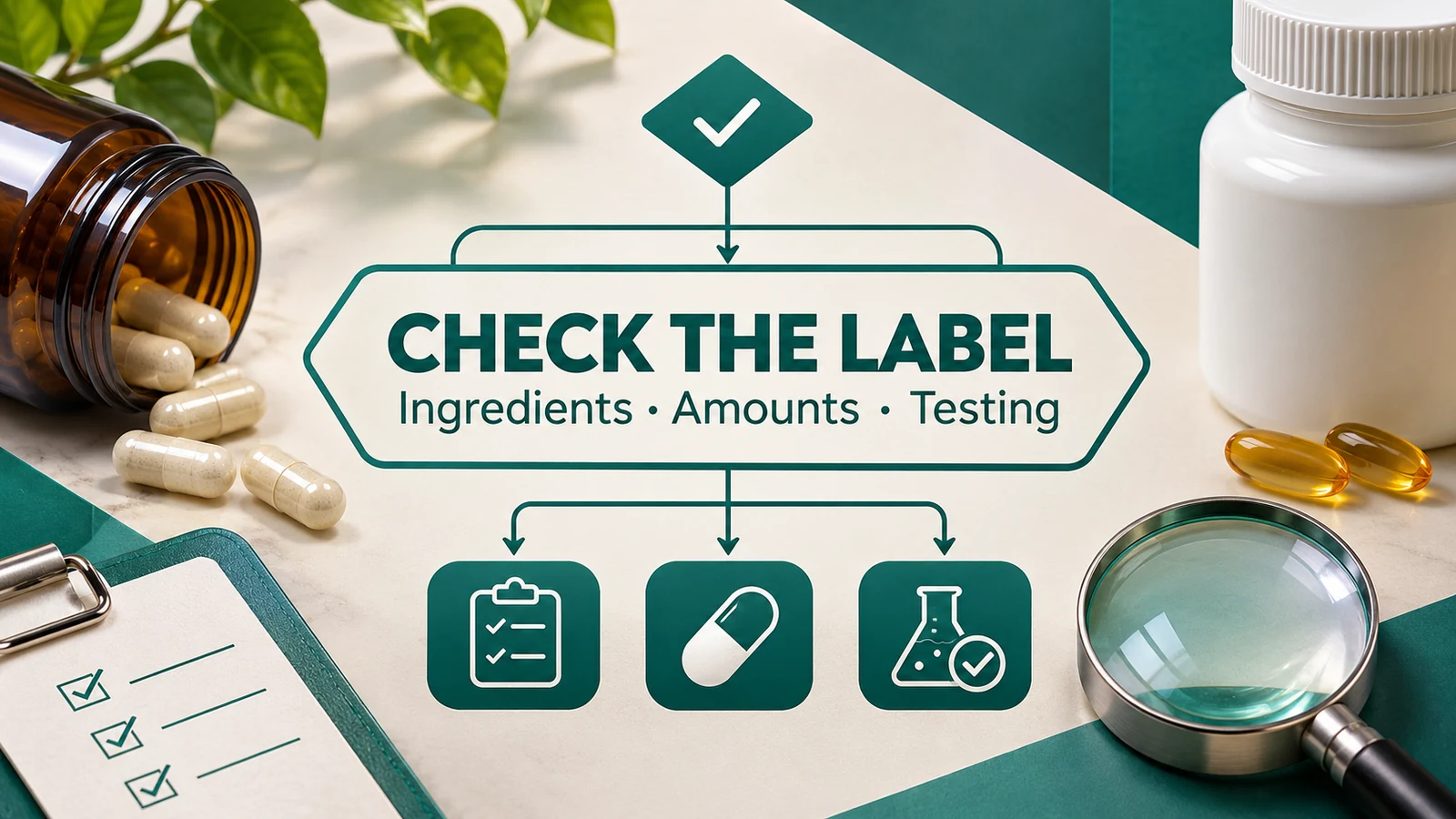
Walk down any supplement aisle and you will see dozens of multivitamins, each claiming to be complete, advanced or tailored to you. There is no single “best” multivitamin, and price or packaging tells you little about what is inside. What you can do is read the label carefully, match the formula to your age and life stage, avoid doses far above what you need, and look for signs that the product was independently checked. This guide walks through those steps at the category level, without naming brands, drawing on the NIH Office of Dietary Supplements (ODS) and the FDA.
First, a reality check. In generally healthy, well-nourished adults, large trials such as the Physicians’ Health Study II and COSMOS, and the 2022 US Preventive Services Task Force (USPSTF) statement, do not show that multivitamins prevent heart disease, cancer or death (USPSTF 2022). A multivitamin is best seen as a way to fill specific gaps, such as vitamin B12 after 50 or folic acid before pregnancy, not as health insurance. For the bigger picture, see do multivitamins work.
Choosing multivitamins: the short answer
Choosing multivitamins: a category-level guide to choosing a multivitamin: reading the Supplement Facts panel and %DV, avoiding megadoses and upper limits, iron or iron-free by life stage, folic acid, vitamin D and B12 forms, third-party testing, red flags, FSA/HSA and FDA oversight.
Start with the Supplement Facts panel
Every dietary supplement sold in the US must carry a Supplement Facts panel. It lists the serving size, each nutrient, the amount per serving and, for nutrients that have one, the percent Daily Value (%DV). The %DV compares the amount in one serving with a reference amount used on food and supplement labels. A figure of 100% means one serving provides roughly the full reference amount for that nutrient; 500% means about five times that amount.
Check the serving size before anything else. Some products list amounts for two, three or even more tablets or gummies a day. If you only plan to take one, the amounts you actually get may be a fraction of what the label suggests.
Aim near 100% DV, not megadoses
For most people, a basic multivitamin with most nutrients near 100% of the DV is a sensible choice. The ODS notes that many multivitamin/mineral products provide nutrients at around the DV, while others contain much larger amounts (ODS MVMS). Your diet already supplies many of these nutrients, and many people also eat fortified foods such as breakfast cereals, so a high-dose multivitamin can push total intake well above what you need.
Some nutrients have a Tolerable Upper Intake Level (UL), the highest daily intake unlikely to cause harm for most people. Exceeding the UL regularly raises the risk of side effects. The nutrients most worth watching in a multivitamin are summarized below; specific UL values vary by age and sex, so check the ODS fact sheets for your group.
| Nutrient | Why the amount matters | What to look for |
|---|---|---|
| Vitamin A (preformed, as retinol or retinyl esters) | Too much can harm the liver and, in pregnancy, the developing baby | Moderate amounts; some products use part beta-carotene instead |
| Beta-carotene | High-dose supplements raised lung cancer risk in smokers in trials | Smokers and former smokers should ask a doctor first |
| Iron | Can cause stomach upset; risky with iron overload and dangerous to young children | Match to life stage (see below) |
| Vitamin D | Very high long-term intakes can raise blood calcium | Total from all supplements, not just the multivitamin |
| Folic acid | Has a UL; large amounts can mask B12 deficiency | Usually near 100% DV, except in prenatal products |
| Zinc, selenium, niacin | Upper limits exist and are easy to approach when stacking products | Avoid adding separate high-dose versions without advice |
The beta-carotene point deserves emphasis. In the Finnish ATBC study of male smokers, beta-carotene supplements were linked with more lung cancer, not less (ATBC 2019). If you smoke or used to, talk with your doctor before choosing a product with substantial beta-carotene. For a full look at downsides, see multivitamin side effects.
Match the formula to your life stage
Multivitamins are often sold in versions for women, men, adults over 50, children and pregnancy. The labels are marketing, but the differences underneath can be real, and iron is the biggest one.
Iron or iron-free. People who menstruate, are pregnant, or have been told they have low iron often benefit from a multivitamin with iron. Men and postmenopausal women generally need less iron, and many “50+” and men’s formulas are iron-free or low in iron for that reason (ODS Iron). If you have hemochromatosis or another iron overload condition, avoid iron-containing supplements unless your doctor advises otherwise. Iron is also a leading cause of poisoning in young children, so keep any iron-containing product locked away (MedlinePlus). More detail is in multivitamin with iron.
Folic acid. Anyone who could become pregnant is advised to take a daily supplement with folic acid to reduce the risk of neural tube defects (USPSTF 2023). Most standard multivitamins contain folic acid, but if you are pregnant or planning to be, a prenatal vitamin is usually the better fit; see multivitamin vs prenatal vitamin.
Older adults. Absorption of vitamin B12 from food tends to fall with age, and the crystalline B12 in supplements is generally better absorbed in people with low stomach acid (ODS B12). Older adults may also need more vitamin D and calcium. See multivitamin for older adults, multivitamin for women and multivitamin for men.
Nutrient forms: vitamin D, B12 and folate
Vitamin D comes as D3 (cholecalciferol) or D2 (ergocalciferol). Both raise blood levels, and the ODS notes that some research suggests D3 may raise levels more and keep them up longer (ODS Vitamin D). D3 is the more common form in multivitamins; vegans may want to check the source. Our vitamin D guide has more.
Vitamin B12 usually appears as cyanocobalamin, a stable form widely used in research, or as methylcobalamin. The ODS does not identify a clear advantage of one form over another for most people (ODS B12). See our vitamin B12 guide.
Folate may be listed as folic acid or as a methylfolate form. Folic acid is the form used in the studies behind neural tube defect prevention (ODS Folate). If you have been told you need a specific form, follow your clinician’s advice.
Third-party testing and quality
In the US, multivitamins are dietary supplements. The FDA does not approve them for safety or effectiveness before they are sold. Manufacturers are responsible for making sure their products are safe and accurately labeled, must follow current good manufacturing practices, and the FDA can act against unsafe or misbranded products after they reach the market (FDA).
Because of that gap, some manufacturers pay independent organizations to test their products. Programs such as USP Verified and similar seals from other independent testers generally check that a product contains the listed ingredients in the stated amounts, does not contain harmful levels of certain contaminants, and was made under good manufacturing practices. A seal does not mean the product is effective or right for you. Research using the NIH Dietary Supplement Ingredient Database has found that measured amounts in multivitamins can differ from label claims (DSID 2018), which is part of why independent testing has value.
Red flags, cost and FSA/HSA
Be cautious with any multivitamin that:
- Claims to cure, treat or prevent a disease. Supplements are not allowed to make disease claims.
- Lists many nutrients at several thousand percent of the DV.
- Hides most ingredients inside a proprietary blend.
- Adds herbs, stimulants or “boosters” that can interact with medicines.
- Is sold with pressure tactics, miracle testimonials or “doctors don’t want you to know” language.
Price is not a reliable quality signal. A basic multivitamin with sensible amounts and a third-party seal is often inexpensive. If you hope to pay with a flexible spending account (FSA) or health savings account (HSA), rules vary, so check with your plan administrator before buying.
When to talk to a doctor or pharmacist
Ask a health professional before choosing a multivitamin if you are pregnant or planning pregnancy, take prescription medicines (especially thyroid medicine, blood thinners or antibiotics), have kidney disease, have an iron overload condition, smoke or used to smoke, or are choosing a product for a child. See multivitamin interactions, and note that gummies often leave out iron (multivitamin gummies).
Frequently asked questions
What is the best multivitamin?
There is no single best product. A good choice usually has most nutrients near 100% DV, iron that matches your life stage, no disease claims and, ideally, an independent testing seal.
Is a higher %DV better?
Not usually. Food already supplies many nutrients, and some have upper limits. Amounts far above 100% DV add risk without clear benefit for most people.
Should I choose a multivitamin with or without iron?
People who menstruate or are pregnant often benefit from iron; most men and postmenopausal women usually do not need it. Ask your doctor if unsure, and avoid iron with iron overload.
Does the FDA approve multivitamins?
No. Multivitamins are dietary supplements and are not approved before sale. The FDA can act against unsafe or mislabeled products after they are on the market.
Can I buy a multivitamin with my FSA or HSA?
Rules differ by plan and situation, so check with your plan administrator.
Sources
- NIH ODS. Multivitamin/mineral Supplements: Fact Sheet for Health Professionals.
- NIH ODS. Iron: Fact Sheet for Health Professionals.
- NIH ODS. Folate: Fact Sheet for Health Professionals.
- NIH ODS. Vitamin B12: Fact Sheet for Health Professionals.
- NIH ODS. Vitamin D: Fact Sheet for Health Professionals.
- FDA. Dietary Supplements.
- MedlinePlus. Iron overdose.
- US Preventive Services Task Force. Vitamin, mineral, and multivitamin supplementation to prevent cardiovascular disease and cancer. JAMA. 2022.
- US Preventive Services Task Force. Folic acid supplementation to prevent neural tube defects. JAMA. 2023.
- Beta-carotene supplementation and lung cancer incidence in the ATBC study. Nicotine Tob Res. 2019.
- Dietary Supplement Ingredient Database (DSID): analytically based estimates of ingredient amounts. J Nutr. 2018.
Last reviewed November 2026. VitaBrief is educational and is not medical advice. Talk with a doctor, registered dietitian or pharmacist before starting a supplement, especially if you are pregnant, take medication or have kidney disease.
Not medical advice. This guide is for general education. Talk to your doctor or pharmacist before taking a supplement, especially if you are pregnant or breastfeeding, take medication or have a health condition. Medical disclaimer