Supplement basics
What to look for in a prenatal vitamin: a label checklist
How to read a Supplement Facts panel for folic acid, iron, iodine, vitamin D, DHA and choline, what to avoid, and why the label does not always match the bottle.
VitaBrief editorial · Last reviewed November 2026 · Sources listed below
Reader-supported. This page may contain affiliate links. If you buy through one, we may earn a commission at no extra cost to you. It never changes what we write. Affiliate disclosure
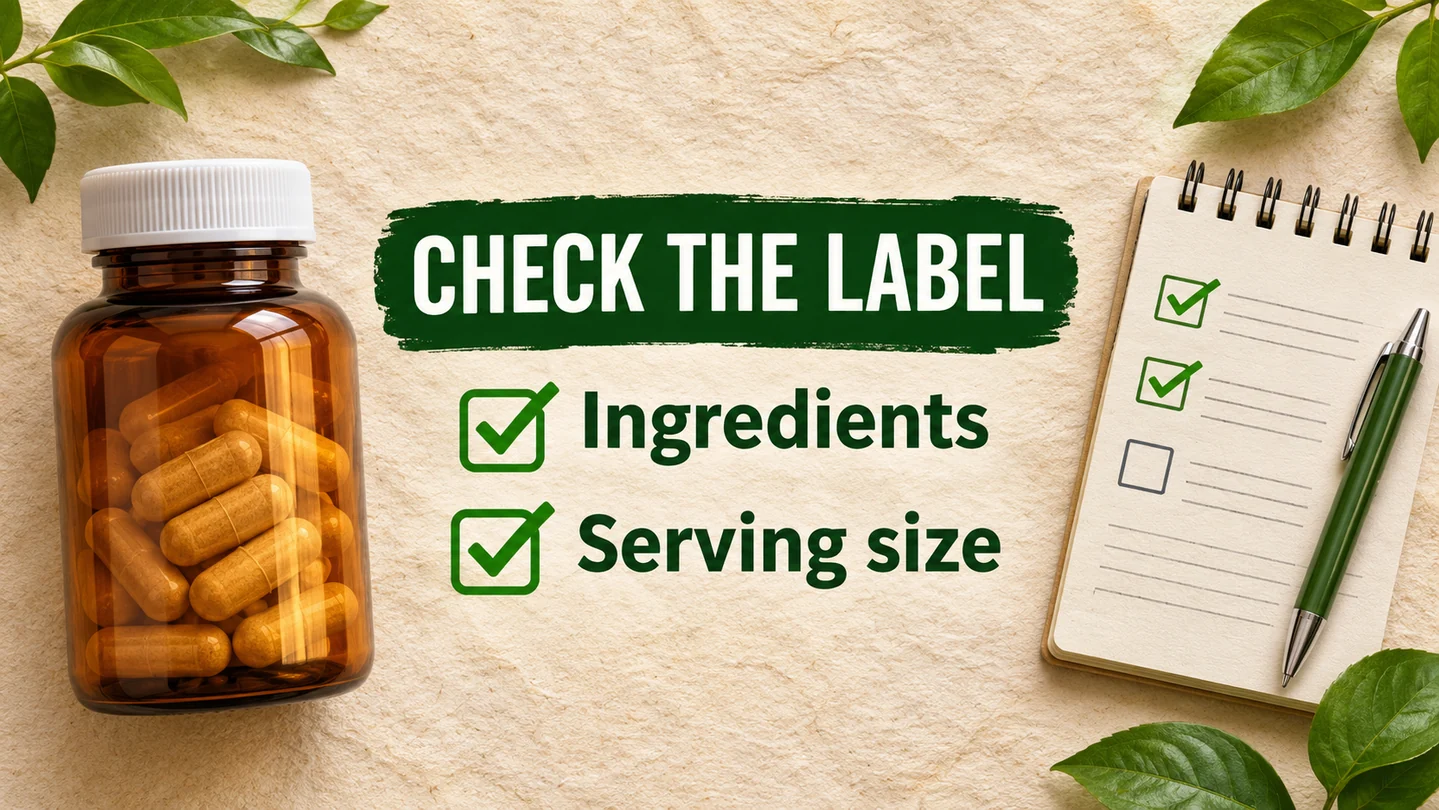
Prenatal vitamins line a whole shelf in most pharmacies, and their labels can look nearly identical at a glance. Underneath, they differ a lot. Some contain no iodine, many contain little choline, and many gummies have no iron. Because there is no required formula, the only way to know what you are getting is to read the Supplement Facts panel. This checklist explains what to look for, what to be wary of, and where a clinician’s advice should override the label. It does not recommend brands; the goal is to help you judge any product yourself, using the NIH Office of Dietary Supplements (ODS), MedlinePlus and published studies.
What to look for in a prenatal vitamin: the short answer
What to look for in a prenatal vitamin: folic acid, iron, iodine, vitamin D, DHA and choline, preformed vitamin A limits, herbal add-ons, quality and when to ask a clinician.
The quick checklist
| Check | What to look for | Notes |
|---|---|---|
| Folic acid | At least 400 mcg (shown as mcg DFE on newer labels) | The ingredient with the strongest evidence |
| Iron | Present, unless your clinician says otherwise | Often missing from gummies |
| Iodine | Listed on the panel | Many prenatals contain none |
| Vitamin D | Listed | Amounts vary widely |
| Vitamin A | Mostly as beta-carotene, not high preformed retinol | Excess preformed vitamin A is harmful in pregnancy |
| DHA and choline | Check whether included or needed separately | Usually low or absent |
| Herbs and “blends” | Avoid unless a clinician approves | Little safety data in pregnancy |
Folic acid: check this first
The USPSTF recommends that anyone who could become pregnant take a daily supplement containing 0.4 to 0.8 mg (400 to 800 mcg) of folic acid to reduce the risk of neural tube defects (Barry et al. (USPSTF) 2023). Almost every prenatal includes it, but confirm the amount.
Newer labels list folate in micrograms of dietary folate equivalents (mcg DFE), which can make the number look larger than the folic acid amount, because folic acid is absorbed better than food folate. The ODS folate fact sheet explains the conversion. Some products use methylfolate instead of folic acid; the trial evidence for neural tube defect prevention is based on folic acid. See folate vs folic acid and methylfolate.
Iron: present, and the right amount for you
Iron needs rise substantially in pregnancy (NIH ODS), and a Cochrane review found that daily iron supplements reduce maternal anemia and iron deficiency (Finkelstein et al. 2024). Many tablet prenatals include iron; many gummies do not.
Iron is also a common cause of digestive side effects (Tolkien et al. 2015), and the benefits and harms for people who are not anemic are still debated (Watt et al. 2025). Your blood tests should guide the amount. See prenatal vitamins with or without iron and iron during pregnancy.
Iodine and vitamin D
Iodine is needed for thyroid hormones that support the baby’s brain development, and needs are higher in pregnancy (NIH ODS). Yet many prenatals contain none. A study of US prenatal products found that many lacked iodine or contained amounts that differed from the label (Leung et al. 2009). If your prenatal has none, ask whether you should get it from iodized salt, dairy or a separate source. See iodine in pregnancy.
Most prenatals include vitamin D, in varying amounts. Cochrane reviews rate most of the evidence on pregnancy outcomes as low or very low certainty, including for doses above the standard recommendation (Palacios et al. 2024; Palacios et al. 2019). See vitamin D in pregnancy.
DHA and choline: often missing
DHA, an omega-3 fat, supports brain and eye development, and a Cochrane review found omega-3 supplements in pregnancy may lower the risk of preterm birth (Middleton et al. 2018). Many prenatals leave it out or offer it as a separate softgel. Fish low in mercury is another source; see omega-3 during pregnancy.
Choline is easy to overlook. Most pregnant people do not meet the recommended intake from food (Korsmo et al. 2019), and the ODS sets an Adequate Intake of 450 mg a day in pregnancy. Most prenatals contain far less than that, if any. Eggs, meat, fish and soy are good food sources. See choline in pregnancy.
What to be wary of
- High preformed vitamin A. Vitamin A listed as retinol or retinyl palmitate counts toward a safety limit; high intakes are linked to birth defects (Rothman et al. 1995). Beta-carotene does not carry the same risk. See vitamin A in pregnancy.
- Herbal blends. Herbs have little safety data in pregnancy (El Hajj et al. 2020). See supplements to avoid during pregnancy.
- Megadoses. More is not better. Very large amounts of single nutrients add risk without proven benefit.
- Doubling up. A prenatal plus a multivitamin, a gummy and a “hair” product can stack the same nutrients. Add up the totals.
- Big claims. Labels promising faster hair growth or easier conception go beyond the evidence; see prenatal vitamins for hair growth.
Labels and quality
The FDA does not approve dietary supplements before they are sold, and label accuracy is not guaranteed. A 2025 study that measured selected nutrients and heavy metals in prenatal products found that actual content did not always match the label (Borgelt et al. 2025). Third-party testing seals indicate that a product was checked for what it claims to contain, though they do not prove a product works. The NCCIH offers general tips for choosing supplements wisely. Format matters too; see gummy vs pill prenatal vitamins. Remember that a prenatal is a backup to a varied diet, not a replacement for it or for prenatal care.
Making the one you choose work
The best label in the world does little if the bottle sits unopened. A product you can take every day is worth more than a “complete” one you skip. If a large tablet triggers nausea, taking it with food or at bedtime may help, and splitting doses is sometimes an option if the label allows. If iron causes constipation, more fluids and fiber can help, but ask before switching to a lower-iron product. See prenatal vitamin side effects.
Keep a simple list of everything you take, including any separate DHA, iodine or choline, and bring it to appointments. That makes it easy for your clinician to spot gaps or doubling up. Store supplements out of children’s reach, since iron-containing products can be dangerous to young children if swallowed in large amounts (NIH ODS).
When to ask a clinician
Bring your prenatal to your first visit and ask whether it suits you. Individual advice matters most if you have anemia, thyroid disease, diabetes, epilepsy, a history of a neural tube defect pregnancy, past bariatric surgery, or use GLP-1 medicines. Some of these situations call for higher-dose folic acid by prescription or different amounts of iron. Seek care promptly for severe nausea and vomiting, bleeding, or signs of anemia such as unusual tiredness or breathlessness.
FAQ
Is a more expensive prenatal better?
Not necessarily. Price does not guarantee better content. Compare the Supplement Facts panels against this checklist.
Do I need methylfolate instead of folic acid?
For most people, no. The prevention evidence is for folic acid. See methylfolate.
What if my prenatal has no iodine or choline?
Ask your clinician whether diet covers it or whether a separate source makes sense.
Is a regular multivitamin acceptable?
Sometimes, if folic acid is adequate and preformed vitamin A is not high. See multivitamins vs prenatal vitamins.
When should I start taking one?
Before conception if possible. See when to start prenatal vitamins.
Sources
- NIH Office of Dietary Supplements. Folate: Fact Sheet for Health Professionals.
- NIH Office of Dietary Supplements. Iron: Fact Sheet for Health Professionals.
- NIH Office of Dietary Supplements. Iodine: Fact Sheet for Health Professionals.
- NIH Office of Dietary Supplements. Choline: Fact Sheet for Health Professionals.
- NIH Office of Dietary Supplements. Vitamin A: Fact Sheet for Health Professionals.
- MedlinePlus. Pregnancy and nutrition.
- FDA. Dietary Supplements.
- NCCIH. Using Dietary Supplements Wisely.
- Barry et al. (US Preventive Services Task Force). Folic acid supplementation to prevent neural tube defects: reaffirmation recommendation statement. JAMA. 2023.
- Finkelstein et al. Daily oral iron supplementation during pregnancy. Cochrane Database Syst Rev. 2024.
- Watt et al. The benefits and harms of oral iron supplementation in non-anaemic pregnant women: a systematic review and meta-analysis. Fam Pract. 2025.
- Tolkien et al. Ferrous sulfate supplementation causes significant gastrointestinal side-effects in adults: a systematic review and meta-analysis. PLoS One. 2015.
- Leung et al. Iodine content of prenatal multivitamins in the United States. N Engl J Med. 2009.
- Palacios et al. Vitamin D supplementation for women during pregnancy. Cochrane Database Syst Rev. 2024.
- Palacios et al. Regimens of vitamin D supplementation for women during pregnancy. Cochrane Database Syst Rev. 2019.
- Middleton et al. Omega-3 fatty acid addition during pregnancy. Cochrane Database Syst Rev. 2018.
- Korsmo et al. Choline: exploring the growing science on its benefits for moms and babies. Nutrients. 2019.
- Borgelt et al. Content of selected nutrients and heavy metals in prenatal multivitamins and minerals: an observational study. Am J Clin Nutr. 2025.
- Rothman et al. Teratogenicity of high vitamin A intake. N Engl J Med. 1995.
- El Hajj et al. Herbal medicine use during pregnancy: a review of the literature with a special focus on sub-Saharan Africa. Front Pharmacol. 2020.
Last reviewed November 2026. VitaBrief is educational and is not medical advice. Talk with a doctor, registered dietitian or pharmacist before starting a supplement, especially if you are pregnant, take medication or have kidney disease.
Not medical advice. This guide is for general education. Talk to your doctor or pharmacist before taking a supplement, especially if you are pregnant or breastfeeding, take medication or have a health condition. Medical disclaimer