Ingredient guides
Prenatal vitamins: what they contain, who needs them and what the evidence shows
This prenatal vitamins guide covers why folic acid is the one ingredient with strong evidence, what else a prenatal usually adds, why contents vary so much, and why food and prenatal care come first.
VitaBrief editorial · Last reviewed November 2026 · Sources listed below
Reader-supported. This page may contain affiliate links. If you buy through one, we may earn a commission at no extra cost to you. It never changes what we write. Affiliate disclosure

Prenatal vitamins are among the most widely recommended supplements in the United States, and they are often treated as a simple box to tick once pregnancy is on the horizon. The reality is more nuanced. One ingredient, folic acid, has strong evidence behind it. The rest of a typical prenatal acts mainly as a backup for gaps in the diet, and products differ a great deal in what they actually contain. This guide explains what prenatal vitamins are, what the research shows, and how to think about safety, drawing on the NIH Office of Dietary Supplements (ODS), MedlinePlus and published reviews.
Prenatal vitamins guide: the short answer
Prenatal vitamins guide: what they contain, the strong evidence for folic acid, what studies show for iron, vitamin D, iodine, DHA and choline, label gaps, safety and when to talk to a clinician.
What a prenatal vitamin is
A prenatal vitamin is a multivitamin and mineral product designed for people who are pregnant, planning a pregnancy or breastfeeding. Compared with a standard adult multivitamin, it usually emphasizes nutrients whose needs rise in pregnancy, such as folic acid and iron. For a side-by-side look, see multivitamins vs prenatal vitamins.
There is no single legal recipe for a prenatal vitamin in the US. Most are sold as dietary supplements, and the FDA does not approve supplements for safety or effectiveness before they reach the market. Manufacturers decide which nutrients to include and in what amounts.
Health agencies frame these products as a supplement to good nutrition, not a substitute. MedlinePlus and the Office on Women’s Health both stress a varied diet and regular prenatal care alongside any vitamin.
Folic acid: the ingredient with strong evidence
The clearest reason to take a prenatal vitamin is folic acid. Taking it before conception and in early pregnancy reduces the risk of neural tube defects, serious birth defects of the brain and spine that form in the first weeks of pregnancy, often before a person knows they are pregnant. The US Preventive Services Task Force recommends that anyone who could become pregnant take a daily supplement containing 0.4 to 0.8 mg (400 to 800 mcg) of folic acid (Barry et al. (USPSTF) 2023).
We cover the details in folic acid in pregnancy, the broader folate guide and folate vs folic acid. For timing questions, see when to start prenatal vitamins.
What else is usually inside
Beyond folic acid, most prenatals add a mix of other nutrients. The evidence for each is different.
| Nutrient | Why it matters in pregnancy | What the evidence suggests |
|---|---|---|
| Folic acid | Neural tube development | Strong: reduces neural tube defect risk when started before conception |
| Iron | Blood volume expands; supports the baby’s iron stores | Reduces maternal anemia and iron deficiency; benefits for other outcomes less clear |
| Iodine | Thyroid hormones for brain development | Needs rise in pregnancy; many prenatals contain little or none |
| Vitamin D | Bone health and calcium use | Mixed trial results for pregnancy outcomes |
| DHA (omega-3) | Brain and eye development | Some evidence for lower preterm birth risk; often sold separately |
| Choline | Brain development | Many people fall short; most prenatals contain little |
A Cochrane review found that daily oral iron in pregnancy reduces maternal anemia and iron deficiency (Finkelstein et al. 2024); see iron during pregnancy. For vitamin D, a 2024 Cochrane review rated most of the evidence on pregnancy complications as low or very low certainty (Palacios et al. 2024). Omega-3 fats are covered in omega-3 during pregnancy, iodine in iodine in pregnancy and calcium in calcium during pregnancy. Choline gets its own page in choline in pregnancy.
What the evidence shows for the whole product
Studying a prenatal vitamin as a whole is harder than studying folic acid alone. A Cochrane review of multiple-micronutrient supplements compared them with iron and folic acid alone and found some benefits for birth outcomes such as low birth weight, but most trials were done in low- and middle-income countries where deficiencies are more common (Keats et al. 2019). The results may not translate directly to well-nourished populations.
Other research is observational. Studies have linked prenatal vitamin or folic acid use around conception with a lower likelihood of autism in children (Schmidt et al. 2011; Surén et al. 2013), and a 2026 observational study from China linked multivitamin use before and during pregnancy with higher odds of medically indicated preterm birth, though the authors noted causality could not be confirmed (Sun et al. 2026). These studies show associations, not cause and effect.
Contents vary more than you might expect
Because there is no standard formula, prenatals differ widely. Some contain no iodine. Many contain little or no choline. Gummy prenatals often leave out iron entirely. Older research found that many US prenatals either lacked iodine or contained amounts that differed from the label (Leung et al. 2009), and a 2025 study that measured the actual content of prenatal products found that some did not match their labels for selected nutrients (Borgelt et al. 2025).
The practical takeaway is to read the Supplement Facts panel rather than assume. Our label checklist walks through what to check, and gummy vs pill prenatal vitamins covers the trade-offs of each format.
Safety: more is not better
Prenatal vitamins are generally well tolerated, but a few points matter:
- Preformed vitamin A. High intakes of preformed vitamin A (retinol) are linked to birth defects (Rothman et al. 1995; NIH ODS). See vitamin A in pregnancy.
- Doubling up. Taking a prenatal plus a separate multivitamin or several single nutrients can push some intakes too high. Check totals across everything you take.
- Herbal add-ons. Some products include herbs, which have little safety data in pregnancy. See supplements to avoid during pregnancy.
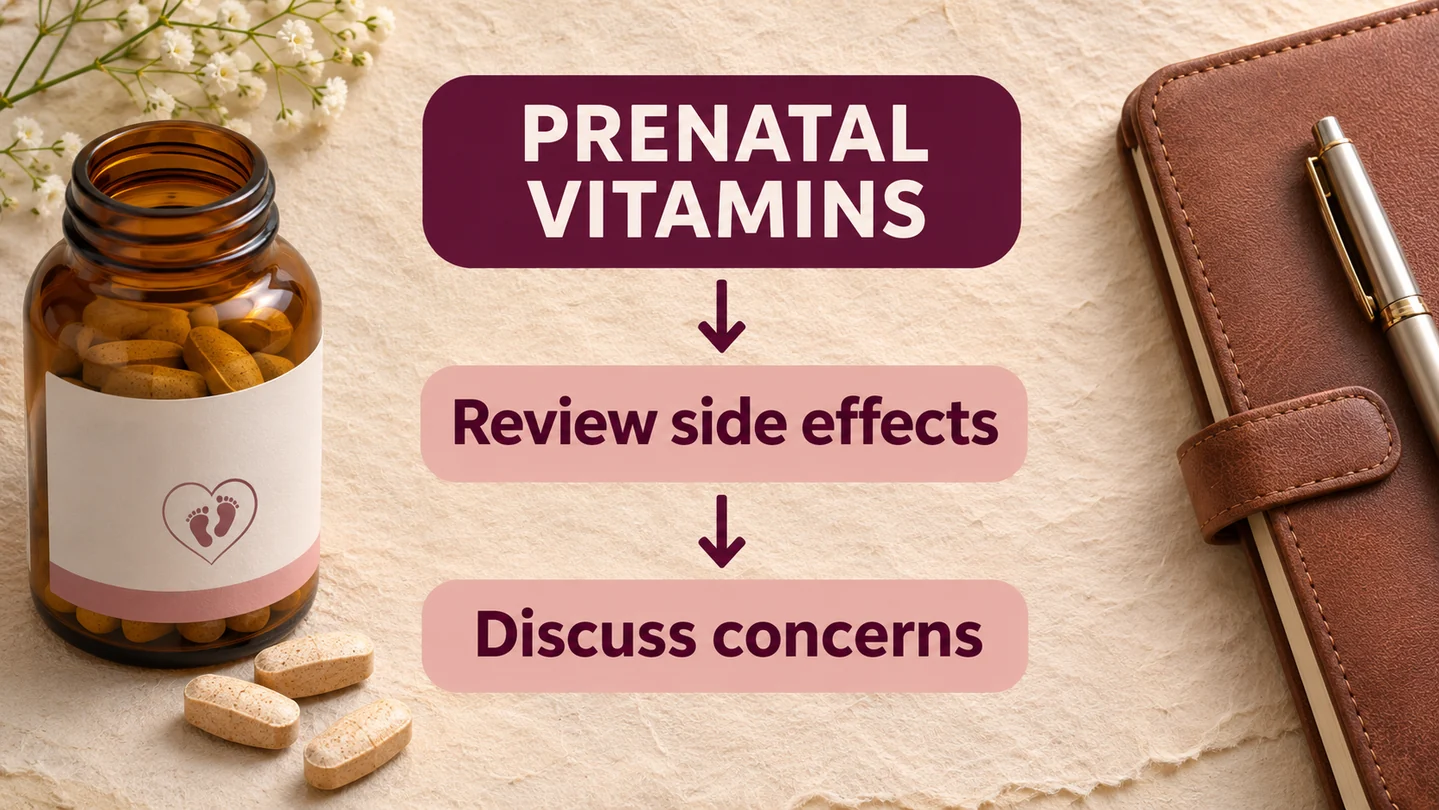
- Side effects. Nausea, constipation and dark stools are common, and iron is a frequent cause of digestive side effects (Tolkien et al. 2015). See prenatal vitamin side effects.
Two common myths are also worth addressing. Prenatal vitamins do not cause weight gain, and they do not make hair grow faster in people who are not deficient. More on that in prenatal vitamins for hair growth and prenatal vitamins when not pregnant. The NCCIH also advises telling your health care providers about every supplement you use.
Food and prenatal care come first
A prenatal vitamin cannot make up for a poor diet, and it is not a replacement for prenatal care. Regular visits allow screening for anemia, blood pressure problems, gestational diabetes and thyroid issues, none of which a supplement can detect. The NICHD emphasizes early and regular care as a cornerstone of a healthy pregnancy. After birth, needs shift again; see prenatal vs postnatal vitamins.
When to talk to a doctor
Talk with a doctor, midwife or pharmacist about your supplements if any of the following apply:
- A previous pregnancy affected by a neural tube defect, epilepsy medicines, diabetes or past bariatric surgery. Some people in these groups need higher-dose folic acid by prescription or other tailored advice.
- Anemia, thyroid disease or a restrictive diet.
- Use of GLP-1 medicines or plans to stop them; see prenatal vitamins and GLP-1.
Seek care promptly for severe nausea and vomiting that stops you keeping food or fluids down (hyperemesis), any vaginal bleeding, or feeling faint or very tired, which can signal anemia. A vitamin is not a treatment for any of these.
FAQ
Do I need a prenatal vitamin if I eat well?
Folic acid is still recommended for anyone who could become pregnant, because it is hard to rely on food alone for that early window. Other nutrients depend on your diet; ask your clinician.
Is a regular multivitamin good enough?
It may be, if it has enough folic acid and no excess preformed vitamin A. See multivitamins vs prenatal vitamins.
Do prenatal vitamins help you get pregnant?
The evidence is limited and mostly observational. See prenatal vitamins and fertility.
Should I take my prenatal while breastfeeding?
Many people do, but needs change after birth. See prenatal vs postnatal vitamins.
Do prenatal vitamins make you gain weight?
No. Vitamins and minerals contain essentially no calories. Weight changes in pregnancy have other causes.
Sources
- NIH Office of Dietary Supplements. Folate: Fact Sheet for Health Professionals.
- NIH Office of Dietary Supplements. Iodine: Fact Sheet for Health Professionals.
- NIH Office of Dietary Supplements. Vitamin A: Fact Sheet for Health Professionals.
- MedlinePlus. Pregnancy and Nutrition.
- NICHD. Pregnancy.
- Office on Women’s Health. Staying healthy and safe during pregnancy.
- FDA. Dietary Supplements.
- NCCIH. Using Dietary Supplements Wisely.
- Barry et al. (US Preventive Services Task Force). Folic acid supplementation to prevent neural tube defects: reaffirmation recommendation statement. JAMA. 2023.
- Keats et al. Multiple-micronutrient supplementation for women during pregnancy. Cochrane Database Syst Rev. 2019.
- Finkelstein et al. Daily oral iron supplementation during pregnancy. Cochrane Database Syst Rev. 2024.
- Palacios et al. Vitamin D supplementation for women during pregnancy. Cochrane Database Syst Rev. 2024.
- Middleton et al. Omega-3 fatty acid addition during pregnancy. Cochrane Database Syst Rev. 2018.
- Korsmo et al. Choline: exploring the growing science on its benefits for moms and babies. Nutrients. 2019.
- Borgelt et al. Content of selected nutrients and heavy metals in prenatal multivitamins and minerals: an observational study. Am J Clin Nutr. 2025.
- Leung et al. Iodine content of prenatal multivitamins in the United States. N Engl J Med. 2009.
- Tolkien et al. Ferrous sulfate supplementation causes significant gastrointestinal side-effects in adults: a systematic review and meta-analysis. PLoS One. 2015.
- Rothman et al. Teratogenicity of high vitamin A intake. N Engl J Med. 1995.
- Schmidt et al. Prenatal vitamins, one-carbon metabolism gene variants, and risk for autism. Epidemiology. 2011.
- Surén et al. Association between maternal use of folic acid supplements and risk of autism spectrum disorders in children. JAMA. 2013.
- Sun et al. The association between maternal multivitamin intake and premature birth. Sci Rep. 2026.
Last reviewed November 2026. VitaBrief is educational and is not medical advice. Talk with a doctor, registered dietitian or pharmacist before starting a supplement, especially if you are pregnant, take medication or have kidney disease.
Not medical advice. This guide is for general education. Talk to your doctor or pharmacist before taking a supplement, especially if you are pregnant or breastfeeding, take medication or have a health condition. Medical disclaimer