Supplement basics
Vitamin E deficiency: symptoms, causes and who is at risk
Why true vitamin E deficiency is rare in healthy people, the nerve, muscle and eye symptoms it can cause, the conditions behind most cases and how it is checked.
VitaBrief editorial · Last reviewed November 2026 · Sources listed below
Reader-supported. This page may contain affiliate links. If you buy through one, we may earn a commission at no extra cost to you. It never changes what we write. Affiliate disclosure

Searches for vitamin E deficiency symptoms are common, often from people who feel tired or notice tingling and wonder whether a missing nutrient is to blame. The short answer is that true vitamin E deficiency is rare in healthy people. When it does happen, it is almost always linked to a condition that stops the body from absorbing fat, or to a rare inherited disorder.
This article explains what deficiency looks like, who is at risk, how it is checked and why taking a high-dose supplement “just in case” is not the same as treating a deficiency. It draws on the NIH Office of Dietary Supplements (ODS) health professional fact sheet and its consumer fact sheet.
Vitamin E deficiency: the short answer
An evidence-based look at vitamin E deficiency: why it is rare, its neurological symptoms, the main causes such as fat malabsorption and rare genetic disorders, how status is measured and when supplements are used.
What vitamin E does and why deficiency matters
Vitamin E is the collective name for a group of fat-soluble compounds with antioxidant activity. Of the eight natural forms, alpha-tocopherol is the only one recognized to meet human requirements (ODS). As an antioxidant, it helps protect cells from damage caused by free radicals, which the body forms when it turns food into energy and which also come from cigarette smoke, air pollution and ultraviolet light. The consumer fact sheet adds that the body needs vitamin E for immune function, and that it helps widen blood vessels and keep blood from clotting within them (ODS consumer).
Because vitamin E is fat-soluble, the digestive tract needs fat to absorb it. That single fact explains most cases of deficiency: when fat is not properly digested or absorbed, vitamin E goes with it. For a full overview of the nutrient, see our vitamin E guide.
How rare is vitamin E deficiency?
This is where the numbers can look confusing. According to ODS, most people in the United States consume less than the recommended amount of vitamin E. In the August 2021 to August 2023 National Health and Nutrition Examination Survey (NHANES), average daily intake from food and beverages among people aged 2 and older was 9.8 mg for males and 8.5 mg for females, against an adult RDA of 15 mg. ODS notes these estimates might be low, because the amounts and types of fat added during cooking are often unknown (ODS).
Yet ODS also states that frank vitamin E deficiency is rare, and that overt deficiency symptoms have not been found in healthy people who obtain little vitamin E from their diets. The consumer sheet puts it simply: the diets of most Americans provide less than the recommended amounts, but healthy people rarely show any clear signs that they are not getting enough (ODS consumer). In other words, intake below the RDA is common, while clinical deficiency is not.
Symptoms of vitamin E deficiency
ODS lists the signs and symptoms of vitamin E deficiency as anemia, peripheral neuropathy, ataxia, skeletal myopathy, retinopathy and impairment of the immune response (ODS). Several of these terms are medical shorthand, so the table below translates them, using the plainer wording from the consumer fact sheet where it exists.
| Sign or symptom (ODS term) | What it means in plain language |
|---|---|
| Peripheral neuropathy | Nerve damage; ODS describes loss of feeling in the arms and legs |
| Ataxia | Loss of body movement control |
| Skeletal myopathy | Muscle damage and muscle weakness |
| Retinopathy | Damage to the retina; ODS describes vision problems |
| Impaired immune response | A weakened immune system |
| Anemia | Listed by ODS as a sign of deficiency |
The common thread is the nervous system. Neurological symptoms (numbness, poor coordination and muscle weakness) feature heavily in the ODS descriptions, especially in the rare inherited forms covered below. These symptoms are not specific to vitamin E, though. Numbness, tingling, unsteadiness, weakness and vision changes have many possible causes, some of them serious, so they need a proper medical assessment rather than a self-diagnosis.
Causes and groups at risk
ODS names four groups most likely to have inadequate vitamin E status: preterm infants with very low birthweight, people with fat-malabsorption disorders, people with abetalipoproteinemia, and people who have ataxia with vitamin E deficiency (ODS).
Fat-malabsorption disorders. Because the digestive tract requires fat to absorb vitamin E, people who cannot absorb fat well are more likely to become deficient. ODS gives Crohn’s disease, cystic fibrosis and an inability to secrete bile from the liver into the digestive tract as examples. People with these conditions often pass greasy stools or have chronic diarrhea, and they sometimes need water-soluble forms of vitamin E, such as tocopheryl polyethylene glycol-1000 succinate.
Abetalipoproteinemia. This is a rare inherited disorder that results in poor absorption of dietary fat. According to ODS, vitamin E deficiency caused by it leads to problems such as poor transmission of nerve impulses, muscle weakness and retinal degeneration that leads to blindness. Some people with the condition need enormous doses of supplemental vitamin E, approximately 100 mg per kilogram or 5 to 10 g a day, given under specialist care.
Ataxia with vitamin E deficiency (AVED). AVED is another rare inherited disorder, in which the liver’s alpha-tocopherol transfer protein is defective or absent. ODS states that people with AVED have such severe deficiency that they develop nerve damage and lose the ability to walk unless they take large doses of supplemental vitamin E.
Preterm infants with very low birthweight. Babies born preterm weighing under 1,500 grams might be deficient. ODS notes that supplementation in these infants might reduce the risk of some complications, such as hemolytic anemia and retinopathy of prematurity, but it can also increase the risk of infections. This is a decision for the neonatal care team.
How vitamin E status is checked
Vitamin E status is not routinely assessed in clinical practice. When it is, a clinician can measure alpha-tocopherol in plasma or serum. ODS explains that the mean serum concentration in the U.S. population is about 30 micromol/L, and deficiency is typically defined as a plasma concentration below 12 micromol/L (ODS).
These results are not always easy to read. Blood lipids rise with age, which pushes circulating alpha-tocopherol up, and blood levels do not track dietary intake well. ODS says they are therefore not useful for confirming adequate status, although they can identify inadequate status. Testing is a clinician’s call, usually prompted by symptoms or by a known absorption problem.
Preventing low intake: food first
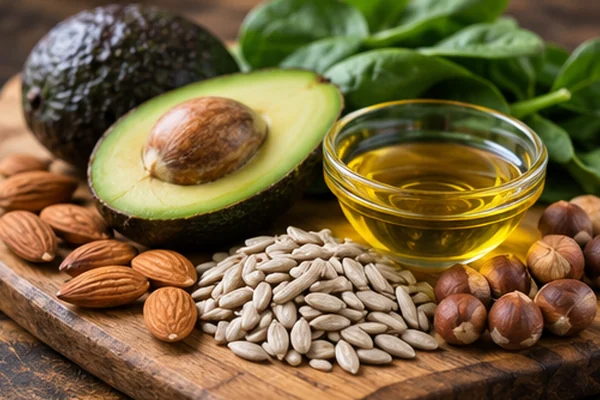
For people without an absorption disorder, the realistic goal is to meet the RDA through food. ODS lists nuts, seeds and vegetable oils among the best sources, with significant amounts in green leafy vegetables and fortified cereals. Examples from the ODS food table include wheat germ oil (20.3 mg per tablespoon), dry roasted sunflower seeds (7.4 mg per ounce) and dry roasted almonds (6.8 mg per ounce). ODS also states that no adverse effects have been reported from consuming large amounts of vitamin E from food (ODS). Our vitamin E foods article has the full list.
| Age | RDA (males and females) | Pregnancy | Lactation |
|---|---|---|---|
| 14 to 18 years | 15 mg | 15 mg | 19 mg |
| 19+ years | 15 mg | 15 mg | 19 mg |
A once-daily multivitamin typically provides about 13.5 mg of vitamin E, according to the ODS consumer sheet, while vitamin E-only supplements commonly contain 67 mg or more, much higher than the recommended amounts. If you already take a multivitamin, our multivitamins guide explains how to check what it contains.
When supplements are and are not the answer
For diagnosed deficiency caused by a medical condition, treatment is set by the doctor managing that condition, sometimes with special water-soluble forms or very large doses that would not be appropriate for anyone else. For a healthy person with no absorption problem, the evidence does not support taking high-dose vitamin E to prevent a deficiency that is unlikely to occur.
High doses carry their own risks. ODS sets the adult Tolerable Upper Intake Level (UL) for supplemental alpha-tocopherol at 1,000 mg a day and links high-dose supplements to bleeding and hemorrhagic stroke risk (ODS). A meta-analysis of 19 trials concluded that high-dosage (400 IU a day or more) vitamin E supplements may increase all-cause mortality and should be avoided (Miller 2005).
Vitamin E supplements can also interact with blood thinners; see vitamin E, bleeding risk and blood thinners and vitamin E side effects. The FDA regulates supplements under a different set of rules from drugs, and manufacturers are responsible for evaluating the safety and labeling of their products before marketing.
Frequently asked questions
What are the first signs of vitamin E deficiency?
ODS lists nerve and muscle problems such as loss of feeling in the arms and legs, loss of movement control, muscle weakness and vision problems, plus a weakened immune system. These signs have many other causes, so see a doctor rather than self-treating.
Can a poor diet cause vitamin E deficiency?
Low intake is common, but ODS says overt deficiency symptoms have not been found in healthy people who get little vitamin E from food. Deficiency is almost always linked to conditions that affect fat absorption.
Does vitamin E deficiency cause neurological symptoms?
Yes. ODS lists peripheral neuropathy and ataxia among the symptoms, and describes nerve damage and loss of the ability to walk in severe inherited forms such as AVED.
Should I take vitamin E if I have Crohn’s disease or cystic fibrosis?
People with these conditions are at higher risk, but the form and dose should come from the doctor managing your care. ODS notes some need water-soluble forms.
How much vitamin E do adults need?
The RDA for adults is 15 mg a day, or 19 mg during breastfeeding. See our vitamin E dosage article for the full table and IU conversions.
Sources
- NIH Office of Dietary Supplements. Vitamin E: fact sheet for health professionals.
- NIH Office of Dietary Supplements. Vitamin E: fact sheet for consumers.
- Miller, et al. Meta-analysis: high-dosage vitamin E supplementation may increase all-cause mortality. Ann Intern Med. 2005.
- U.S. Food and Drug Administration. Dietary supplements.
Last reviewed November 2026. VitaBrief is educational and is not medical advice. Talk with a doctor, registered dietitian or pharmacist before starting a supplement, especially if you are pregnant, take medication or have kidney disease.
Not medical advice. This guide is for general education. Talk to your doctor or pharmacist before taking a supplement, especially if you are pregnant or breastfeeding, take medication or have a health condition. Medical disclaimer