Ingredient guides
Vitamin E for skin and hair: what is known and what is not
Topical vitamin E oil versus oral supplements, what the evidence does and does not show for scars, wrinkles and hair growth, and why high-dose capsules are not a safe shortcut to better skin.
VitaBrief editorial · Last reviewed November 2026 · Sources listed below
Reader-supported. This page may contain affiliate links. If you buy through one, we may earn a commission at no extra cost to you. It never changes what we write. Affiliate disclosure
Vitamin E oil is one of the most popular home remedies for skin. People rub it on scars, use it as a face oil, massage it into the scalp and take capsules hoping for stronger hair or fewer wrinkles. The appeal is easy to understand: vitamin E is an antioxidant, and sunlight generates the kind of damage antioxidants counter.
But appeal is not evidence. This article explains what vitamin E is, how putting it on your skin differs from swallowing it, what the sources behind this site can and cannot tell you, and why high-dose supplements are not a safe way to chase better skin or hair. It draws on the NIH Office of Dietary Supplements (ODS) and published trials.
Vitamin E for skin and hair: the short answer
Vitamin E for skin and hair: what vitamin E does as an antioxidant, topical oil vs oral supplements, the limits of the evidence, safety of high-dose capsules and practical, cautious advice.
The short answer
None of the government fact sheets or clinical studies this article relies on show that vitamin E, applied to the skin or taken by mouth, fades scars, prevents wrinkles or makes hair grow. That does not prove it never helps anyone, but it means any claims of results should be treated with skepticism. What the sources do show clearly is that vitamin E is an essential nutrient best obtained from food, and that high-dose supplements carry real risks.
| Common claim | What our sources show | Verdict |
|---|---|---|
| Fades scars | No evidence in our sources | Unproven |
| Prevents or reduces wrinkles | No evidence in our sources | Unproven |
| Makes hair grow faster or thicker | No evidence in our sources | Unproven |
| Protects cells from free radicals, including from UV light | ODS describes vitamin E as an antioxidant and lists UV light as a source of free radicals | Biological role, not a proven skin treatment |
| High-dose capsules are harmless | ODS links high-dose supplements to bleeding and hemorrhagic stroke risk | False |
Why vitamin E is linked to skin
Vitamin E is a group of fat-soluble compounds with antioxidant activity, and alpha-tocopherol is the form recognized to meet human needs. Antioxidants protect cells from free radicals, unstable molecules that damage cells. ODS notes that the body forms free radicals when it converts food to energy and is also exposed to them from cigarette smoke, air pollution and ultraviolet radiation from the sun. Vitamin E stops the production of reactive oxygen species formed when fat undergoes oxidation (ODS).
Skin is constantly exposed to sunlight and air, so the idea that an antioxidant could protect it is plausible on paper. The gap is between that mechanism and a visible result. ODS describes many areas where a plausible antioxidant theory did not translate into benefits in randomized trials, including heart disease and cancer (see vitamin E benefits). Skin claims should be held to the same standard, and ODS does not list skin or hair among the health areas it reviews.
Topical oil vs oral supplements
These are two very different things, and it helps to keep them apart.
Topical vitamin E means oils, creams and serums applied to the skin or scalp. Here the vitamin acts, if at all, where it is applied, and it is not counted toward your dietary intake. Our sources do not evaluate topical products, so we cannot say how well vitamin E penetrates the skin or whether it improves any skin condition. As with any cosmetic ingredient, some people may react to it, so a cautious approach is to try a small amount on a small area first and stop if irritation develops. If you have broken skin, a fresh wound or a skin condition, ask a doctor or pharmacist before applying anything.
Oral vitamin E means food and supplements. This is where the safety data apply. ODS says vitamin E from food does not need to be limited, but high-dose supplements might increase the risk of bleeding and of hemorrhagic stroke (ODS Consumer). Popping capsules for your skin exposes your whole body to those doses.
Some people break open a supplement capsule and apply the oil to their skin. That does not carry the internal risks of swallowing it, but it also does not turn the capsule into a tested skin treatment.
Scars, wrinkles and the face
Scars and wrinkles are among the most searched uses of vitamin E. Our sources include no clinical trials of vitamin E for either, so we make no claims about results. Scars change appearance on their own over time, which can make it hard to judge any remedy without a controlled comparison. If a scar is raised, painful, itchy or growing, or if you are concerned about a wound healing, a doctor or dermatologist can advise on options with better evidence.
For the face, the plainest point is that vitamin E oil is an oil. Whether that suits your skin is a matter of personal tolerance rather than proven benefit. The most consistent advice for protecting skin from sun damage is sun protection itself, a point that does not depend on any vitamin.
Hair and scalp
Searches such as “vitamin E for hair growth” are common, but none of our sources examined vitamin E for hair growth, thickness or hair loss, so we cannot say it works. Hair loss has many possible causes, including medical ones, and a doctor can help find the reason, especially if it is sudden or patchy.
Deficiency is sometimes cited as a reason to supplement for hair. ODS lists the signs of vitamin E deficiency as anemia, peripheral neuropathy, ataxia, skeletal myopathy, retinopathy and impaired immune response; hair loss is not among them. ODS also says deficiency is rare in healthy people and is almost always linked to fat-malabsorption conditions or rare genetic disorders (ODS). See vitamin E deficiency for details.
Why high-dose capsules are not a shortcut
Many vitamin E capsules sold for skin and hair are high dose. ODS notes that vitamin-E-only supplements commonly contain 67 mg or more, much more than the adult RDA of 15 mg (ODS Consumer). The upper limit for adults is 1,000 mg a day of supplemental alpha-tocopherol, but ODS adds that some research suggests harm even below that.
The trial evidence explains the caution:
- In the Physicians’ Health Study II, 400 IU of vitamin E every other day had no effect on major cardiovascular events but was associated with an increased risk of hemorrhagic stroke (Sesso 2008).
- In SELECT, 400 IU/day of synthetic vitamin E led its authors to conclude that “Dietary supplementation with vitamin E significantly increased the risk of prostate cancer among healthy men” (Klein 2011).
- A meta-analysis concluded that high-dosage vitamin E (400 IU/day or more) may increase all-cause mortality and should be avoided (Miller 2005).
ODS also warns that vitamin E can increase bleeding risk in people taking anticoagulant or antiplatelet medicines such as warfarin. If you take a blood thinner or have surgery planned, talk to your doctor before taking vitamin E (see vitamin E and blood thinners). More is in vitamin E side effects.
A sensible approach
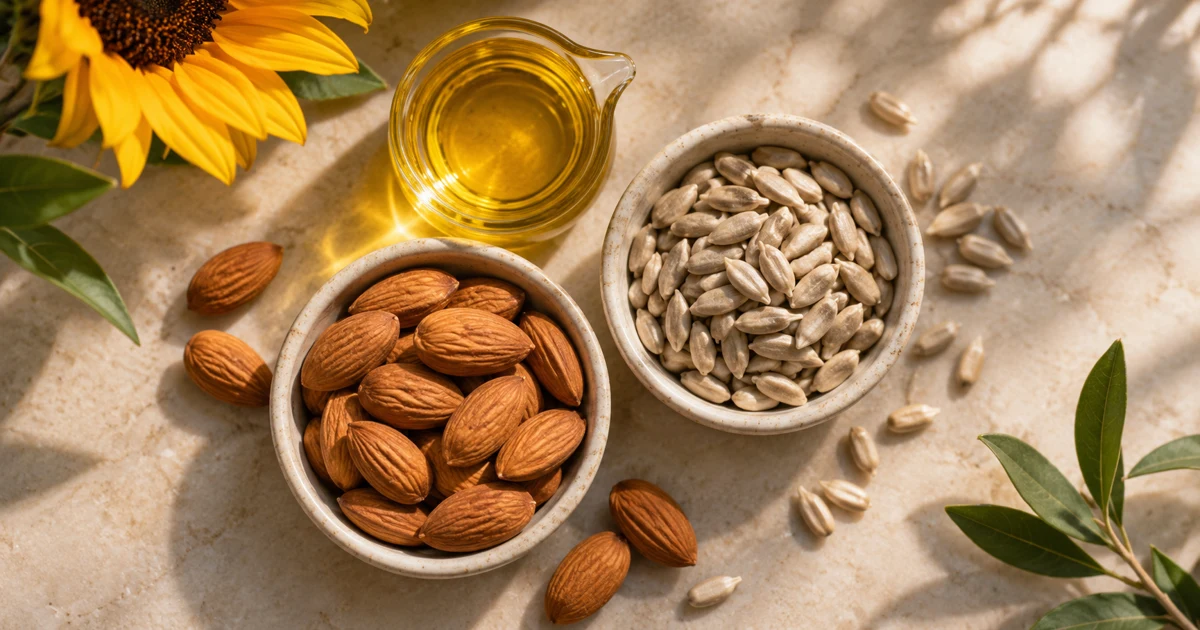
If your goal is healthier skin and hair, the evidence-backed part is making sure you get enough vitamin E from a varied diet. Nuts, seeds, vegetable oils and green vegetables are good sources; an ounce of dry-roasted sunflower seeds provides 7.4 mg and an ounce of dry-roasted almonds 6.8 mg, according to ODS. See vitamin E foods. Other nutrients often discussed for skin, such as vitamin C and zinc, are covered in our vitamin C guide and zinc guide, and the two antioxidants are compared in vitamin E vs vitamin C.
If you enjoy a vitamin E cream or oil and it does not irritate your skin, there is little reason to stop, but keep expectations modest. Avoid taking high-dose capsules for cosmetic reasons, and if you do take a supplement, check how much a multivitamin already gives you and read how to choose a vitamin E supplement.
Frequently asked questions
Is vitamin E oil good for your face?
Our sources contain no trials of topical vitamin E on the face, so we cannot say it improves skin. Some people may find it irritating; testing a small area first is a cautious step.
Does vitamin E help scars?
There is no evidence in our sources that vitamin E fades scars. Ask a doctor or dermatologist about scars that concern you.
Does vitamin E help hair growth?
None of our sources studied vitamin E for hair growth, and ODS does not list hair loss as a sign of deficiency. Persistent hair loss is worth discussing with a doctor.
Should I take vitamin E capsules for my skin?
High-dose supplements have been linked to bleeding, hemorrhagic stroke and, in SELECT, prostate cancer risk in men. Food is the safer way to meet your needs.
Can vitamin E cause acne?
Our sources do not address this. If a product seems to worsen breakouts or irritation, stop using it and seek advice if it persists.
Sources
- NIH Office of Dietary Supplements. Vitamin E: fact sheet for health professionals.
- NIH Office of Dietary Supplements. Vitamin E: fact sheet for consumers.
- Sesso, et al. Vitamins E and C in the prevention of cardiovascular disease in men: the Physicians’ Health Study II randomized controlled trial. JAMA. 2008.
- Klein, et al. Vitamin E and the risk of prostate cancer: the Selenium and Vitamin E Cancer Prevention Trial (SELECT). JAMA. 2011.
- Miller, et al. Meta-analysis: high-dosage vitamin E supplementation may increase all-cause mortality. Ann Intern Med. 2005.
Last reviewed November 2026. VitaBrief is educational and is not medical advice. Talk with a doctor, registered dietitian or pharmacist before starting a supplement, especially if you are pregnant, take medication or have kidney disease.
Not medical advice. This guide is for general education. Talk to your doctor or pharmacist before taking a supplement, especially if you are pregnant or breastfeeding, take medication or have a health condition. Medical disclaimer