Comparisons
Collagen vs. whey protein (and creatine)
Collagen is a protein, but not a complete one. Here is how it compares with whey for muscle, older adults and daily protein, and where creatine fits.
VitaBrief editorial · Last reviewed November 2026 · Sources listed below
Reader-supported. This page may contain affiliate links. If you buy through one, we may earn a commission at no extra cost to you. It never changes what we write. Affiliate disclosure
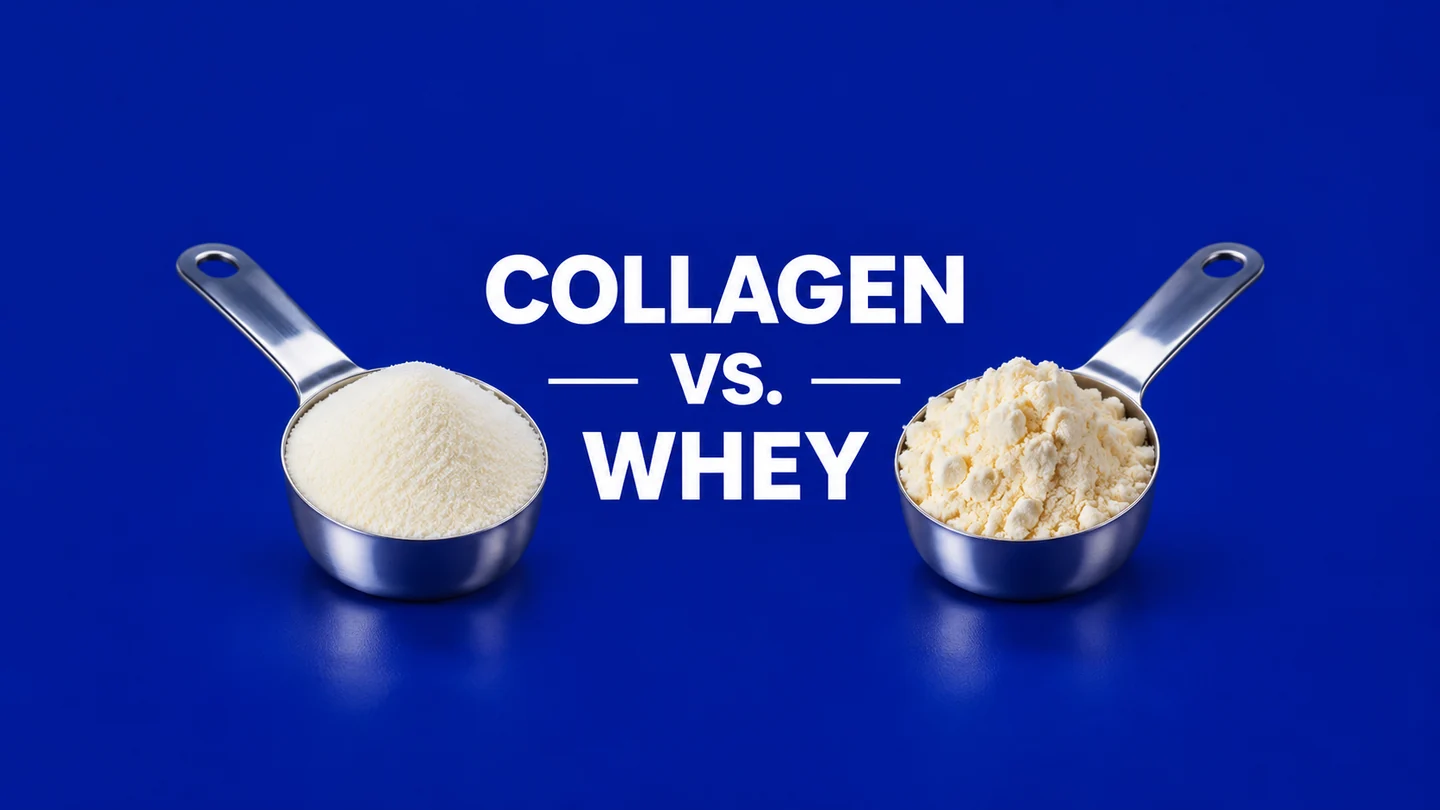
Collagen vs Whey Protein: the short answer
Whey is a complete, leucine-rich protein and clearly better for muscle protein synthesis. Collagen is incomplete but still counts toward daily protein in a mixed diet. Collagen-plus-training trials compared collagen with no protein, not with whey. Use collagen for its connective-tissue niche and keep a complete protein for muscle; creatine can be taken alongside either.
Collagen and whey are both sold as protein powders, and Google Autocomplete shows people often weigh “collagen vs. whey protein,” “collagen vs. protein powder” and “collagen and creatine.” They do very different jobs. Whey is a complete, leucine-rich protein that reliably supports muscle building. Collagen is an incomplete protein with a unique amino acid profile aimed at connective tissue. This guide compares them using muscle research indexed in PubMed and protein guidance from MedlinePlus.
At a glance
| Feature | Collagen peptides | Whey protein |
|---|---|---|
| Source | Animal hide, bone, fish skin | Milk |
| Complete protein? | No (lacks tryptophan) | Yes |
| Leucine per 25 g protein | About 0.7–0.9 g | About 2.5–3 g |
| Rich in | Glycine, proline, hydroxyproline | Leucine, other branched-chain amino acids |
| Muscle protein synthesis | Weak | Strong |
| Studied for | Skin, joints, tendons, bone | Muscle mass and strength, recovery |
| Dissolves in | Hot and cold liquids, no taste | Best in cold liquids; flavored |
| Lactose | None | Some (less in isolate) |
Is collagen a complete protein?
No. A complete protein supplies all nine essential amino acids in adequate amounts. Collagen lacks tryptophan entirely and is low in several others, so under the standard protein-quality score (PDCAAS) it rates as incomplete (Paul 2019). That does not make collagen useless as protein. In a mixed diet with meat, dairy, eggs, soy or legumes, the missing amino acids come from other foods. The same analysis estimated collagen can make up a sizable share of protein intake without causing an essential amino acid shortfall.
Muscle protein synthesis: whey wins
Muscle growth depends partly on how strongly a protein switches on muscle protein synthesis, and leucine is the key trigger. A randomized trial in 22 healthy older women compared 30 grams of whey with 30 grams of collagen twice daily for six days, with and without resistance exercise. Whey increased muscle protein synthesis at rest and after exercise. Collagen raised it only modestly after exercise in the short term and did not raise it over the longer measurement period. The authors concluded whey is the more effective supplement for supporting muscle in older women (Oikawa 2020).
This fits what is known about protein quality. For building or keeping muscle, whey, milk, eggs, soy and other complete proteins are better choices. See whey vs. plant protein for more options.
But what about collagen + strength training trials?
Several trials from German research groups found that adding 15 grams of collagen peptides to 12 weeks of resistance training increased fat-free mass more than placebo.
| Study | Participants | Finding |
|---|---|---|
| Zdzieblik 2015 | 53 older men with sarcopenia | Greater fat-free mass and strength gains than placebo |
| Jendricke 2019 | 77 premenopausal women | Greater fat-free mass and hand-grip strength gains |
| Kirmse 2019 | 57 young men | Greater fat-free mass gain; similar strength |
There is an important catch: the placebo in these trials was a non-protein substance such as silica or maltodextrin. So they show that adding 15 grams of protein helps compared with adding no protein, which is expected. They do not show collagen beats whey. Some of the gain in “fat-free mass” may also reflect connective tissue or water rather than muscle fibers. No trial has shown collagen outperforms an equal amount of a complete protein for muscle.
Whey plus collagen blends
Recent research suggests a blend may combine strengths: whey for muscle fibers and collagen for connective tissue. In one 2025 study, a whey-plus-collagen blend increased synthesis rates of both muscle fiber protein and muscle connective tissue protein (Aussieker 2025). This is early research, but it supports a practical approach: if you like collagen, use it alongside, not instead of, a complete protein.
Older adults
Older adults need more protein per meal to stimulate muscle, and leucine-rich proteins work best. In a small study of older women on a low-protein diet, a fortified collagen hydrolysate maintained nitrogen balance similarly to whey (Hays 2009), which suggests collagen protein is not “wasted.” But for preserving muscle, the muscle synthesis data favor whey. See protein for older adults.
Collagen and creatine together
“Collagen and creatine” is a fast-rising search. They are unrelated: creatine is a compound that helps recycle energy in muscle and has strong evidence for strength and power, while collagen is a structural protein. There is no known interaction, and they can be mixed in the same drink. Note one confusion: “creatine” and the blood test “creatinine” are different things. See our creatine guide.
| Goal | Better first choice |
|---|---|
| Build muscle and strength | Complete protein (whey, milk, soy) plus creatine |
| Recover from training | Complete protein |
| Support tendons during rehab | Collagen or gelatin with vitamin C before loading exercise |
| Joint discomfort | Collagen (modest evidence) |
| Raise daily protein with a neutral-taste add-in | Collagen is convenient; count it as part of total |
| Dairy-free | Collagen or plant protein; lactose-sensitive people may tolerate whey isolate |
Putting it together: a sample day
For an active adult aiming for about 1.2 to 1.6 grams of protein per kilogram of body weight, a practical pattern is three or four meals that each contain 25 to 40 grams of mostly complete protein, such as eggs or Greek yogurt at breakfast, fish, poultry, tofu or beans at lunch and dinner, and a whey or plant shake after training. Collagen can slot in on top, for example 10 grams in morning coffee, contributing about 9 grams to the daily total. If you take creatine, 3 to 5 grams a day can go into any of those drinks. See how much protein per day for targets by age and activity.
The main mistake to avoid is counting a collagen-only coffee as your protein for the morning and skipping a complete-protein meal. That trades a leucine-rich meal for one that does little for muscle, which matters most for older adults and anyone eating less while losing weight.
Cost and convenience
Per gram of protein, collagen and whey are often similarly priced, though marine collagen costs more. Collagen’s advantages are that it has almost no taste, dissolves in hot coffee and does not contain lactose. Whey’s advantages are its amino acid profile and decades of muscle research. If you are choosing only one product for fitness, whey or another complete protein is the better buy. See how to choose a protein powder.
Safety notes
Both are generally safe for healthy adults. Whey can cause digestive symptoms in people with lactose intolerance; isolate is lower in lactose. Collagen sources may include fish or egg allergens. People with kidney disease should discuss total protein intake with their care team before adding either. See collagen side effects and protein powder side effects.
The bottom line
- Whey is a complete, leucine-rich protein and clearly better for muscle protein synthesis.
- Collagen is incomplete but still counts toward daily protein in a mixed diet.
- Collagen-plus-training trials compared collagen with no protein, not with whey.
- Use collagen for its connective-tissue niche and keep a complete protein for muscle; creatine can be taken alongside either.
Frequently asked questions
Can collagen replace protein powder?
Not for muscle building. It can supplement protein intake but should not be your only protein source.
Can I mix collagen and whey?
Yes. Early research suggests the combination supports both muscle and connective tissue protein synthesis.
Does collagen count toward my protein goal?
Yes, as long as the rest of your diet supplies complete protein.
Is collagen better for women than whey?
No. Women build muscle with the same proteins as men; whey or other complete proteins work best.
Does collagen build muscle?
Weakly. It helps more than no protein, but less than an equal amount of complete protein.
Sources
- Oikawa SY, et al. Whey protein but not collagen peptides stimulate acute and longer-term muscle protein synthesis with and without resistance exercise in healthy older women. Am J Clin Nutr. 2020;111(3):708-718.
- Paul C, et al. Significant amounts of functional collagen peptides can be incorporated in the diet while maintaining indispensable amino acid balance. Nutrients. 2019;11(5):1079.
- Zdzieblik D, et al. Collagen peptide supplementation in combination with resistance training improves body composition and increases muscle strength in elderly sarcopenic men. Br J Nutr. 2015;114(8):1237-1245.
- Jendricke P, et al. Specific collagen peptides in combination with resistance training improve body composition and regional muscle strength in premenopausal women. Nutrients. 2019;11(4):892.
- Kirmse M, et al. Prolonged collagen peptide supplementation and resistance exercise training affects body composition in recreationally active men. Nutrients. 2019;11(5):1154.
- Aussieker T, et al. Ingestion of a whey plus collagen protein blend increases myofibrillar and muscle connective protein synthesis rates. Med Sci Sports Exerc. 2025;57(3):544-554.
- Hays NP, et al. Effects of whey and fortified collagen hydrolysate protein supplements on nitrogen balance and body composition in older women. J Am Diet Assoc. 2009;109(6):1082-1087.
- MedlinePlus. Protein in diet.
Last reviewed November 2026. VitaBrief is educational and is not medical advice. Talk with a doctor, registered dietitian or pharmacist before starting a supplement, especially if you are pregnant, take medication or have kidney disease.
Not medical advice. This guide is for general education. Talk to your doctor or pharmacist before taking a supplement, especially if you are pregnant or breastfeeding, take medication or have a health condition. Medical disclaimer