Ingredient guides
Prebiotics: a practical guide to what they are and what the research shows
What prebiotics are, how they differ from probiotics, what reviews of inulin and FOS found, and how to try them without upsetting your gut.
VitaBrief editorial · Last reviewed November 2026 · Sources listed below
Reader-supported. This page may contain affiliate links. If you buy through one, we may earn a commission at no extra cost to you. It never changes what we write. Affiliate disclosure
Prebiotics have moved from nutrition textbooks onto supplement shelves, fiber powders and even canned drinks. The word sounds a lot like “probiotic,” and the two are often sold together, which makes it easy to blur them. They are not the same thing, and the evidence behind each is different.
This guide explains what prebiotics are, according to the National Center for Complementary and Integrative Health (NCCIH) and the NIH Office of Dietary Supplements (ODS), what systematic reviews have found, where the evidence is weak, and how to approach them sensibly. It is general information, not medical advice.
What are prebiotics?
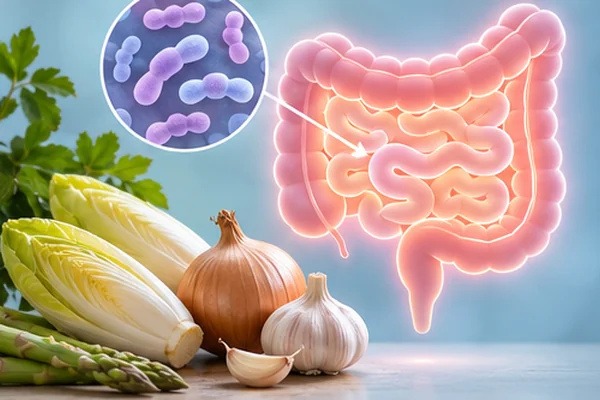
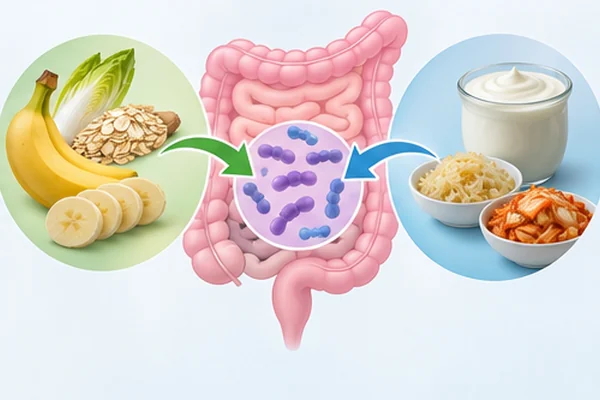
NCCIH answers the most common question directly: prebiotics are not the same as probiotics. It describes prebiotics as nondigestible food components that selectively stimulate the growth or activity of desirable microorganisms. In plain terms, they are food for some of the microbes already living in your gut, rather than microbes themselves.
The ODS fact sheet adds detail. It says prebiotics are typically complex carbohydrates, such as inulin and other fructo-oligosaccharides (FOS), that microorganisms in the gastrointestinal tract use as metabolic fuel. Because your own digestive enzymes do not break these carbohydrates down, they travel further along the gut, where bacteria can ferment them.
Two related terms come up often. NCCIH defines synbiotics as products that combine probiotics and prebiotics. ODS, citing a consensus statement from the International Scientific Association for Probiotics and Prebiotics (ISAPP), describes postbiotics as preparations of dead, intact or fragmented microorganisms, with or without their metabolites, that confer a health benefit on the host. Our postbiotics explainer covers that newer category in more depth.
Prebiotics, probiotics and related terms at a glance
| Term | What it is | Common examples |
|---|---|---|
| Prebiotic | Nondigestible food component that selectively stimulates desirable gut microorganisms (NCCIH) | Inulin and other fructo-oligosaccharides (ODS) |
| Probiotic | Live microorganisms that, in adequate amounts, confer a health benefit (ISAPP definition, as quoted by ODS) | Some fermented foods, supplements |
| Synbiotic | Product combining probiotics and prebiotics (NCCIH) | Combination supplements |
| Postbiotic | Preparation of dead, intact or fragmented microorganisms, with or without metabolites, that confers a health benefit (ODS, citing ISAPP) | An emerging product category |
| Dietary fiber | A type of carbohydrate found in plants (MedlinePlus) | Whole grains, nuts, seeds, fruit and vegetables |
Many prebiotics are a kind of dietary fiber, but not every fiber is generally described as a prebiotic. For a deeper side-by-side, see prebiotic vs. probiotic, and for live-microbe products, our probiotics guide.
How many people use them?
NCCIH reports that the 2012 National Health Interview Survey found about 4 million US adults, or 1.6 percent, had used probiotics or prebiotics in the past 30 days. The survey grouped the two together, so it does not tell us how many people used prebiotics alone.
What the research shows
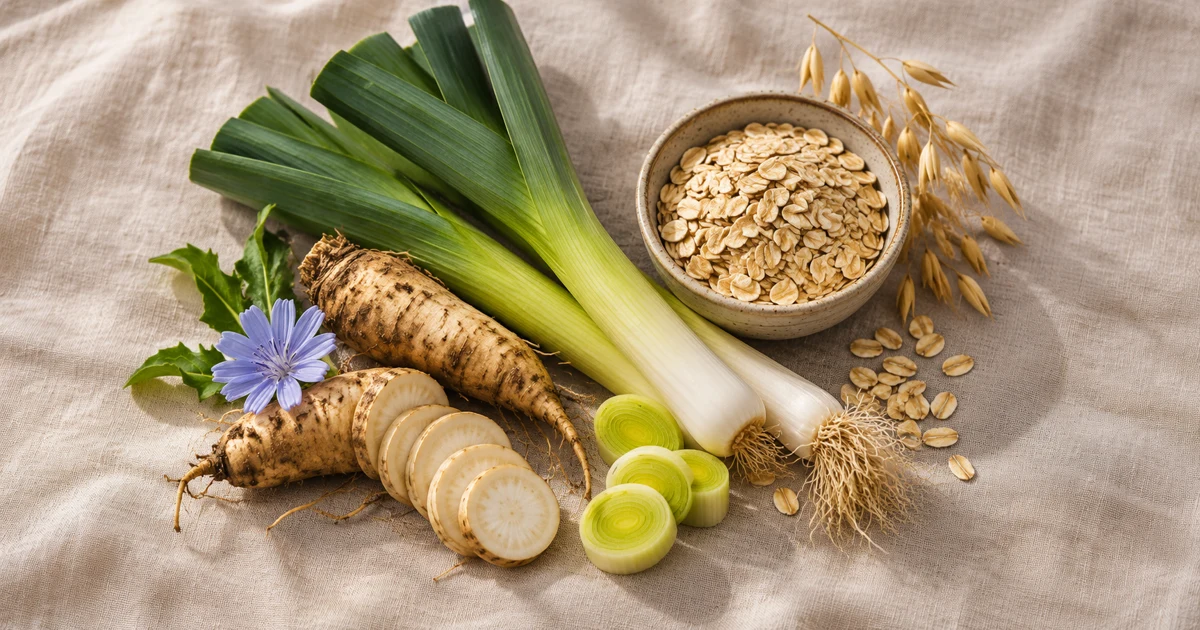
Most human research on prebiotics focuses on inulin-type fructans, a family that includes inulin and FOS, often extracted from chicory root. Several systematic reviews have pooled the trials.
Gut bacteria and bowel function
A 2023 review by Nagy and colleagues pooled 50 studies with 2,525 participants aged 0 to 83. Chicory-derived inulin-type fructans at 3 to 20 g per day significantly increased Bifidobacterium, a group of bacteria often considered beneficial. The effect was seen in healthy people and in several groups with health problems, but not in people with gastrointestinal disorders. The authors also reported beneficial effects on bowel function measures in healthy participants.
A 2022 review by Dou and colleagues looked at FOS in eight trials. FOS raised Bifidobacterium counts, with larger increases at doses above 5 g and with durations longer than four weeks. The authors found no difference from comparators in reported gastrointestinal side effects and concluded that higher doses (7.5 to 15 g per day) and longer use (more than four weeks) showed more distinct effects and were well tolerated.
A rise in one bacterial group is a change in the gut, not proof of a health benefit.
Weight, cholesterol and blood sugar
Reimer and colleagues (2024) pooled 32 studies of chicory inulin-type fructans and found an average body weight difference of about 0.97 kg compared with placebo, along with small reductions in BMI, fat mass and waist circumference. Two of the authors work for a company that produces prebiotic ingredients, which the paper discloses.
Talukdar and colleagues (2024) analyzed 55 randomized trials and found small reductions in LDL cholesterol, triglycerides and body weight, but rated the certainty of evidence as low to very low. Wang and colleagues (2019) pooled 33 trials and reported improvements in fasting glucose, HbA1c, fasting insulin and insulin resistance, with larger effects in people with prediabetes or type 2 diabetes.
Taken together, the effects are modest. Prebiotics are not a weight-loss product and do not replace diabetes or cholesterol treatment. Our prebiotics benefits page breaks down each outcome.
Prebiotics, IBS and bloating
Gut symptoms are one of the main reasons people try prebiotics, yet this is where the evidence is weakest. A 2018 review of treatments for irritable bowel syndrome by Ford and colleagues found that data for prebiotics and synbiotics were sparse. A 2024 network meta-analysis by Wu and colleagues found that prebiotics and synbiotics did not show significant improvement in IBS.
Inulin and FOS are also fermentable carbohydrates, part of the group often called FODMAPs, and they may make symptoms worse for some people with IBS. If you have IBS, it is sensible to talk with a clinician or dietitian before adding them. Gut symptoms that are new, severe or persistent should be checked by a doctor rather than self-treated. More detail is in prebiotics for bloating and IBS.
Food first, then supplements
MedlinePlus notes that most Americans do not eat enough dietary fiber and lists whole grains, nuts and seeds, and fruit and vegetables as good sources. Its page on soluble vs. insoluble fiber says soluble fiber is found in oat bran, barley, nuts, seeds, beans, lentils, peas and some fruits and vegetables, as well as psyllium, while insoluble fiber is found in wheat bran, vegetables and whole grains.
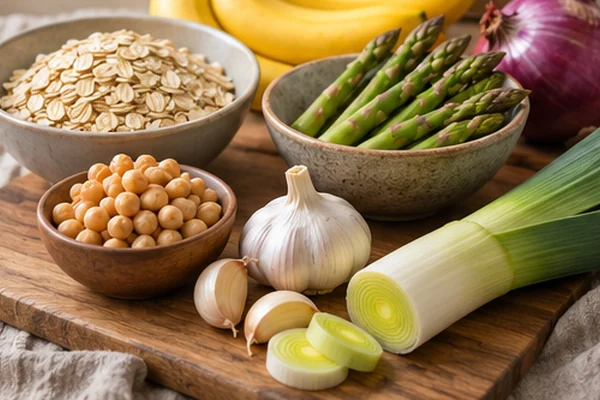
Building a varied, fiber-rich diet is a reasonable starting point before buying a supplement. Some vegetables are often described as natural sources of inulin-type fibers, though amounts vary. Our prebiotic foods page covers this, and the psyllium guide covers a widely used fiber supplement that is not usually marketed as a prebiotic.
If you do try a supplement, inulin and FOS powders are the most studied types. Our guide on how to choose a prebiotic supplement explains what to look for on the label, and we look separately at prebiotic soda.
Dose and side effects
There is no established recommended dose for prebiotics. Studies have used a range of amounts: the Nagy review covered 3 to 20 g per day of chicory inulin-type fructans, and Wang and colleagues suggested 10 g per day for six weeks or longer for glycemic outcomes. Those are study amounts, not recommendations. See prebiotics dosage for more.
The most common complaints are digestive. MedlinePlus advises adding fiber to your diet slowly, because increasing it too quickly can lead to gas, bloating and cramps. Our side effects page goes further. If you are wondering whether women have different needs, our page on prebiotics for women explains what the evidence does and does not say.
Safety and regulation
Prebiotic supplements are generally sold as dietary supplements in the US. According to the FDA, manufacturers and distributors are responsible for evaluating the safety and labeling of their products before marketing, and the FDA has authority to act against adulterated or misbranded products after they reach the market.
Talk with a doctor, pharmacist or dietitian before starting if you have a digestive condition, are pregnant, take medication or have a chronic illness. If you take medicine for diabetes or cholesterol, do not change it on the basis of a fiber supplement. People weighing other supplements for blood sugar, such as berberine, should discuss the full picture with their clinician.
FAQ
What does prebiotic mean?
NCCIH defines prebiotics as nondigestible food components that selectively stimulate the growth or activity of desirable microorganisms. They feed gut microbes rather than adding new ones.
Are prebiotics the same as fiber?
Many prebiotics, such as inulin and FOS, are types of fiber, but not all fiber is usually classed as a prebiotic.
Do I need a prebiotic supplement?
Not necessarily. A varied diet with whole grains, beans, nuts, seeds, fruit and vegetables provides fiber. Supplements are optional, and the measured benefits in studies are modest.
Can prebiotics help IBS?
Reviews have not shown a clear benefit. Ford 2018 found the data sparse, and Wu 2024 found no significant improvement. Inulin and FOS may worsen symptoms in some people with IBS.
Can I take prebiotics and probiotics together?
Products combining both are called synbiotics. Whether a combination helps depends on the specific product and goal, so check with a clinician if you have a health condition.
Sources
- National Center for Complementary and Integrative Health. Probiotics: what you need to know.
- NIH Office of Dietary Supplements. Probiotics: fact sheet for health professionals.
- MedlinePlus. Dietary fiber.
- Nagy, et al. Effect of chicory-derived inulin-type fructans on abundance of Bifidobacterium and on bowel function: a systematic review with meta-analyses. Crit Rev Food Sci Nutr. 2023.
- Dou, et al. Effect of fructooligosaccharides supplementation on the gut microbiota in human: a systematic review and meta-analysis. Nutrients. 2022.
- Reimer, et al. The effects of chicory inulin-type fructans supplementation on weight management outcomes: systematic review, meta-analysis, and meta-regression of randomized controlled trials. Am J Clin Nutr. 2024.
- Talukdar, et al. The effects of inulin-type fructans on cardiovascular disease risk factors: systematic review and meta-analysis of randomized controlled trials. Am J Clin Nutr. 2024.
- Wang, et al. Inulin-type fructans supplementation improves glycemic control for the prediabetes and type 2 diabetes populations: results from a GRADE-assessed systematic review and dose-response meta-analysis of 33 randomized controlled trials. J Transl Med. 2019.
- Ford, et al. Systematic review with meta-analysis: the efficacy of prebiotics, probiotics, synbiotics and antibiotics in irritable bowel syndrome. Aliment Pharmacol Ther. 2018.
- Wu, et al. The efficacy of probiotics, prebiotics, synbiotics, and fecal microbiota transplantation in irritable bowel syndrome: a systematic review and network meta-analysis. Nutrients. 2024.
- MedlinePlus. Soluble vs. insoluble fiber.
- US Food and Drug Administration. Dietary supplements.
Last reviewed November 2026. VitaBrief is educational and is not medical advice. Talk with a doctor, registered dietitian or pharmacist before starting a supplement, especially if you are pregnant, take medication or have kidney disease.
Not medical advice. This guide is for general education. Talk to your doctor or pharmacist before taking a supplement, especially if you are pregnant or breastfeeding, take medication or have a health condition. Medical disclaimer