Comparisons
Moringa vs matcha: how do these green powders compare?
Both are bright green powders, but they come from different plants and have very different evidence. Here is a fair comparison, plus spirulina and green tea.
VitaBrief editorial · Last reviewed November 2026 · Sources listed below
Reader-supported. This page may contain affiliate links. If you buy through one, we may earn a commission at no extra cost to you. It never changes what we write. Affiliate disclosure
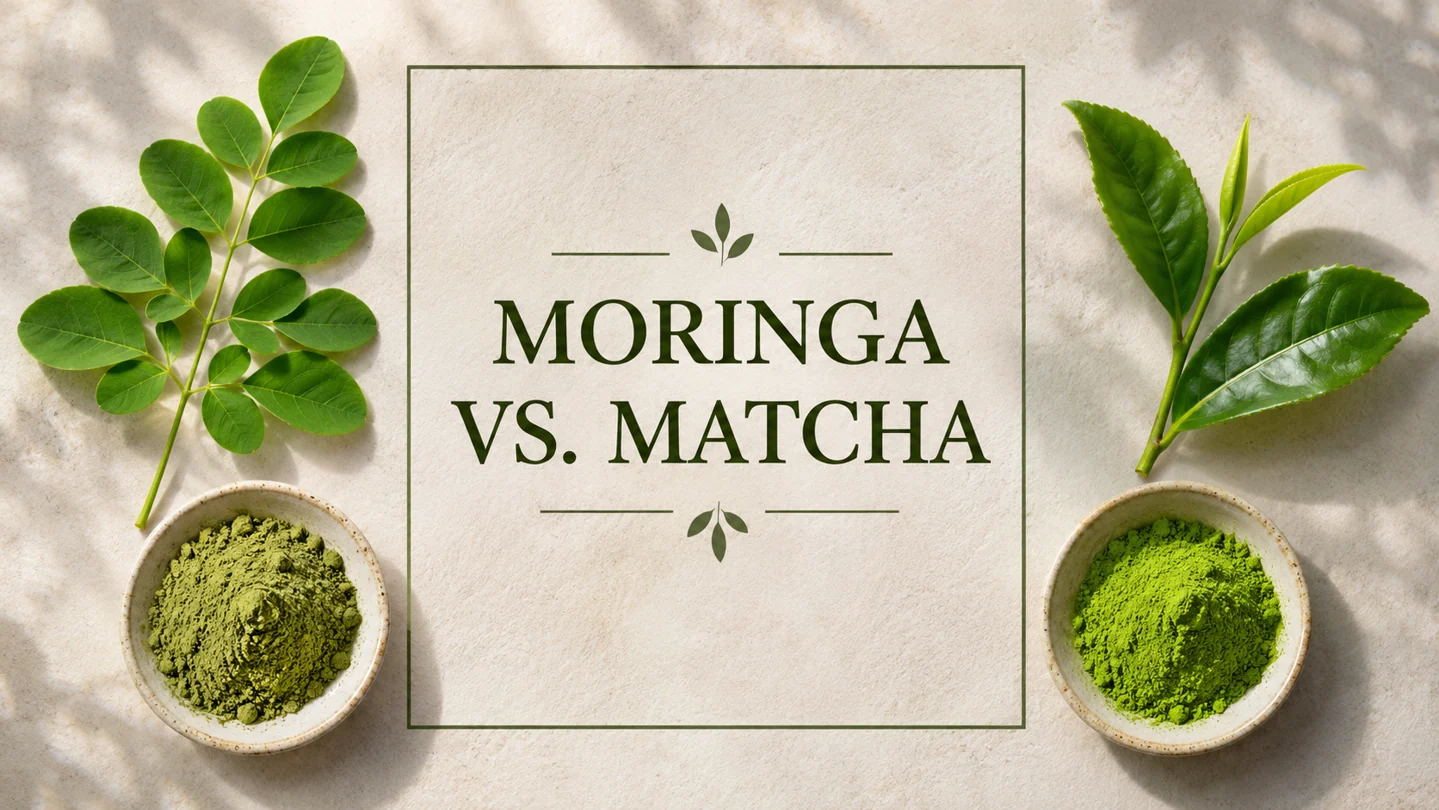
Moringa and matcha look almost identical in a jar: fine, bright green powders that get whisked into drinks, stirred into smoothies and baked into snacks. Both are marketed as healthy, and both appear on lists of “superfoods.” But they come from different plants, are used for different reasons, and have different bodies of research behind them.
This comparison covers what each powder is, the caffeine question, taste and use, and what the evidence does and does not show. It also touches on two other common comparisons: moringa vs spirulina and moringa vs green tea. No study in our verified sources compared these products head to head, so the comparison is necessarily cautious. It is general information, not medical advice. For background on moringa itself, see our moringa guide.
At a glance
| Feature | Moringa powder | Matcha |
|---|---|---|
| Plant | Leaves of the moringa tree (Moringa oleifera) | Leaves of the tea plant, ground into powder |
| Caffeine | Generally sold as caffeine-free; check the label of blends | Contains caffeine, as tea does |
| Typical use | Food powder, capsules, herbal tea | Whisked tea, lattes, baking |
| Taste (general description) | Earthy, grassy, sometimes bitter | Grassy, umami, can be bitter |
| Best human evidence in our sources | Meta-analysis of 9 trials: no consistent cardiometabolic benefit; very low certainty | Not covered by our verified sources |
| Head-to-head trials | None found in the sources reviewed | |
What moringa and matcha are
Moringa powder is made from the dried leaves of Moringa oleifera, a fast-growing tree whose leaves are eaten as a vegetable in many parts of the world. In the Philippines it is called malunggay. Moringa is sold as loose powder, capsules and tea bags. There is no NIH or MedlinePlus monograph on moringa, and human evidence is limited and mostly comes from small, short trials.
Matcha is a type of green tea. It is made from tea leaves that are ground into a fine powder, so when you drink matcha you consume the whole leaf rather than an infusion. That is the main difference between matcha and regular green tea, which is brewed from leaves and then strained.
So, while the powders look similar, moringa is an herb from an unrelated tree, and matcha is tea. That distinction matters most for caffeine.
Caffeine: the biggest practical difference
As a general point (our verified sources did not measure caffeine), matcha comes from the tea plant, so it contains caffeine, and the amount varies with how much powder you use.
Moringa is generally sold as caffeine-free, because it does not come from the tea plant. Two cautions apply. First, some moringa products are blends that include green tea, matcha or other ingredients, so check the label. Second, “caffeine-free” does not mean moringa has no effects on the body. Its effects are simply less well studied.
If you are sensitive to caffeine, pregnant, or have been told to limit caffeine, this difference may decide the choice for you. Note, though, that moringa’s safety in pregnancy has not been established. See moringa in pregnancy, and read moringa tea for more on drinking it at night.
Nutrition claims: be wary of the numbers
Online comparisons often claim that moringa has many times more iron, calcium or vitamin content than other foods, or that one powder is far more “nutrient-dense” than the other. Our verified sources do not include a nutrient comparison of moringa and matcha, so we do not repeat those numbers.
A few general points still help. Both powders are typically used in small amounts, often a teaspoon or so, which limits how much of any nutrient they can contribute compared with a full serving of vegetables. Nutrient content can also vary with how the plant was grown, harvested, dried and stored. And a nutrient listed on a label is not the same as proof of a health benefit.
If you are trying to fill a specific gap, such as low iron, a test and a targeted plan from your clinician are more reliable than a superfood powder. Our iron guide and multivitamins guide cover the better-studied options.
What the research shows for moringa
For moringa, the strongest summary in our sources is a 2025 meta-analysis of nine randomized controlled trials with 649 participants (Crișan 2025). It found no significant effect on most cardiometabolic outcomes, including measures of weight, blood lipids and blood sugar. A modest reduction in diastolic blood pressure was seen but was not robust in sensitivity analyses. The certainty of evidence was very low for all outcomes, and the authors concluded that current evidence does not support consistent cardiometabolic benefits. Subgroup hints at doses under 10 g a day, in people under 50 and in trials of 12 weeks or more were treated as questions for future trials.
Individual trials are small. In adults with prediabetes, 2,400 mg per day of moringa leaf powder for 12 weeks led to favorable changes in fasting glucose and HbA1c compared with placebo (Gómez-Martínez 2021). In adults with type 2 diabetes, 20 to 60 g of leaves daily for 14 days showed no significant differences after adjustment (Afiaenyi 2025). In healthy adults, diastolic pressure two hours after a single meal of 120 g cooked leaves was significantly lower than before it (Chan Sun 2020).
Our verified sources do not cover matcha or green tea research, so we make no claims about their effects here. The fair takeaway is that neither powder should be chosen as a treatment for any condition. For more detail on moringa, see moringa benefits, moringa for blood sugar and moringa for blood pressure.
Moringa vs spirulina and green tea
Spirulina is a type of blue-green algae sold as a deep green or blue-green powder and in tablets. It is often compared with moringa because both are marketed as nutrient-rich greens. They are very different organisms, and our sources contain no studies of spirulina or direct comparisons, so we cannot say one is better. As with any supplement, quality and purity depend on the manufacturer.
Green tea is brewed from tea leaves, so like matcha it contains caffeine (a general point, not measured in our sources). Moringa tea is an herbal infusion, generally without caffeine. If you want a warm drink and mainly care about caffeine, that difference is the clearest one.
Whatever you choose, the regulatory picture is the same for supplement products. According to the FDA, manufacturers and distributors are responsible for evaluating the safety and labeling of their products before marketing, and the FDA can act against adulterated or misbranded products after they reach the market. Our guide on how to choose a moringa supplement covers labels and third-party testing.
How to choose between them
Since no study compares them directly, the choice comes down to practical factors:
- Want caffeine? Matcha or green tea. Want to avoid it? Plain moringa, after checking for blends.
- Taste. Taste is personal; buying a small package first can help you decide.
- Cost and use. Consider how often you will use it and how much you need per serving.
- Health conditions and medications. If you take medication for blood sugar or blood pressure, ask your clinician before adding moringa, since small studies reported changes in these measures.
MedlinePlus advises telling your health care provider about any dietary supplements you use and not taking a bigger dose than the label recommends. For moringa amounts used in research, see moringa dosage, and for possible downsides, see moringa side effects. To use either powder in food, our moringa powder article has practical tips.
FAQ
Is moringa better than matcha?
No study in our sources compared them, so neither can be called better. The clearest difference is caffeine: matcha has it, plain moringa generally does not.
Does moringa have caffeine?
Moringa is generally sold as caffeine-free because it is not a tea plant. Some blends add green tea or matcha, so check the ingredient list.
Which has more antioxidants, moringa or matcha?
Our verified sources do not compare them, so we cannot say. Antioxidant content on its own also does not prove a health benefit.
Can I mix moringa and matcha?
Some products do. The combination has not been studied in our sources. If you take medication or have a health condition, check with your clinician first.
Is moringa or spirulina better for nutrition?
There is no head-to-head evidence in our sources. A varied diet and clinician-guided supplements for specific gaps are better studied than either powder.
Sources
- Crișan, et al. Effects of Moringa oleifera Lam. supplementation on cardiometabolic outcomes: a meta-analysis of randomized controlled trials with GRADE assessment. Nutrients. 2025.
- Gómez-Martínez, et al. Moringa oleifera leaf supplementation as a glycemic control strategy in subjects with prediabetes. Nutrients. 2021.
- Afiaenyi, et al. Effects of Moringa oleifera leaves on the blood glucose, blood pressure, and lipid profile of type 2 diabetic subjects: a parallel group randomized clinical trial of efficacy. Nutr Health. 2025.
- Chan Sun, et al. Consumption of Moringa oleifera Lam leaves lowers postprandial blood pressure. J Am Coll Nutr. 2020.
- US Food and Drug Administration. Dietary supplements.
- MedlinePlus. Dietary supplements.
Last reviewed November 2026. VitaBrief is educational and is not medical advice. Talk with a doctor, registered dietitian or pharmacist before starting a supplement, especially if you are pregnant, take medication or have kidney disease.
Not medical advice. This guide is for general education. Talk to your doctor or pharmacist before taking a supplement, especially if you are pregnant or breastfeeding, take medication or have a health condition. Medical disclaimer